




The Eurovision Song Contest Asia is going to feel familiar to fans of the Eurovision franchise. Songs are three minutes long, one from each competing nation, in a diversity of language and song styles all competing to the be the winner.
And how that winner will be decided also feels familiar. Jurors representing each of the participating nations will award their points, along with a public vote across each of the participating broadcasters and the Rest of the World. Furthermore, the scoring system is that Borda count we are all familiar with – 12 points to your favourite, followed by 10, 8, 7, all the way down to 1 point for 10th place in your ranking.
There is no Rest of the World jury, meaning the 11 song show will have an 11:12 ratio between jury points and publicly awarded points. The fabled 50:50 split is actually 48:52, giving slight weighting towards the public vote.
Viewers should note that, with only 11 participating countries, that is going to mean that using the traditional Eurovision scoring system means there is a guaranteed score for each participating nation of 20 points, at least one point from each country’s jury and televote. 20 points in Eurovision Asia is, statistically, a worse score than a zero at the Eurovision Song Contest, as that score would mean placing dead last in each of the 23 different voting constituencies.
On the flip side the maximum number of points is 276 points – 12 multiplied by 23. Any total score over 200, corresponding to an 8.7 points per jury/public split, would likely be enough for victory.
What we want to investigate before the show takes place is the public vote mechanism. How people can vote in the first ever Eurovision Asia is very different to any voting mechanism seen before.

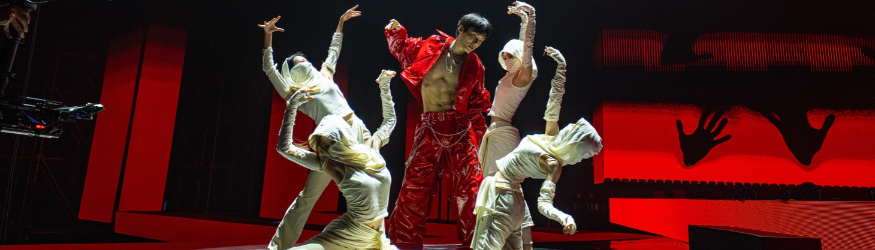
Monetrey rehearsing ‘I Let You Go’, Cambodia’s first-ever Eurovision Asia entry (Photo: Ralph Larmann / Voxovation)
Choice, But Not Too Much
Voting for Eurovision Asia will not be conducted by a public vote. Nor will it be conducted through the prepayment card system that the Rest of the World vote has carried in recent years.
Those wishing to vote will all head to https://eurovisionasia.com/vote during the live show.
- According to the terms and conditions, voters must be 18 years of age and need to be able to verify themselves through their Google, Apple or Privy social media accounts.
- Voters will have to give consent for voting, and complete an automated check.
- Voters are then required to cast eight votes.
- These eight votes need to be spread out across at least three different songs.
- These eight votes are free.
- Voters can thereafter, should they wish, purchase ten extra votes to cast freely.
- According to the official Eurovision Asia website, there is no way of purchasing more votes after those ten.
Now, obviously the demographics taking part in Eurovision Asia may well be engaging with the Eurovision brand for the first time. This means predicting voting behaviour based on previous studies and results in Europe should be done with many grains of salt. However, we present our thoughts on this voting system below and what impacts that would have on such a competition.
The majority of votes will be free votes
We have witnessed through national finals in Northern Europe that the number of votes at the competition has rapidly increased when voting systems are free to use. In Finland this year, voting for free through broadcaster Yle’s network outweighed SMS and phone voting by a ratio of roughly 4:1. In Sweden, Melodifestivalen switch to free voting via the App – it massively exceeded expectations, with the broadcaster suggesting in 2021 that their voting system generated a world record for official second screen interaction during the Melodifestivalen heats.
The amount of money raised at Melodifestivalen through the charity donation hotline dropped rapidly with the introduction of the free app; a solid proxy for the amount of voters and, for this purpose, good evidence of previous paying voters being satisfied with the free options available.
It is also sensible to note that the countries of Eurovision Asia are not nations comparable to many in Europe in terms of disposable income. Now we are not aware currently of the cost of these extra votes in participating broadcasters, but based on our previous work looking at Estonia’s high televote cost, we believe that high prices for televoting do put off some groups from engaging in excessive voting.
Without other data to go off, we will conclude that our expectation is that the majority of votes will be via this free method. What a free, online method may also result in is an increasingly skewed voting profile. Eurovision’s press releases have spoken proudly of how the Eurovision family of events can engage younger audiences. With a requirement to log in to online accounts a prerequisite (though limited to eighteen years old), that might be a structural barrier that tech-familiar younger viewers will find easier to navigate.
Dividing By Three
Those familiar with the Eurovision family of events will be aware that it has been the norm in recent editions of the Junior Eurovision Song Contest that voters have been required to vote for three different entries.
Because the public vote at Junior Eurovision is presented as one big block, it is quite clear to see how this system spreads out the votes across more of the entries. At this year’s Contest in Malta, the lowest score of the public vote received was 43 points, with the median value being 51.
One often discussed theory within circles at that show is that voters may vote for their one, perhaps two, favourite entries, but then put far less thought into their other votes. On some online forums, there have been discussions about which countries to vote for to give your extra votes the least impact – increasing the chance of success for your favourite.
While recent public vote winners at Junior Eurovision have been relatively unsurprising to those following the broadcast, there have been headline-worthy success stories in the pack. San Marino is a clear modern example, placing 3rd and 2nd respectively in the online vote at Junior Eurovision. Both Sammarinese entries were well performed on the night, but these placings exceeded expectations for many against pre-Contest proxies such as streaming data etc.
Let me suggest, quietly, that San Marino’s status as a microstate did help boost their televote score by being underestimated by a small number of voters.
Now this might be amplified by the fact that Junior Eurovision allows voting before the live performance is broadcast, which might exaggerate the power of underestimation. However, there is evidence – albeit twenty year old evidence – that this has happened in multi-vote entertainment shows between Asian nations.
In 2007, six winners of the Idol series from India, Indonesia, Malaysia, The Philippines, Singapore, and Vietnam competed for the title of Asian Idol. Journalist Susi Ivvaty explained at the time that the victory of Singapore was a surprise, and suggests that the voting system allowed Singapore to overperform on a competitive scoreboard. That was because the voting system forced voters to vote for at least two entries, and, to cap the difference between the large and small nations, it limited the percentage score of the winning act from a country’s televote to 50%. That guaranteed a wider voting spread, limiting the effect of supporting your own country, and benefitting a country that was not considered a hot favourite pre-show.
We can anticipate that Eurovision Asia will also have some tactical voting just like this, as part of the voting requirement to vote for three entries.
Dividing Eight Into Three
The most interesting part of the Eurovision Song Contest Asia voting system is the decision to award eight votes to each user for no cost. This lifts the voting system away from the methodology of Junior Eurovision and adds an extra, previously unseen, level of difficulty to the user interface.
Each user voting at Eurovision Asia has the freedom to divide their votes up in different ways. One can choose to award two votes to their favourite four entries, whereas the most extreme method is instead to award six votes to your favourite entry, and one vote to the other two entries.
It is difficult to anticipate what user behaviour will look like in this choice architecture. Fans may choose to create a ranking system, perhaps awarding votes in a 4-2-2 or 5-2-1, 3-2-2-1 or 3-3-1-1 pattern to distribute them in their own Borda count style. There may also be those pushing their votes to the extreme 6-1-1 method to maximise their support for their favourite.
Elections in America’s St. Louis utilise a system where voters can choose to vote for any number of candidates. In the 2025 election for Mayor, around two-thirds of all voters only voted for one candidate, with only 6.4% approving three or more candidates. Is this a similar model breakdown that we would see for the Eurovision Asia, where roughly two-thirds of voters will maximise their vote to prioritise their favourite entry?
I would argue that would be an unrealistic behavioural expectation, and I would argue it is more likely for viewers to enjoy, or want to support, more than one competing act rather than a political candidate. However in giving this choice to the viewer, you also delegate the responsibility of dividing the votes to them.
Loss Aversion and Throwaway Votes
This perhaps expects too much from the prospective voter. Mathematician Steven Brams describes how such ranking and power voting systems can be “envy-ensuring”. Loss averse voters tactically avoid giving votes to what may be their second or third favourite entry, perceiving it to be a rival.
It also means some users, wanting to mainly support one favourite, may “throw away” their extra votes with significantly less care and consideration, basing it on pressing adjacent countries for example.
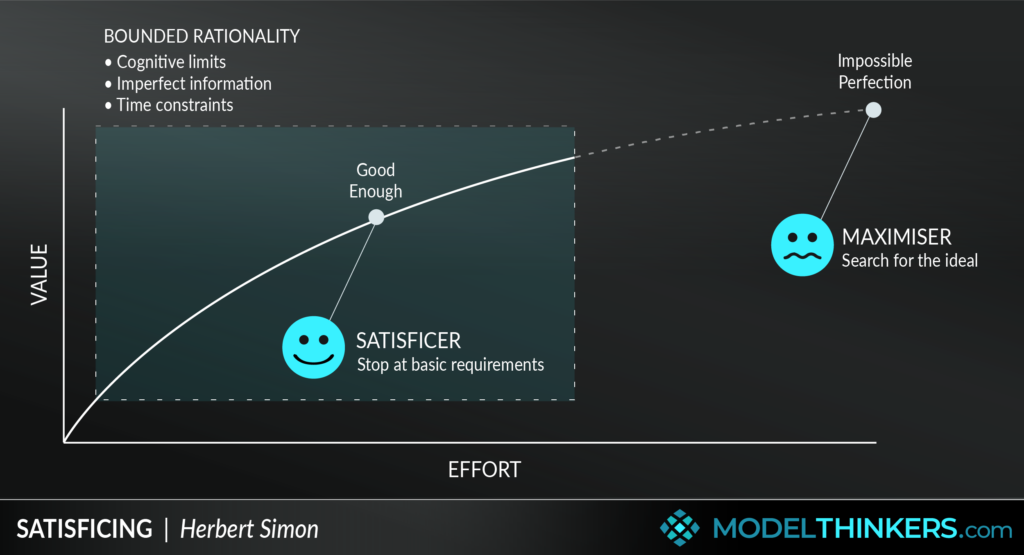
How Satisficing works in practice (ModelThinkers.com)
We note in political elections of multiple candidates we have seen that the opposite is true, with a small percentage increase noted for political candidates at the top of ballot papers compared to the bottom. Herbert Simon described the process of Satisficing in 1956. In this purpose, that understanding is that people will make a decision based on a quick assessment to get a satisfactory solution, rather than an optimal one. Choosing that final vote at Eurovision Asia as the final recap draws to a close might just be one of those.
Perhaps this implementation change will balance out the impact of running order bias, or songs placed around the big favourites on the night, as voters look for a quick solution.
Why Try a New Voting System?
There are clear benefits to establishing a multi-candidate voting system for Eurovision Song Contest events. By forcing more votes to spread, the system increases the amount of consensus in the public voting, which in theory should mitigate impacts of bloc or political voting. By engaging in this unbalanced and free division of vote casting, one is encouraging voters to take an active and considered decision about where and how to cast their vote.
Our understanding is that this system might be a step too far for some, be it through the barrier of a separate social media log-in or in working out their vote division, that does provide some additional barriers to participation. This could reduce the quality of votes, with voters confused or challenged by deciding where to divide their eight votes.
In terms of the scoreboard, our expectation is that this will generally lead to increased agreement between public vote scores between countries at the top of the leaderboard, making it more possible for songs to perform well across the voting countries rather than isolated bloc voting and campaign-influenced votes. Our other expectation is that the votes at the bottom half of each country’s vote level will be increasingly close and variable, making he bottom of the rankings look particularly scattered.
This is our expectation for how Eurovision Asia will play out with this voting system. But we are aware of reports from Swedish newspaper Aftonbladet that this voting mechanism is a trial for what could be coming to the Eurovision Song Contest itself.
There will be time to review that in due course. But implementing an exact copy of this system at the Eurovision Song Contest might lead to different results. In a 26 song Grand Final, we would anticipate such a spread of free votes would give increasing uniformity of taste across Europe, making songs that unite tastes tronger on the scoreboard than those which divide opinion.
Furthermore, it could also increase the risk of numerous countries falling lower down the scoreboard to be squeezed further, making it harder for perceived weaker tracks to rely on bloc voting for points.
Eurovision Asia is more than a Song Contest. It is a vehicle to spread the Eurovision brand further and to help with its own sustainability. Eurovision Asia is also a place of experimentation. Implementations, like choosing three songs to give eight votes out to, might not be chosen for this purpose because they are the best or optimal strategy. They might in themselves be an experiment – a test to see how users cope with new barriers and more open choice architecture – to see where any limit for the future might be.
Voting reform is on the Eurovision agenda. Will the future be free votes and inventive UI solutions?
If this experiment goes well, it could be coming to a Song Contest near you very soon.