





Armenia wins their third Junior Eurovision
The main headline is of course that the 2026 Junior Eurovision Song Contest was won by Armenia. Naré, performing the song ‘BOO!’ received 202 points to take victory. This is the lowest number of points for a victory since Valentina won for France in 2020, although we must not that edition had only 16 participating nations, rather than the 12 that took part in 2020.
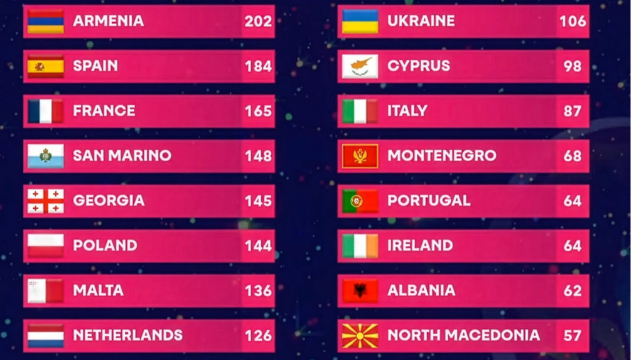
The final scoreboard at Junior Eurovision 2026
The First Ever ‘Timely’ Winner
This 2026 Junior Eurovision Song Contest was the first ever to take place in the now-past European Central Summer Time, CEST, with previous editions being a November or December broadcast. Now what is hyper cool about an October 24th show is that there’s a holiday that is now part of the mainstream culture from Yerevan to Yarmouth – Halloween.
‘BOO!’ is suitably spooky and in theme with the culture on this very date, in a way I don’t think any other Eurovision song or any type has ever tapped into. Sure, we have songs, including eventual winner ‘Insieme: 1992’ in the Eurovision history book, but that song wasn’t timely to a particular time of the year where the Contest was in. One can’t speculate if an October contest helped or hindered Armenia’s chances, but it will remain a fascinating example for etertnity about tapping into the current season for success.
Armenia, the Junior Eurovision Powerhouse
While both France and Georgia still remain top of the Junior Eurovision Song Contest medal table, each with four Junior Eurovision wins to their name. Armenia now pulls into a clear 3rd place behind them with their 3rd Junior victory. However there are other statistics to Armenia’s name that now could argue they are at least an equal powerhouse at Junior Eurovision to the two frontrunners.
Armenia’s Junior Eurovision history now includes:
- Three wins
- Five 2nd places
- Three 3rd places
- And a record of NEVER being outside the top nine in 19 appearances.
A Rare Televote Winner
We will look into the jury/public vote split at Junior Eurovision later in this article. For now note simply that it has been increasingly unusual for a song that did not win the jury vote to win Eurovision in recent times, Junior or otherwise. ‘BOO!’ won after placing 3rd with the juries and 1st with the televote. In both the senior contest and Junior Eurovision you have to go back to ‘Stefania‘ by Kalush Orchestra to find a winner that was not also a winner of the jury vote before this.
And in exclusively Junior Eurovision terms, the last time a televote winner won was when ‘Qami Qami‘ won in 2021…for Armenia…after placing 3rd in the jury vote…behind France that placed 1st.
The history book on the shelf….
Spain Came Up Short
Not only was the 202 points that ‘BOO!’ received the lowest for a winner since 2020, remarkable was also the margin of victory, with just 18 points separating Armenia from second place Spain.
Spain managed to score 2nd place thanks to finishing top 3 with both juries and viewers: second with the jury and third with the public. Spain was also the only nation to score jury points from all competing nations.
Spain’s only got one Junior Eurovision victory to their name, back in a different era of the Contest in 2004. However their overall record is remarkable. This result now gives them their fourth second place of all time and leaves Spain on the staggering statistic that of 12 attempts at Junior Eurovision the country has only finished outside the top 6 on one occasion.
France’s Staggering Run Of Success
French artist Alec finished in third place at Junior Eurovision 2026, after winning the jury vote. During the jury voting reveal Alec’s song ‘Comment tu vas?‘ received douze points from five different nations, Netherlands, North Macedonia, Poland, Portugal and Spain, whereas no other song received more than two maximum scores.
This is the, wait for it, 6th year out of the last seven that France has won the Junior Eurovision jury voting. Of course, France has won Junior Eurovision in four of those years, and their overall record now boasts seven podium positions in ten total appearances.
Another Junior Eurovision Year, Same Result
The statistics showcase that Armenia, Spain and France have had excellent records at recent Junior Eurovision Song Contests, and that record has only been further cemented by this year’s results.
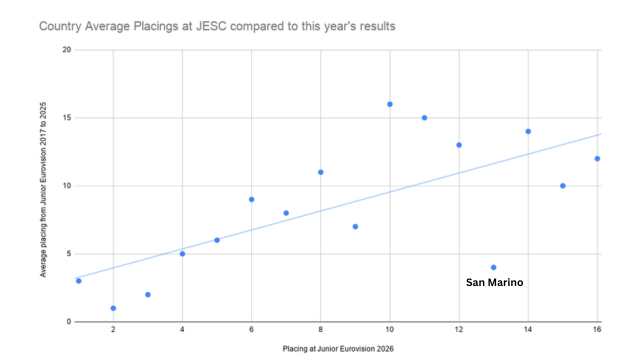
The graph shows how almost all of this year’s results are similar to their country’s average Junior Eurovison placing since 2017 (Image: Ben Robertson, ESC Insight)
This can be best viewed graphically. France, Spain and Armenia occupy the bottom left hand corner – the top three being the nations who have scored best at Junior Eurovision since the online vote was brought in for the 2017 edition. Conversely the bottom three in this year’s competition, Ireland, Albania and North Macedonia, fill a space in the top right hand side of the graph alongside other nations in a cluster of scoreboard strugglers.
Conducting Spearman’s Rank Correlation on this data gives us a number of +0.70. Statistically that would be recognised as a very strong correlation between the results of previous years to this year, and further evidence of the huge gulf that exists on the Junior Eurovision scoreboard.
But what about that anomaly in the bottom right?
San Marino’s Time To Shine
Last year we wrote about how San Marino had recorded their best ever Eurovision result in any format last November when they came 9th at Junior Eurovision.
This year the Principality came into the dizzy heights of a 4th place finish. San Marino’s route to a record victory was a public vote score that was the second highest of all the 16 competitors. If I compare the Sammarinese act to those other show topping entries there is a stark contrast, as performer Violamarie performed alone on stage without huge pyrotechnics or gigantic props. Proof that you can compete as a smaller broadcaster in this show.
It was also a successful competition for Montenegro, which also secured their highest-ever all-format Eurovision result with a 12th place, beating their previous Eurovision and Junior Eurovision record of 13th.
The Flattest Public Vote In History
Throughout this voting system at Junior Eurovision it has been notable how the public vote has a particularly narrow spread of votes. However this year has been the most extreme example in how narrow that spread was.
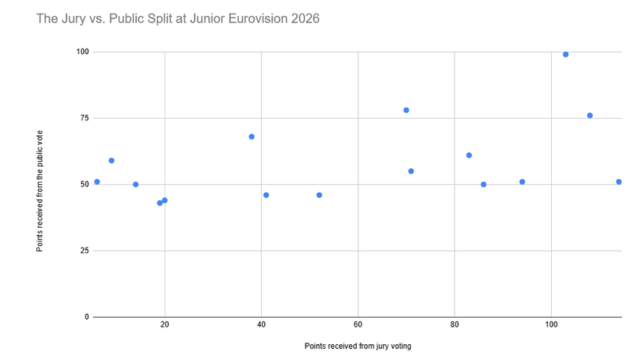
Comparison of jury votes and Public votes at Junior Eurovision 2026 (Image: Ben Robertson, ESC Insight)
The above graph compares the jury scores to the public vote. Note here how there is a huge cluster of public vote scores that seem centred around the 50 point mark. Indeed just 18 points split last placed Albania from 5th place Poland in the Public vote scores. The comparative difference from 5th to last on the jury side of the equation was 80 points.
Indeed our calculations suggest this is the most narrow a Junior Eurovision has ever been in terms of the impact of the televote score.
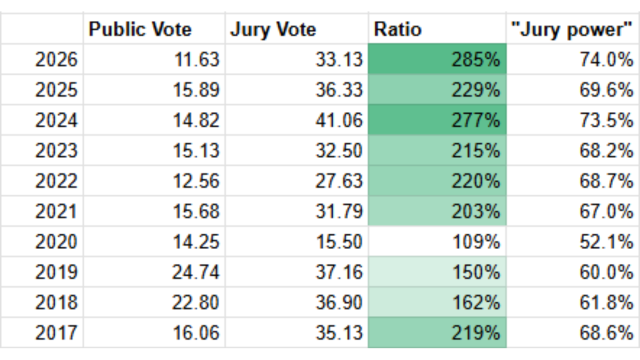
Data showing the ratio of average absolute difference from the mean of jury and public vote from 2017 to 2026
The table above shows the average difference that a country received from jury vote and the public. For example, looking at 2026, the score of 11.63 refers to an average difference of 11.63 points from the public compared to the mean (58 points). For juries this value 33.13, almost three times more spread than the public votes. This difference between the two different voting methods of Junior Eurovision is the widest we have witnessed at this competition. The result of this is that effectively the “power” of the jury score is roughly 74 % – meaning your points total is almost three quarters dependent on your jury vote success rather than your public vote score.
How Would It Look With An Even Spread?
What we can do is mathematically multiply the public score to give it an even ratio to the jury score. For 2026 that would mean multiplying the public vote score difference from the mean by 2.85, to give an equal spread to the jury scores. This results in a public vote spread from 175 to 15 points, rather than the 99 to 43 that was witnessed on Saturday night.
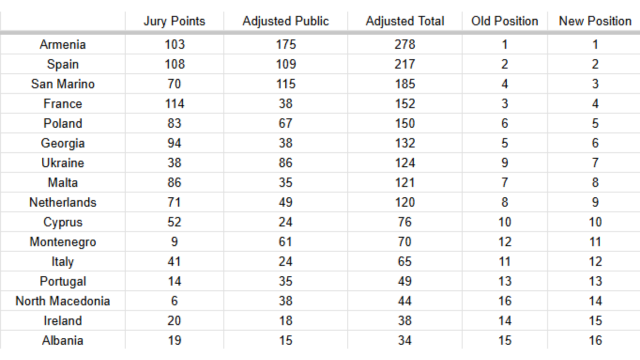
Table showing adjusted results for Junior Eurovision with a pubilc vote score given the same spread as the jury score.
Unsurprisingly, this result gives Armenia a more convincing Junior Eurovision victory. What though is perhaps notable is how little actually changes in this example despite the widening of that narrow public vote score we witnessed. At most, it would alter the placings by just two positions, allowing Ukraine to move from 9th to 7th and for Albania and North Macedonia to trade 14th and 16th place.
Voters From Across The Globe
Junior Eurovision once again can be demonstrated by the European Broadcasting Union as a success in the show’s reach and engagement. The post-results press release informs us that the show received public votes from 194 different nations, the highest value since 2021 and an increase of six nations from last year.
While exact voting numbers were not revealed, we note that “millions of valid votes” were received. We know in 2025 there were 2.5 million votes cast, slightly more than 2024’s 2.3 million votes.
Whether we end up in Yerevan or elsewhere next year, congratulations for a successful Junior Eurovision and for a show of musical entertainment.