





Why did we run this test?
During Basel 2025, we managed to cast 160 votes during the Eurovision Song Contest’s Grand Final whilst the maximum votes per payment method was 20. We brought the test results to the EBU’s attention.
Given the changes to the rules and our previous experience casting multiple votes in 2025, we wished to test whether it was still possible to cast multiple votes in 2026. We hoped to see evidence that the loophole for potential manipulation had been closed through security measures in the esc.vote portal.
Testing During The Second Semi Final In 2026
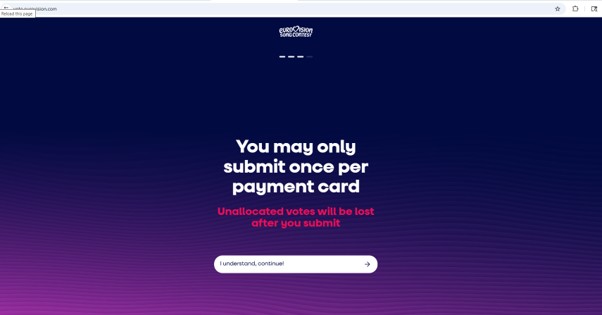
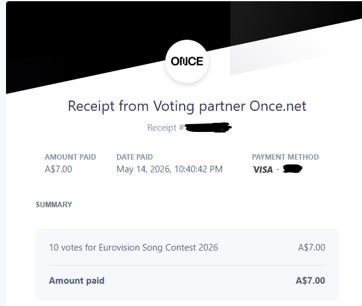
Utilising nine separate payment cards, including five personal debit and credit cards, two virtual one-use cards which can be freely generated through banking services such as Wise and Revolut, and two prepaid Visa debit cards purchased over the counter in a supermarket, I was able to cast 90 votes in total over the space sixteen minutes from the time of the votes opening for the Semi Final held on Thursday 14 May 2026.
All of the tests were conducted manually, with individual details typed into the sections provided for countries voted, card details, and email addresses.
Investigating the 2026 Televote regulations (image: Sharleen Wright)
The cards were all issued within Australia, which is where my voting territory on esc.vote website was set, and there was no flagging of false voting. Upon completing every ten votes, I received a confirmation message of vote acceptance, and the card was debited for 70 Australian cents per vote. The total cost for the 90 votes was therefore $63AUD.
Investigating the 2026 Televote regulations (image: Sharleen Wright)
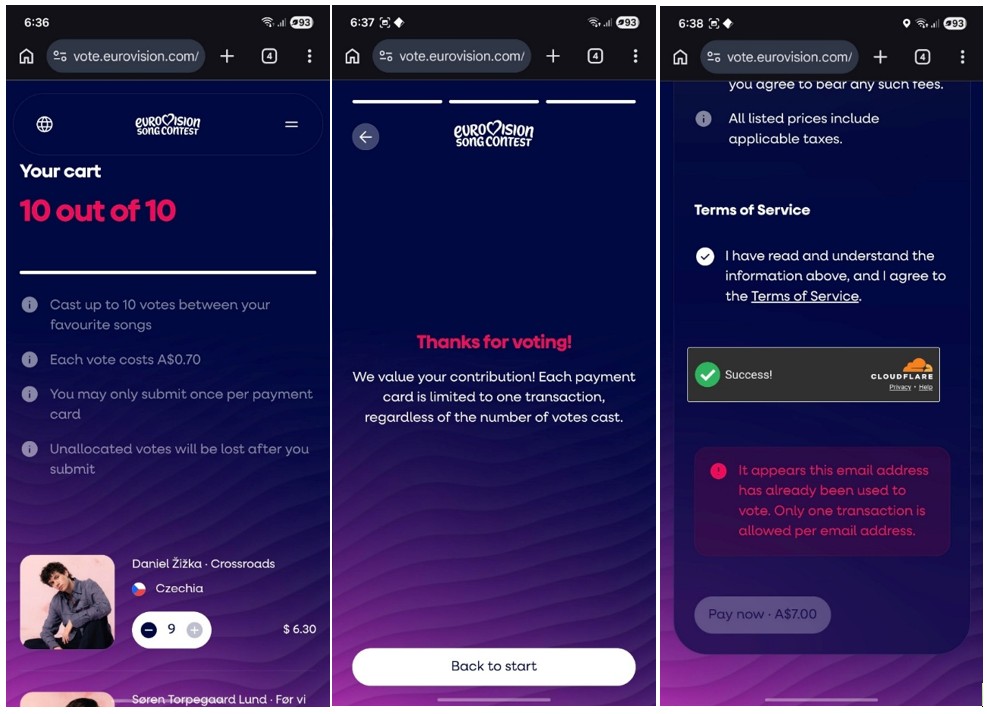
It would be reasonable for us to state here that had we known prior about the unique email address requirement, a new element introduced in the 2026 voting system, we would have been able to cast 100 votes over the period utilsing additional cards held.
It was during the second attempted vote, during the Grand Final, that we were rejected due to the repeated email address. The email addresses we subsequently provided were a mix of legitimate and fake, none of which were rejected at any point in the voting.
Investigating the 2026 Televote regulations (image: Sharleen Wright)
Testing During The Grand Final In 2026
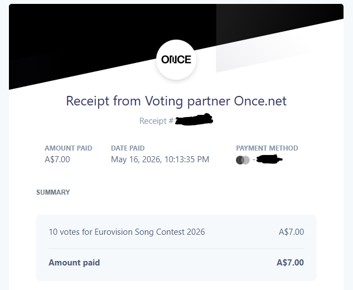
Following the success of the voting test during the second Semi Final, I then went on to replicate this same test with the same type and amount of cards during the Grand Final on Saturday, 16th May, 2026
Given that we were aware of how the esc.vote website operated, I was better prepared on this occasion with the details in order to type details such as email addresses, which were now pre-prepared to enter, however all elements were still physically entered into the text boxes. The one main change made for this test was that, unlike the Semi Final where votes were cast for two entries, all the votes were chosen to be limited to one.
On this occasion, we successfully cast 80 votes for this entry in ten minutes.
Investigating the 2026 Televote regulations (image: Sharleen Wright)
It should be noted that over this ten-minute block we potentially could have cast 100 votes, but two of the prepaid payment cards that had previously been successfully used in the Semi Final testing were declined by the system as invalid. These prepaid cards are designed to be used multiple times, unlike virtual cards, until their value is depleted. All virtual and personal card testing was successful, and payment and voting receipts were sent by email.
What’s the impact of this test on the voting?
80 or 90 votes within a country is very unlikely to make any difference to a voting table. However, the fact that one is able to successfully cast multiple votes utilising multiple cards on the same device, for the same entry in the space of just a few minutes, shows the system is open to misuse.
Our Findings
Now that the EBU has amended the voting from 20 votes per payment method to 10, the process slows down and you must have additional cards to undertake it, but our experience shows it is still entirely possible and easy to do.
Beyond the fact that the per payment method allowance is in play, which in turn legitimises one’s ability to actually cast multiple votes, the integrity has to be called into question, how and why it is allowed with no visible detection or security to prevent someone from voting multiple times on the same device, same number, same IP address, etc., for the same entry.
It may be presumptuous, but the 2025 results published by the New York Times for Spain do show that there is a large voting number discrepancy to be accounted for, and from other broadcasters’ claims made following both the 2024 and 2025 Contests this discrepancy was also seen in other territories.
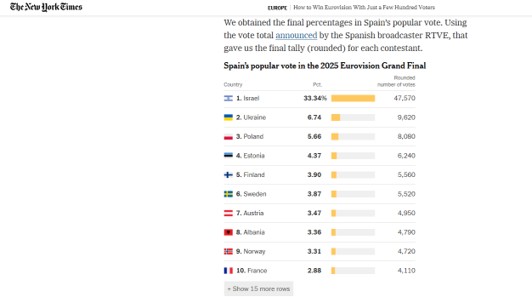
Investigating the 2026 Televote regulations (image: New York Times)
As shown above for 2025, if an entry received over 4100 votes they would have reached the top 10 in the country and thus scored points. Last year, ESC Insight also undertook research on how many votes it may take to reach a top 10 placing, and the results were consistent with this.
Given this year’s halving of the maximum votes per payment method, we could reasonably expect that it may take as few as 2000 votes in 2026 in an average participating country for an entry to gain points on the scoreboard, and likely fewer in smaller nations.
In other words, if using our same method, just 20 people, with access to 10 cards each and a rather low investment of under $1400 AUD might have been just enough to avoid a nul points on the televote for an entry.
With a time taken of 16 minutes to cast 90 votes during the 2026 second Semi Final, using that formula and calculating based on the 2025 Grand Final voting window of 172 minutes total and the ability of a maximum 20 instead of 10, one could have cast approximately 1935 votes per device last year. These figures were also passed onto Swedens’ Aftonbladet in the lead up to this year’s Grand Final, which were subsequently published.
Investigating the 2026 Televote regulations (image: Aftonbladet)
Or, based on our Grand Final test results, where we made 80 votes in 10 minutes during the 2026 Grand Final’s 160-minute open voting window, a total of 1280 votes per device could have been easily cast this year, should one be sufficiently prepared.
It might not be in the spirit of the Contest, but right now, it’s still all well within the published rules, which EBU hold very tightly to.
Conclusion
Based on our experience, we have found that the main constraints from the user-end are unique payment methods and unique email addresses. All of these were easily obtained, created, and utilised with success based on receipts, thus seemingly leaving the results open to manipulation by motivated bad actors.
We have approached EBU for comment, but as per last year’s testing result query and also delegation requests, we are yet to receive response.
Contest Director Martin Green has previously gone on record, including in his 2025 open letter to fans, stating that “every decision related to the outcome is documented and assessed,” with results overseen by senior professionals with decades of experience and reviewed according to strict auditing principles. This is the extent to which the voting issues have been publicly addressed so far.
However, whilst the EBU insists on a per-payment method rule that is a well-known and unaddressed loophole, and the organisation continues to remain tight-lipped on results, it fails to address the overall concerns we, other broadcasters, and many in the public have about legitimacy and fairness within the Eurovision Song Contest.