





-
Bulgaria won the Eurovision Song Contest
The winning song of Eurovision 2026 was ‘Bangaranga’ by DARA with a total of 516 points.
2. Bulgaria won the jury voting and televoting.
‘Bangaranga’ received 204 points from the juries and 312 points from the public.
-
A consensus winner
This is the first time since 2017, and Portugal’s ‘Amar Pelos Dois’ that we have had a song win both jury voting and televoting, a gap of 9 years.
-
Bulgaria’s Best Ever Result?
This is Bulgaria’s first victory at the Eurovision Song Contest. However you may remember Kristian Kostov’s huge score of 615 from the 2017 Song Contest, coming second that year. Now ‘Beautiful Mess’ was in a year with 42 countries, and thus averaged 7.32 points per voting group (i.e. one jury or one televote). ‘Bangaranga’ was close but not quite more than this, averaging 7.27 points per voting group, with the average of 6 points per jury the lowest since the jury/televote split has been available since 2014.
-
A Record Winning Margin
Second place on Saturday night was the song ‘Michelle’ from Israel, receiving 343 points in total. This meant the gap between 1st and 2nd place was 173 points. This is 4 points more than the 169 points that separated ‘Fairytale’ to ‘Is It True?’ in 2009.
-
Benke Rydman’s Third Win
The Swedish choreography and creative director Fredrik ‘Benke’ Rydman has now had a hand in three Eurovision winning performances, ‘Heroes’, ‘The Code’ and now ‘Bangaranga’
-
A zero-to-hero victory
DARA’s route to victory was not one many foresaw before arriving in Vienna. On the day of the Semi Final Bulgaria was available to back at odds of 150-1, before a slow route to being constantly backed in all the way to 3rd favourite with betting markets as the Grand Final kicked off.
I’m quite confident that we’ve not had anything at longer odds in Eurovision week go on and win the Contest since ‘Fly On The Wings Of Love’ from Denmark, which reportedly was available at 200-1 on the day of the show.
-
But a Hero From Day One
With the televote in that 2nd Semi Final, ‘Bangaranga’ absolutely crushed the field. 14 of the 18 voting nations in that heat gave ‘Bangaranga’ 10 or 12 points.
-
Best Result For Other Countries
Romania finished in 3rd place. This equals Romania’s best ever position on the scoreboard, finishing 3rd in 2010 and 2005 previously. Delta Goodrem managed to secure 4th place for Australia, bringing their best result since 2016, and Denmark’s 7th place is their best result since Emmelie de Forest’s 2013 victory. Furthermore their 7th place was the best position for a song drawn number one in the Grand Final since Ukraine’s ‘Tick Tock’ in 2014.
A big shout out though to Montenegro. 13th place in a Semi Final is not a place to celebrate wildly, but it is a result which is the best since 2016.
-
Worst Result For Others
Sweden’s FELICIA came in 20th place in the Eurovision Grand Final. This is Sweden’s worst position since not qualifying for the 2010 edition of the Song Contest. The United Kingdom came in last place this year, with 1 solitary point coming from Ukraine. This is the UK’s worst position since 2021, when ‘Embers’ scored zero points. This is also the worst result for Lithuania since 2019, when they didn’t qualify, as Lion Ceccah finished in 22nd place.
-
Sixteen different douze points
In total 18 of the 25 different countries received douze points from the Eurovision juries. Both Bulgaria and Poland received 4 sets of douze points, the most of the entrants on Saturday night. We have to go back all the way to 1998 to find a Song Contest where 4 was the highest number of douze points for any of the participating broadcasters
-
A Semi Final Shift
In the Semi Final of the Eurovision Song Contest we note that the rankings from the juries were very different from the Grand Final for our eventual winner. While DARA won the 2nd Semi Final (being the first Semi Final opener since Alexander Rybak in 2018 to do so), this was on the back of a 5th place finish in the jury rankings of that show.
-
The Semi Final calculation curse
Let me introduce to you ‘Alice’. Or more correctly let me introduce you to Switzerland’s Veronica Fusaro who took part in Semi Final Two. Sadly Switzerland did not qualify from that show, falling just 14 points shy of the Cypriot entry ‘Jalla’ which finished in 10th. But if this show was a televote only Semi Final like last, Switzerland would have made it through. And if the Eurovision Song Contest was only jury voting, then Switzerland would have qualified to the Grand Final. But the combination of these two scoring systems together meant Switzerland ended up just missing out.
-
The rule change changes everything
We switched this year from a 100% public vote Semi Final to one that saw the return of juries to the Semi Final as an equal partner. These juries are those responsible to see Sweden and Belgium through to the Grand Final, with Estonia and Montenegro missing out. It wouldn’t have even been close, with Sweden scoring just 17 televote points in the Semi Final, and Belgium scoring 10 points. For plucky Switzerland, their place was taken by Czechia, which scored 4th place with juries in the Semi Final, yet were 12th place with the public vote on Thursday evening.
-
Lithuania’s solitary douze points
Lithuania languished at this year’s Eurovision at the bottom of the table with just 12 points from the public. What makes this particularly remarkable is that none of these points came from Lithuania’s usually reliable diaspora partners, but instead all from their neighbour, Latvia.
For the last five years the United Kingdom had rewarded Lithuania at least seven televote points. In the Grand Final Lithuania ranked 11th from the United Kingdom televote.
-
The voting distribution of Israel
The following graphic shows the televote distribution of second placed nation Israel. Given the organised campaigns of last year, and the formal warning for campaigning before this year’s Contest, there is significant interest to see where Israel scores their televote points from.
Like in previous years, the most heavy concentration of Israel televote points comes from the western nations, as well as the Caucuses, with eastern Europe more rare to place Israel within their top 3.
However what is notable here is that some countries has significantly lower televote scores than their partners, in particular the nations of Norway and Denmark only gave 5 and 2 points respectively.
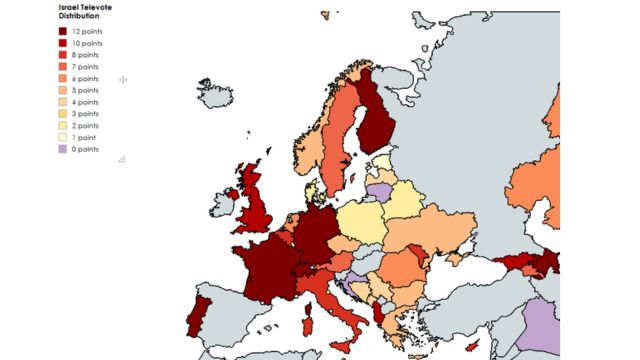
Israel’s televote across Europe during the 2026 Grand Final. Note that Kazakhstan here represents Rest of the World, and Iraq represents Australia.
Statistics from the European Broadcasting Union have been slowly released during the night and morning. Not all of the data has been published yet, and we await more data in the future to analyse even further. Keep checking ESC Insight going forward!