




Location, Location, Location
The circus will most likely move to Sofia, Bulgaria’s capital. In 2015, the city hosted the Junior Eurovision Song Contest at the Sofia Arena, so there’s a good chance the festival will return to that indoor venue, which opened in 2011. Public broadcaster BNT also resides in the capital, and almost every big television show is taped in the BNT Studios in the west of Sofia. In the press conference after Dara’s victory, the Bulgarian broadcaster already hinted at Sofia as a host city.
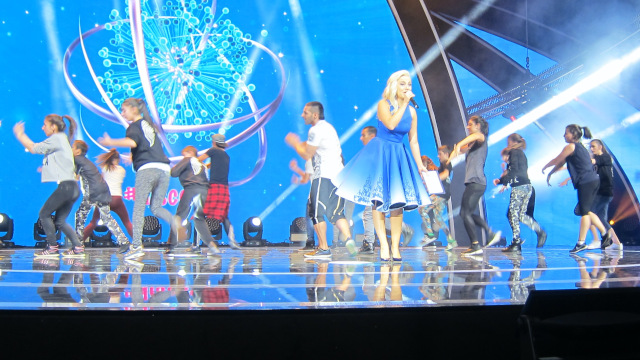
Poli Genova, JESC 2015 (photo: Ewan Spence)
That said, there is one interesting contender. In Burgas, Bulgaria’s second city, a brand-new indoor arena opened in 2023, with a capacity of 15,000 spectators.
Burgas, located in eastern Bulgaria on the Black Sea coast, is an attractive option for reasons beyond its shiny new arena. The city has a solid hotel infrastructure and a well-connected international airport. In 2025, Burgas Airport handled around 1.8 million passengers and served 51 airlines. It is primarily a ‘summer airport’, but it also has the capacity and infrastructure to handle large international crowds.
Host
Many in the Eurovision Song Contest community have already jumped to the conclusion that Poli Genova will host the Song Contest in 2027. She does have experience, having hosted Junior Eurovision in 2015 when BNT brought Junior to Sofia, and, of course, is familiar with Eurovision, having sung twice for Bulgaria and served as a juror in several National Finals.
Yet the Song Contest is one of the highest-profile gigs for any National Broadcaster, a blue-ribbon hosting role that comes with intense pressure. If you’re looking for a name that can be trusted by management and has a connection, then we’re looking at Georgi Lyubenov.
He first appeared on screen in 1998, and has been a fixture for nearly thirty years, including his hosting of the 2026 National Final ‘Natsionalnata Selektsiya.’
Genova is definitely running the Green Room, though, right?
Budget Constraints
When you decide to do something, it’s always an idea to commit fully to it, with as much resources as you can. All three returning broadcasters to the Contest did that (and all three ended up in the Top Ten, with Romania’s TVR joining BNT on the podium).
Hosting the Eurovision Song Contest needs the same one hundred percent commitment, except you have access to far more resources. Every broadcaster has its emergency funds for unexpected programming; think snap general elections, royal weddings, or Scotland qualifying for the World Cup. The Song Contest falls into that category, but its impact on the tourism economy alone will be worth Government and Agency investment as well as national sponsors. Research following Liverpool 2023 reported “an £11.1m boost to Liverpool City Region’s economy in the year after the event, and a total economic impact exceeding £65.9m.”
There will be a budget, but don’t expect a Budget Contest: expect Bulgaria to be front and centre around the world and a similar budget to Basel and Vienna is likely.
Play It Again, Sam, I’ll Ask Nicely
12 months ago, when we wondered what to expect in Vienna, we wrote
The rulebook was always thought to be clear with ’no live instruments on stage’…unless it’s a harmonica you can play through your microphone. Congratulations to Lucio Corsi and RAI’s delegation for finding a loophole and keeping it open until they reached Basel. I doubt it’s going to stay open by the time we reach May 2026.
Turns out that the loophole was widened. As long as you specifically ask the EBU about something not in the rulebook in advance, then you can get a green flag to check it and implement it. It starts with a harmonica, now it’s a violin. What will we get next year? And how many people will think to ask?
Leveraging The Brand
Is the Eurovision Song Contest a unique annual event, or is it turning into a commercial operation exploiting the community’s goodwill and public service broadcasters across the continent?
Over the last twelve months the flagship live TV show from European Public Broadcasters has been looking to leverage the Song Contest into new areas.
We’re not looking at Junior Eurovision here, which has been an adjunct to May’s Contest for more than twenty years. We’re looking at Eurovision Song Contest Asia, licenced by the EBU and being run for profit. We’re looking at the overambitious Eurovision Song Contest Live Tour, which promised (and failed) to sell out ten Arenas over a three week period. We’re looking at the potential rollout of a premium monthly membership to an enhanced version of the EuroFan account…
By the time Bulgaria 2027 comes around, we may know if the Song Contest is a special moment in the year, or a more capitalistic raid on as many wallets as possible.
Broadcaster Confidence In The Song Contest
It’s unlikely that any of the 35 broadcasters are going to leave the Song Contest, but will any of the five broadcasters who have boycotted the Contest will want to come back? And will the Eastern European location of Eurovision 2027 entice broadcasters who have been away for longer to return?
Many in the community are wondering about Hungary. With a change in government and a Contest in their neighbourhood, would MTVA enter the 2027 Contest? North Macedonia will also be near the top of the list. And with the various noises coming out in the press, it’s not impossible we’ll see Canada.
Viewer Confidence In The Song Contest
We may see broadcasters come back, but there is another group that needs to come back to the Contest: the audience. As the overnight numbers come in from the broadcasters, precipitous drops are being reported…Norway saw its lowest figures since 2007, Sweden its lowest since 2010, and the United Kingdom’s were its lowest since then too.
It’s not hard to understand why many viewers have kept away. In the run-up to the Song Contest, it was impossible to escape discussions around political interference, voting irregularities, and the broadcaster boycott driven by the presence of Israeli broadcaster KAN. Comments by the EBU in response to these reports were weak at best, falling back on platitudes and well-worn phrasing.
Why would an audience looking for some escapism from the world turn to Eurovision?
The Eurovision Song Contest needs the trust and confidence of its audience. Can it begin to earn that back before we get to Bulgaria?
The Future is Now
One late night conversation sprung this observation about ‘Bangaranga’: “this song would win Eurovision in 2030.”
Dara hit fast-forward on that prediction. Bulgaria’s song, which leveraged recent commercial music trends like mid-song tempo changes with traditional Balkan sounds, could paint a picture of what the Song Contest could sound like for years to come. Rather than approaching the show with Eurovision in mind (think Delta Goodrem, whose ‘Eclipse’ would have almost certainly won the jury vote a few years ago), the success of ‘Bangaranga’ proves that Eurovision’s audience, which continues to have a sizeable youth demographic, want to vote for songs that sound like what they listen to on streaming or clip up on TikTok.
There are multiple downstream effects this could have. Record labels, a key source of funding for many Eurovision entries, might see closer alignment between the Contest and their commercial strategies and hope greater investment yields greater reward. National Finals may expand their horizons, inviting braver and more radical songs to come forward.
Could we see hyperpop, trending international sounds like amapiano or even K-pop and J-pop become powerful forces in Eurovision? After ‘Bangaranga’, what a winning Eurovision entry can be has been redefined.
You Can’t Stop The Music
While classifying song by genre is a rather broad brush, the top five from Vienna 2026 can arguably come with tags of chanson, electro/tropical pop, industrial, neomelodic and power ballad. The idea that there is a Eurovision Style is, once more, comfortably disproven by the results.
The success of ‘Bangaranga,’ ‘Choke Me’, and ‘Viva Moldova!’ will hopefully encourage more musical styles and approaches to the Song Contest. That these three standout songs in Vienna came from returning broadcasters will not go unnoticed across other EBU members.
That wide genre spread also shows one of the inherent strengths of the Contest. It is a melting pot of culture from around the world, it is a celebration of musical identity, and every year the art of the song shines through to connect to millions around the globe. No matter what happens over the next twelve months, music will always have that inherent power, no matter if it finds itself in Bangkok, Valletta, or Sofia.
What are you looking forward to for the Eurovision Song Contest in 2027? What needs changed, what should stay the same, and what would be your expectation? Let us know in the comments.