




The Model, a Eurovision Song Contest prediction tool, continues to project Finland as the favourite to win if the competition were held today.
The Model was once again revealed live on the ESC Gabe YouTube channel this week, with a full voting sequence including qualifier reveals and the full breakdown of the final.
In that voting sequence, ‘Liekinheitin’ by Linda Lampenius & Pete Parkkonen extended its lead in this week’s Model projection to reinforce its position as the favourite to win Eurovision 2026. The song is projected to score 387 points by The Model, giving Finland an extended 36-point lead over second-placed France, and a 56-point advantage over Denmark in third.
This projection follows the release of the semi-final running orders, which can have as much as a 10% differential on a country’s overall performance. But despite this change, only one qualifier has changed in The Model compared with last week, while the winning numbers have increased across all shows. This suggests that, as we get closer to this year’s Contest in Vienna, the state of play is beginning to solidify.
In this update, we’ll analyse:
- The winners and losers from the running order reveal
- All the climbers and fallers in the points projection
- And introduce new data that brings fan opinion into the mix
What Is The Model?
The Model was built to answer a simple question: “if the Eurovision Song Contest was held today, who would win?” To do that, The Model turns opinion into data in the lead-up to the Contest to create weekly updates on how the race to Vienna is shaping up. The tool has frequently been more successful in predicting the Contest than betting odds, fan polls, or any other indicator.
This year, The Model is bigger than ever before, with new updates released every Monday from now until Eurovision 2026 on the ESC Insight website, where the results will change and evolve as this year’s Contest comes closer.
A new companion podcast, ‘Inside The Model’, is also launching on the ESC Insight feed, providing weekly prediction updates, unique song analysis, and special guest appearances from the world of the Contest. This week, it’s a collision of statistical minds as ESC Insight’s own Ben Robertson joins James to chat about some of the new rules affecting Eurovision’s voting this year, and what changes we could see when we get to the results sequence.
Under the Hood
The Model is an evolving tool – this week, it evolves in two important ways.
Firstly, the running orders for each semi-final were released on Thursday. While the positions themselves don’t have a drastic impact on a song’s chances, they can matter. The difference between a dream position and a nightmare one can be as much as 20% of your expected performance. With that data taken into account, I’ll get into which countries have got the most help, and which have got the most hindrance from the running order.
But the second way affects every song in The Model: the introduction of fan opinion.
I’m delighted to say that The Model is including data from ‘The Big Eurovision Prediction Survey’, which is being run by ‘Dolphin’ Dane Jørgensen. Dane is running a survey that asks fans directly how strong they think the chances of each country’s success is, both within the jury voting and the public voting. The Model uses this data not to calculate success, but to better identify how each song will perform on either side of the scoreboard.
This data goes alongside the internal musical data, pulled from the Spotify API, that The Model uses for each entry. The best way to think about it is that if that musical data is the quantitative aspect, Dolphin’s survey is the qualitative one. Fan opinion can reveal some of the idiosyncrasies that make songs perform differently to sonic expectations. They allow us to measure things that the Spotify data doesn’t pick up which really impact an entry, from vocal capacity and lyrical content to non-musical factors like politically motivated voting.
Dolphin’s data has already changed how some countries perform substantially, and in this update I’ll touch on some of those songs as they come up. A huge thank you to Dane for providing some of this data for use within The Model – if you want to check out what he does, last year he ran 100,000 simulations of Eurovision 2025 in Basel and reported his findings here on ESC Insight.
Now, it’s time to dive into what The Model says would happen if the Eurovision Song Contest was held today, April 6 2026.
Semi-Final One
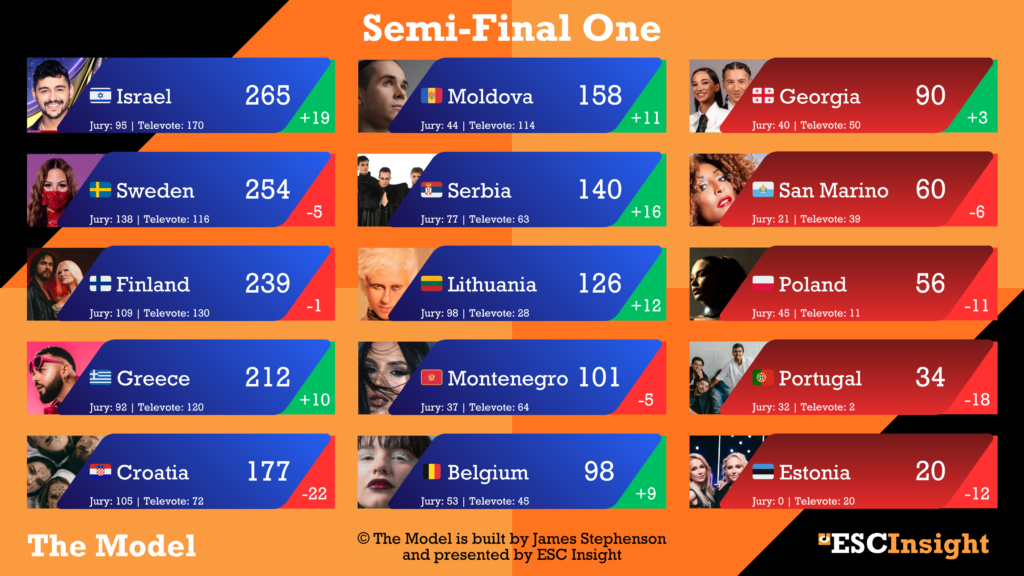
Semi-Final One from The Model – 06/04/2026 (James Stephenson)
We start off with Semi-Final One as usual, where the headline news is that the top 10 has remained unchanged. However, that doesn’t mean the reveal of the running orders hasn’t caused some things to shift, with nine of the songs moving by double digits, and there’s a brand-new winner.
The Model now projects that Israel is the favourite to win this semi-final with the running order taken into account. ‘Michelle’ from Noam Bettan has jumped up to 265 points in this simulation, up 19 on last week. The song is in the second half, which historically has produced better voting results, often driven by recency bias. Let’s see who the big winners and losers have been from the running order.
The Model calculates the effect of the running order in two ways. Firstly, it adjusts based on the position each song performs in. The rough trend for semi-final performance is that the opening slot is seen as a solid position, performance drops to its lowest point at song two, then works its way higher and higher until the closing spot, historically the best to have. ‘Kraj Mene’, Serbia’s metal entry from Lavina, has the slot this year, and that drives a 3.8% expected increase to its performance.
But the second effect is arguably more decisive – it’s something I call ‘relative running order’, and it’s based on which songs come before you and after you in the order. Naturally, you wouldn’t want to go next to a big favourite, as that might take some of the spotlight away from your entry. Because of this, favourites do very well in this metric, and it’s no surprise to see Finland as the country that benefits most. Their 8.1% increase is driven by not only their contender status, but by getting the best spot available in the first half at song number seven.
Performing in between jury-friendly entries from Croatia and Portugal has helped Greece climb 6.5%, while Israel gets a 6.4% jump from being in the second half of the semi-final, which statistically appears weaker overall. It’s why the songs that have been hurt most by the running order are entries that are competing closer to the favourites in the first half. Even ‘Nova Zora’ from Montenegro, which was drawn in the second half, takes a 7% hit simply because of having to go on after Linda and Pete.
Moldova takes a hit despite getting the coveted opening spot, largely driven by the surprising decision to make Sweden take song two, or the “death slot” as we often like to call it. With Sweden an almost certain qualifier, that feels like a decision to try and help remove some of the stigma from that position.
However, the knock-on effect is that song three is becoming as dangerous. Croatia has that spot this year, and takes a huge 10.2% drop based on being sandwiched between Sweden and Greece. But, with juries back in the semi-finals, ‘Andromeda’ still appears to have what it takes to sail through to Saturday’s final. Portugal is also affected and drops further away from qualifying here, but this is somewhere where I disagree with the statistics. Coming after ‘Ferto’ may help the slower pace of ‘Rosa’ stand out more, and Portugal has a history of beating the odds.
Semi-Final One Running Order Over/Under Projections
Finland – +8.1%
Greece – +6.5%
Israel – +6.4%
Serbia – +3.8%
Lithuania – +2.1%
Sweden – +2.0%
Belgium – +1.2%
Poland – +0.1%
Georgia – 0%
San Marino – 0%
Moldova – -1.5%
Estonia – -4.8%
Montenegro – -7%
Portugal – -7.6%
Croatia – -10.2%
Semi-Final Two
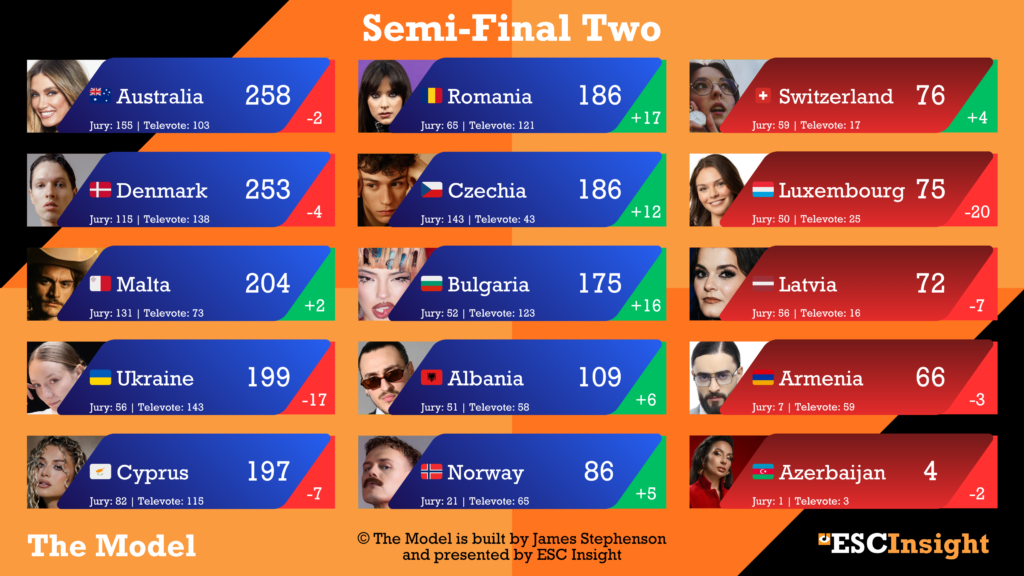
Semi-Final Two from The Model – 06/04/2026 (James Stephenson)
In Semi-Final Two, there are fewer countries making big jumps on the scoreboard. However, the changes that The Model has made are more impactful. Australia continues to lead this semi-final, with Delta Goodrem’s ‘Eclipse’ projected to beat Denmark by five points. But the main interest is towards the final qualifying spots, where we can really see the effect of the running order make a difference.
A pack of countries has emerged in The Model’s projections as being right on the bubble. Albania, Armenia, Latvia, Luxembourg, Norway and Switzerland have been in and around the mark every week, with small gaps between all of them. But this week’s running order has given two of those songs a decisive boost ahead of Vienna, and it might prove crucial when the votes come around.
Albania and Norway were drawn in positions 13 and 15 respectively – the kinds of draws both broadcasters would have dreamed of. For Albania, ‘Nân’ gets a prime position while also following the United Kingdom’s ‘Eins Zwei Drei’ (still feels weird to say), an excellent contrast that will help Alis’s emotional vocals and lyrics stand out. Meanwhile, Norway gets to close the show, which is where we often see the most viewership, and gets maximum recency bias in the voting. Albania gains 2.2% because of this, while Norway jumps up 2%.
What makes those positions better is that their qualifying contenders have all had harsher draws. Luxembourg and Latvia in particular have been hurt by being just before bigger favourites. With ‘Mother Nature’ seen by The Model as stronger with the juries, having jury powerhouses Czechia and France following could be disastrous for their chances, with a 4.4% drop projected.
Meanwhile, Latvia’s position at song number nine is good in isolation – but big favourites Denmark, Australia and Ukraine all follow back-to-back-to-back. As a result, Atvara’s ballad drops 5%, and could get lost underneath that packed run of contenders. Armenia also loses 5.1% coming after France, but France often gives Armenia points.
Switzerland has been dealt a slightly easier hand, although it drops by 1.6%. ‘Alice’ could stand out for its more relaxed energy against ‘Paloma Rumba’ from Armenia and ‘Jalla’ from Cyprus. And, with all of that in mind, it goes to show how much the running order can matter in a close race when you see all six of these songs ordered by how The Model projects their running order benefits. That means Albania and Norway are in, with ‘Ya Ya Ya’ replacing ‘Mother Nature’ compared with last week, while Switzerland has jumped up to 11th place.
Further ahead, the decision to pack Denmark, Australia and Ukraine side-by-side does have some effect, with Denmark helped by being able to get out ahead of its two main rivals. While The Model does project differences here, though, none of these entries will be in danger of missing Saturday’s final.
Meanwhile, the big winners are the countries further east. Romania is seen by The Model to have benefitted most with ‘Choke Me’ getting a 6.4% boost due to coming on after Azerbaijan. Not far behind, two ‘girlbops’ in ‘Jalla’ and ‘Bangaranga’ from Bulgaria open their respective halves, with both spots seen as very favourable in this projection.
Semi-Final Two Running Order Over/Under Projections
Romania – +6.4%
Cyprus – +6%
Bulgaria – +5.9%
Denmark – +3%
Malta – +2.4%
Albania – +2.2%
Norway – +2%
Ukraine – -1.6%
Switzerland – -1.6%
Australia – -1.7%
Czechia – -3.3%
Luxembourg – -4.6%
Latvia – -5%
Armenia – -5.1%
Azerbaijan – -6%
Grand Final
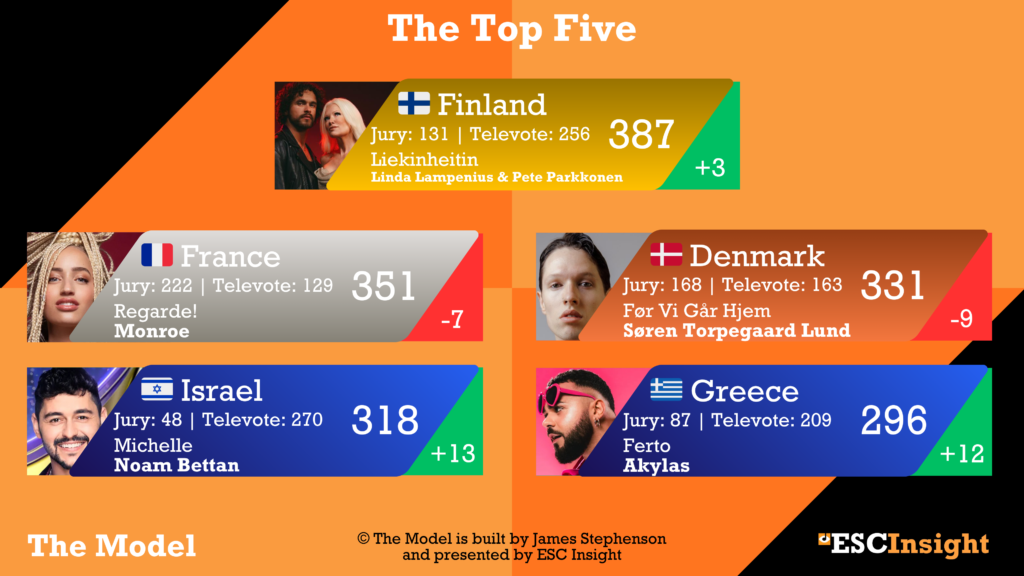
The Top Five from The Model – 06/04/26 (James Stephenson)
On the surface, not much has changed this week. Finland still leads The Model, with the same top five in the same order. But there are plenty of things to note.
The big differences come from the inclusion of Dolphin’s survey into the methodology. Israel and Greece are beneficiaries of this, with the survey results indicating both will be even stronger in the televote than the Spotify data suggests. Israel, driven by historical results, is now expected to win the public vote in Vienna like they did in Basel, while ‘Ferto’ clears 200 in the televote for the first time in this projection.
Another change is that the survey results are much firmer on which songs will be jury contenders. France and Australia are the main beneficiaries on that end, with Monroe’s ‘Regarde!’ now winning the juries with 222, while Australia is in sixth place overall with 209 jury points. However, their televote chances are weaker in The Model as a result – France drops down to 129 in the public vote, while Australia earned just 76 points there this week.
If anything, I’d say those who filled in the survey were even more divided than the odds have been on who will do well on the jury and televote sides. And that is a trend that could continue into Vienna. On ‘Inside The Model’ this week, Ben and I discussed the new make-up of the juries, with seven members instead of five. With more votes to average out, chances are that the jury favourites crystallise – and according to Ben’s own digging for ESC Insight, the inclusion of younger members might make the jury split further from the public, rather than being more in step.
That makes more extreme point splits, and therefore higher points spreads, more likely at Eurovision 2026 than ever before. A good example in The Model is Czechia, which is projected at fourth with the juries at 158 points, and 23rd with the public vote at 2 points. While that seems remarkable, let’s not forget that ‘Voyage’ got 214 jury points and nothing at all from the viewers at home last year. These aren’t anomalies – they are possibilities within the system.
Again, Finland’s winning total is low at 387 – and I do think The Model will become more bullish in its projections the closer to Eurovision we get. But Finland’s issue remains on the jury’s side. Although in Dolphin’s survey the view of fans was that ‘Liekinheitin’ could be a slightly more jury-friendly song as opposed to a televote-friendly one, the competition for jury points is fierce this year. France, Australia and Denmark could all be big beasts on that side, while even songs like Croatia and Malta will have a clear appeal.
That means that Finland is hitting a wall on the jury end, with just 131 points in The Model’s projection. That might not stop them winning in this simulation – but if France or Australia can gain the kind of runaway jury success we’ve seen from Loreen, Nemo and JJ in the last three years, they’ll have a much clearer path to the crystal microphone. Israel’s televote strength is also a problem for Linda and Pete. Without them being in contention, The Model may well have had Finland over 300 there. A score of 256 is still very strong, but it keeps them in range should the jury have a firm favourite.
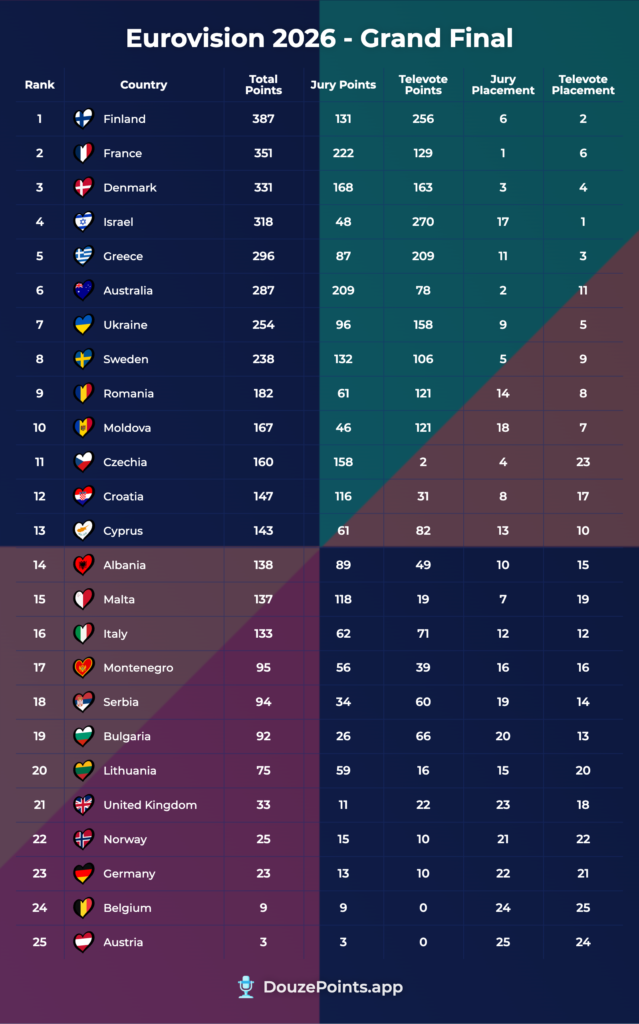
Full Split Results from The Model – 06/04/26 (James Stephenson / DouzePoints.app)
Every song in The Model is a story, and I would get to them all but this article would turn into a thesis. So I’ll direct you to ‘Inside The Model’ instead for more conversation about that: Ben and I cover Moldova’s chances in some depth there, and go into detail about how those jury changes might lead to a step change in Eurovision – go and listen to find out why!
With The Model’s latest update, Finland remains in front – but that is set to keep changing. Next week, the first big pre-party in Amsterdam will have taken place, and fans will have seen live performances from most of the class of Eurovision 2026. With the expected movement in the odds and community rankings, that’s set to make an impact.
Remember, The Model will make weekly projections from now until the contest, updating with new information throughout. If you don’t want to miss any regular weekly update, read The Model on ESC Insight every Monday from now until the Eurovision Song Contest 2026.
Finland’s in front – but could someone catch them next week? See you then for the next update from The Model.