





Executive Summary: Does Age Actually Matter in the Jury Room?
To understand how the EBU’s 2026 jury reforms might reshape the scoreboard, we analyzed the voting patterns of 91 jurors aged 25 and under from 2014–2019. Here is what the data tells us:
- Age isn’t everything: On the whole, jurors under 26 years old, and those older, correlate incredibly strongly (+0.895). In most cases, a juror’s location (which country they are voting from) is a much stronger predictor of their vote than their age.
- Not The Televote: Contrary to the hypothesis that younger jurors would bridge the gap to the public voting, our study found that older jurors showed a slightly higher correlation with the televote than their counterparts under 26.
- The Freshness Factor: While there is no clear split between ballads and pop, younger jurors might slightly reward “fresh” production and boundary-pushing entries (e.g. ‘Soldi’, ‘Heartbeat’) while being more critical of traditional formulas or legacy genres (e.g.,’Occidentalis Karma’, ‘Loin d’ici’).
- History-Altering Potential: By modelling a seven-person jury (including two voters under 26) on past results, we found the impact is usually marginal but can be decisive. In our model, these extra voices should have flipped the trophy from Ukraine to Australia in 2016 and from the Netherlands to Italy in 2019.
- The Room Effect: Beyond the numbers, the mere presence of younger voices in the room may shift the consensus of the entire seven-person block, potentially favouring “cool” and “inventive” entries in the battle for victory or qualification.
Setting Up Our Study
Eurovision juries make up roughly half of the final score at the Eurovision Song Contest. Their power is significant; in the past three years the winner of the Eurovision Song Contest has ultimately ended up being the song that won the jury vote by a comfortable margin, taking home the trophy despite in each case coming over 100 points short of the winner of the public vote.
While this in itself is not controversial, the reforms to Eurovision rules and relegations presented at the end of 2025 included jury reform. Juries will return to the Eurovision Semi Finals, and a wider range of music professionals will be considered acceptable to serve as jurors. Further to that is the change to increase the size of the jury to seven people, of which two of the jurors need to be young people aged between 18 to 25.
While the EBU claims this is to “reflect the appeal of the Contest with younger audiences”, we at ESC Insight wonder whether those younger voters vote more in line with the younger audiences the EBU wants to reflect. We can look at Eurovision history to try to answer this.
Since 2014, full data on each Eurovision juror’s rankings of Eurovision songs, as well as the ranking of Eurovision televotes, has been made available. We are able to use this data to assess if younger Eurovision jurors from history, those in the 26 and under demographic, to see if they vote significantly differently from those older juror members.
Sadly, at least for the purposes of this study, there are two issues that make it significantly more challenging. Since 2021, the juror results that have been published have been randomised, meaning it is impossible, at least officially, to link the juror results to each individual juror, meaning that we can not identify which votes were cast by jurors under the age of 26.
Furthermore, the EBU’s move to a new website has lost a significant amount of historical information, including documents that officially recorded juror ages at the time of the competition. For the years from 2014 to 2019, we have researched as best we could to find as many Eurovision jurors as possible within the specified age range.
We believe we have successfully identified 91 Eurovision jurors in this six-year period who were under the age of 26 on the day of the Eurovision Grand Final. These include names such as Emmelie de Forest, Aminata Savagogo, Getter Jaani and numerous other ESC stars, National Final entrants, and people of other musical backgrounds as well. We do though, want to stress that it is possible some, perhaps lesser famous names, may have been too difficult to find their ages for this study, but we believe we are confident enough in the spread of names available to suggest this study has some credence.
Do Younger Jurors Match The Televote More?
The first analysis we can do is to investigate the group of younger jury members under 26 and compare them to older jury members. We can calculate the average rankings for each of these groups for each song in the Eurovision Grand Final from 2014 to 2019. We can then also compare this average ranking to the combined televote rankings for each country. The hypothesis here is that younger jurors will ultimately rank songs more similarly to the televote, showing a bias toward Eurovision’s younger demographic, which engages more with the Song Contest.
We can compare these rankings using rank correlation analysis to assess how well the different average rankings correlate with one another. The results of this are available in the following table.
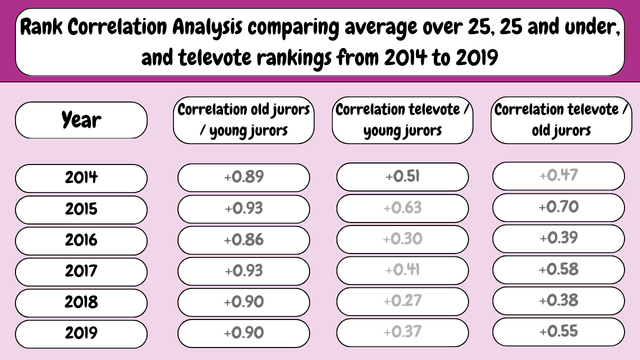
Pearson’s Rank Correlation Analysis comparing average over 25, 25 and under, and televote rankings from 2014 to 2019 (3)
The larger and more positive the correlation figures are, the stronger the correlation is between the two groups. It is immediately apparent that the correlation figures for old and young jury members are extremely strong, averaging +0.895. This demonstrates, first and foremost, that the age difference between jury members is, on the whole, incredibly small, and that they have a very strong correlation with one another regardless of age. That should be a key takeaway from this study: on the whole, the age of jurors is not alone significant to the outcome (however, there is nuance to this that we will observe later in this study).
What is striking, though, is to compare how the younger jury members and older jury members each year correlate to the televote. In five of our six examples, what we witness is that the correlation appears larger for the older jurors (+0.51) to the televote than for the younger jurors (+0.415). That, by itself, suggests that no, younger jury members do not show a stronger correlation with the televote.
Songs That The Younger Jurors Like More
Looking into the data further, we find that there are significant songs where the younger jury members have disagreed with the televote about. 2018’s low correlation of +0.27 between the televote and our cohort of under-26-year-old jurors is heavily shifted by two significant gaps. Cesar Sampson’s ‘Nobody But You’ was a huge hit with our younger jurors, ranking it an average of 3.9 compared to the older jurors’ 7.3. Furthermore, DoReDos’s ‘My Lucky Day’ was a younger-juror miss, ranking an average of 19.4 from younger jurors, compared to a more middling 15.2 from older jurors. Yet on the scoreboard, the Moldovan entry by DoReDos received 115 points from televoting, with an average televote ranking of 10.7, while Austria’s ‘Nobody But You’ received just 71 points, with an average televote ranking of 11.4.
Given that, on the whole, jury members correlate very highly with each other regardless of age, let’s be clear that the differences we see above are actually very rare, as one would expect given the very high correlation between the two groups. The following chart shows the average difference between the older jurors and younger jurors at the 2018 Eurovision Song Contest we mentioned. It shows that only five of the 25 participating songs saw the two distinct jury groups rank songs more than 2 average placings apart, and this general agreement is replicated across the 6 different years we can measure.
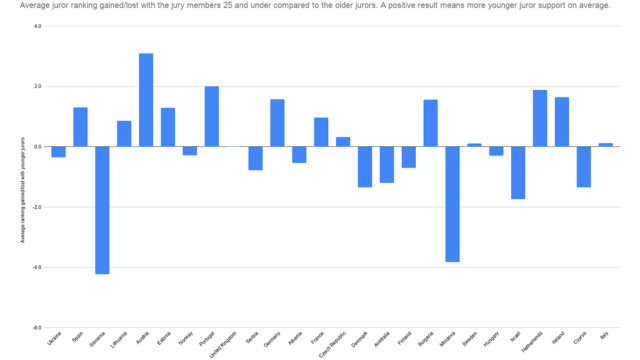
(Chart, Ben Robertson, ESC Insight)
This is evidence that younger and older jurors agree more than they disagree, and even then, it has never happened that disagreements shift a song from the bottom of the scoreboard with one side of the divide to the top with the other. What is curious, though, is whether we can see a pattern between the songs that do best with younger jurors, or conversely, best with older jurors. Does this fit the stereotype? Do younger voters vote more in keeping with current trends and vote for bolder and more contemporary numbers, and do the older voters vote for potentially songs more sedate and traditional?
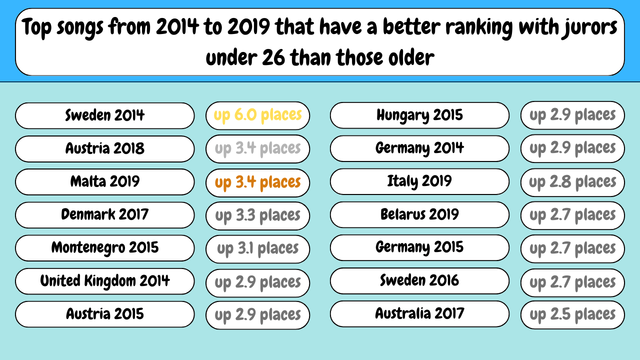
(Chart, Ben Robertson, ESC Insight)
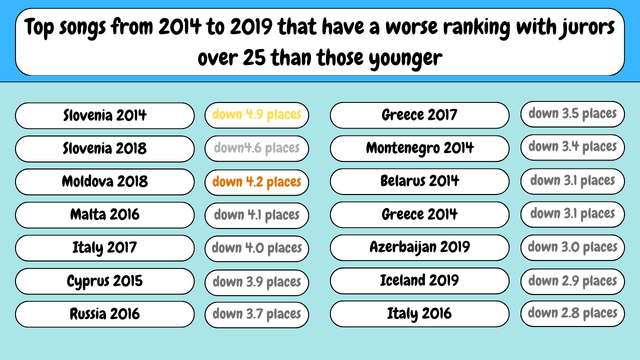
(Chart, Ben Robertson, ESC Insight)
It takes a lot of squinting in these tables to see any perfect pattern. What do ‘Undo’, ‘Nobody But You’, ‘Chameleon’, ‘Where I Am’ and ‘Adio’ have in common? And can anybody hear this combination of songs and have it scream 18-25 year olds? I suspect not. It’s perhaps a little easier on the eye looking at the older juror favourites, with songs like ‘Occidentalis Karma’, ‘Walk On Water’, ‘My Lucky Day’, ‘Hvala, Ne’ and ‘Round and Round’, perhaps I can hear that these songs and performances turned off the younger generation more than those older. But there isn’t any clear trend, I can’t say it is ballads on one side and pop songs on the other, or innovative sounds on one side and traditional sounds on the other.
That’s because, statistically, there is a significant problem with this data set. We know from the studies we have done previously on jury voting at the Song Contest that it isn’t age that is the biggest determining factor in how you vote – it’s location. The people who sit on the German jury, for example, are more likely to agree with the other German jury members than others around Europe of the same age, vocation or gender.
‘Undo’ tops our list here as the song best with younger juries. But in 2014, as per our records, there were only 7 jurors under 26: one Swede, one Brit, one Spaniard, one German, one Moldovan, and one Sammarinese representative. Six of those jurors ranked ‘Undo’, and four of them had ‘Undo’ in the top two positions on Friday night. But every Spanish juror had Sweden in their top two. Three other Belgians had it on the podium, as did three Moldovans. Two other Sammarinese placed Sanna Nielsen first. It’s no surprise to me to see that German juror Madeleine Juro was the black sheep in our juror selection, ranking ‘Undo’ in eighth position, because the average rank of the German jurors gave Sweden seventh place on the night.
I believe the data we have presented needs to be cleaned of its geographical bias if we are to suggest which songs are best for the younger and older voting blocs on Eurovision juries, respectively.
Taking Away The Country-by-Country Bias
If we are going to present information about what the presence of younger jurors does to Eurovision voting, the above information is heavily weighted by the fact that jurors are watching and voting Eurovision in the presence of four others, and that statistically has a greater impact on voting than any other factor. Because of this, we need to measure not which songs do better or worse with younger jurors, but which songs do better or worse with younger jurors compared to their own juries.
For example, in 2014, when we look at the ‘Undo’ example, while yes, these seven younger jurors did vote stronger for Sanna Nielsen’s ballad, they only did so by an average of 1.5 places higher than the other jurors from their own country. This is less than Norway’s ‘Silent Storm’ (3.3 places average), Germany’s ‘Is It Right’ (3.2 places average), Italy’s ‘La Mia Città’ (2.4 places average), Switzerland’s ‘Hunter of Stars’ (2.2 places higher) and Malta’s ‘Coming Home’ (1.8 places higher).
There is a strong argument that it is this pack of songs that most captured the younger jurors’ attention, the ones where they voted differently than the mood of the room they were in, and the ones that other jurors they were alongside dismissed.
Let us now present a list of songs where that change is most significant. The following tables show the songs that are most supported by under-26-year-old jurors compared to their national jury average, and the songs that had the most negative drag from that age group as well.
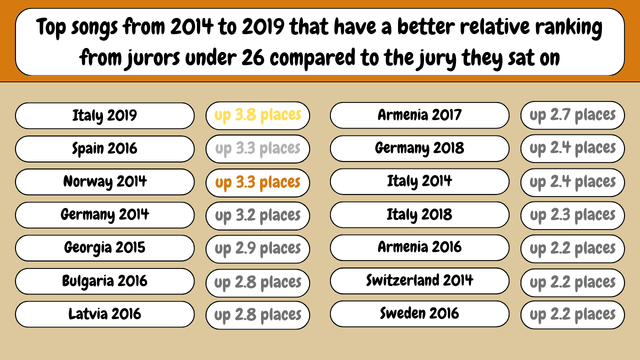
(Chart, Ben Robertson, ESC Insight)
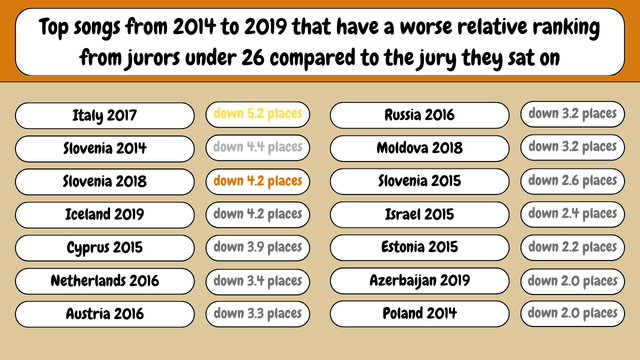
(Chart, Ben Robertson, ESC Insight)
I think we are now at the point of being able to see something, albeit with some squinting, in the data set. When I see songs like ‘Heartbeat’ (Latvia 2016, ‘Say Yay!’ (Spain 2016), ‘If Love Was A Crime’ (Bulgaria 2016) and ‘Fly With Me’ (Armenia 2017) on the side of the heavier younger jury support, I believe we have something notable. I see songs with energy, with a freshness of production, with a sound that, while pop music, aren’t necessarily following all the rules and expectations that pop music had in that era.
And the songs that younger jurors stood up against include those of more tradition. Songs like ‘Loin d’ici’ (Austria 2016), ‘Slow Down’ (Netherlands 2016), ‘One Thing I Should Have Done’ (Cyprus 2015), ‘You Are The Only One‘ (Russia 2016) and yes, even the industrial techno and ultimately controversial ‘Hatriꝺ mun sigra’ (Iceland 2019) came from a musical world that had its heyday in earlier than 2019.
Again, it’s no uniform pattern. I’m not seeing ballads on one side and uptempo songs on the other. But what I am seeing are differences that are more justifiable in showing differences between jurors 25 years and younger compared to their older counterparts.
Finally, there are two songs at the top of each ranking that we have not mentioned. Both come from Italy. In 2017, we all arrived in Kyiv for the Eurovision Song Contest in full expectation of a landslide for Francesco Gabbani and ‘Occidentalis Karma’. That was not the case at all, and ultimately Italy stuttered to a 6th place finish on less than half the number of points as the eventual winner ‘Amar Pelos Dois’.
We found 21 different jurors for the 2017 Contest who were aged 25 and under. Of those, only five ranked Italy in the top 10, while ten jurors ranked Italy in their bottom ten competing entries that year.
On the flip side, this study shows that among younger jurors, it was ‘Soldi’, the Italian entry from 2019, that was an absolute smash hit. Of the 16 jurors we had identified as being 25 and under that year, only three of those jurors had ‘Soldi’ outside their personal top ten, with seven jurors, nearly half our sample, giving Mahmood a ranking of 1st or 2nd place.
For me, these two songs are perfect examples of the dichotomy between the two jury age blocks we are investigating. For all its charm, wit and catchiness, ‘Occidentalis Karma’ tells a cultural story of the west on the east through the medium of a well-worn pop song formula. On the flipside is ‘Soldi’, a revelation, a transformationally fresh entry with a voice of a new generation to the Song Contest that its younger jurors latched onto.
But even with these hyperbole, even with noting these two songs that in our six-year time window were the most divisive, that difference isn’t all that big. With over 150 songs analysed, our biggest overall average difference is one just over 5 places on the ranking. Can the addition of two extra younger jurors change anything significantly in the results of the Song Contest?
Our Model To Reproduce Jury Results
We want to use the data we have collected to see how the jury voting from 2014 to 2019 would look if we added two younger jury members to the mix.
Here is our methodology to attempt this.
- Take the five jury members who have cast their results
- Add two extra jury members to their results, which gives a ranking equal to the average ranking of the five jury members, plus or minus the support factor from younger jurors in each song, as calculated
- Work out the new jury ranking for the combination of the five real juror votes with the two artificially created average younger jurors per country.
*The methods are slightly different for full replication to the original result, as the 2018 and 2019 results use an exponential formula to reduce the weight of negative jury rankings on the overall ranking, as we try to approximate this exponential factor as realistically as possible.
The following six charts show the difference in points between the jury points scored in the real voting and those our model calculated. A positive score on these charts indicates our model gives that country more points in that year.
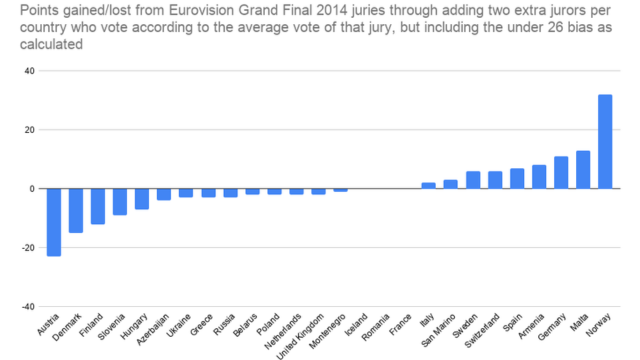
(Chart, Ben Robertson, ESC Insight)
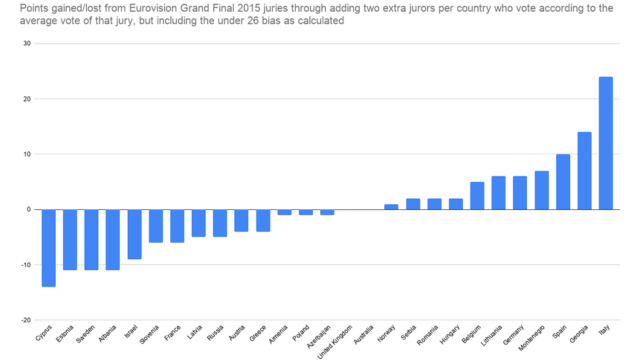
(Chart, Ben Robertson, ESC Insight)
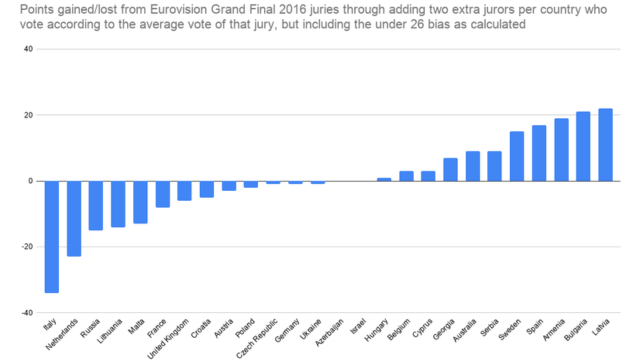
(Chart, Ben Robertson, ESC Insight)
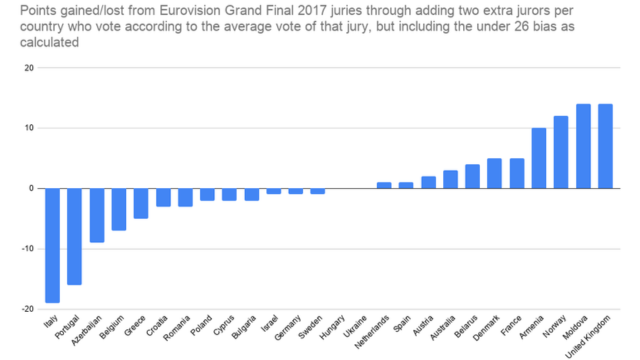
(Chart, Ben Robertson, ESC Insight)
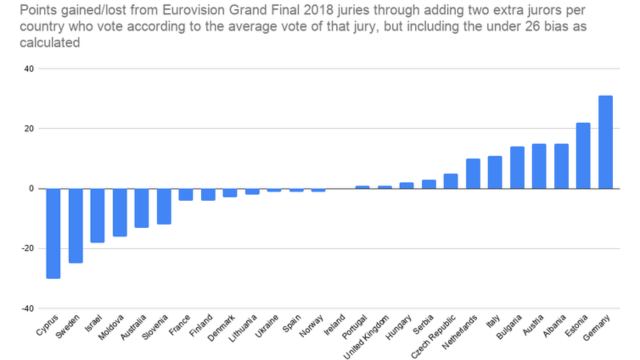
(Chart, Ben Robertson, ESC Insight)
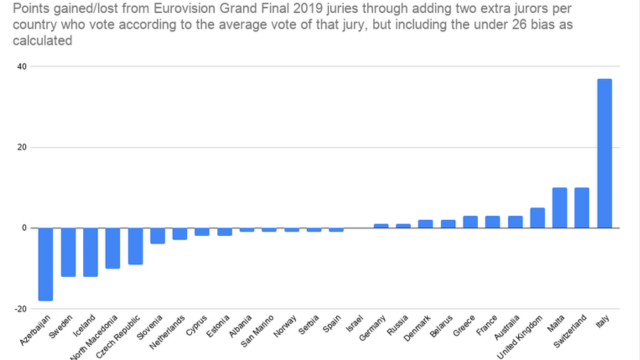
(Chart, Ben Robertson, ESC Insight)
Let us start with a reminder that we were not expecting to see large swings in the difference from adding just two extra artificially created juror scores per country, especially when they are already based on the average vote from that country.
In total, we observe an average of two songs per Eurovision year where the calculated jury score we predict they would receive is more than twenty points different from the actual points total they received at the song contest.
Would this change Song Contest history? In this model, we see an output of Sanna Nielsen’s ‘Undo’ marginally winning the jury vote above Conchita Wurst, which Conchita clearly surpasses via televoting. While ‘Grande Amore’ is the biggest winner in 2015 from this addition, gaining a 35-point swing over ‘Heroes‘ with juries would unlikely be enough, noting how the jury points in 2015 gave Sweden a modern-day equivalent of a margin well over 150 points from Il Volo.
Our calculations for 2016 suggest a 10-point swing between Jamala’s ‘1994’ and ‘Sound of Silence’ from Dami Im in favour of the Australian act. On the night Ukraine won the Eurovision Song Contest with a 23-point margin. However, we note that after the 2016 Song Contest that Danish juror Hilda Heick voted incorrectly, ranking her last-place song first. Her favourite on the night was ‘Sound of Silence’, while she ranked ‘1944’ second last. Should these votes have been correctly ordered, rather than receiving 12 points from Denmark, ‘1944’ would have received zero, and Australia, which received 10 points, would have scored the jury’s douze points. That is a 14 point swing.
Our model therefore gives an output that ‘Sound of Silence’, in a world of having two extra under-25 jury members per country, should have won by a solitary point.
2017 is not dramatic, yes, Portugal’s huge runaway victory is curated somewhat (only eight of the 21 younger jurors had Salvador on the podium), but Salvador Sobral would still receive a record score at the Song Contest. 2018 became closer, with Austria’s jury victory even stronger, including a 48-point swing to Cesar Sampson from the Cypriot act ‘Fuego’ and 33 points from Israel’s ‘Toy’, but not enough to change the podium order.
2019 sees ‘Soldi’ as comfortably our biggest benefactor, gaining 37 points on its already impressive 219 jury points. This would move ‘Soldi’ with juries from 4th place to 1st, and, as ‘Arcade’ loses three points from these newly constructed juries, ‘Soldi’ holds on through televoting to eventually win the Song Contest by a margin of 14 points.
In Conclusion
This data study suggests that the introduction of younger jury members may impact on voting at the Eurovision Song Contest. While there is strong agreement generally between jury members regardless of age, and no evidence that younger jury members more closely replicate the televote of the Song Contest, it appears that there might be certain songs this year that see a gap between the tastes of young and old.
While a generalisation, this shift does move the Song Contest jury taste ever so slightly away from traditional sounds to those that are inventive, and produced with elements that, if we squint, are more made to be ‘cool’ and more made to be for the ‘show’.
We even suggest that, in the coming years, this shift could change the scoreboard enough to change who wins the Song Contest.
There is also one perhaps underappreciated nuance of moving from a five-person jury to a seven-person jury that our data cannot show. As we have stated, the biggest statistical factor we have observed within Eurovision juror taste hasn’t been age, gender or other variables, but who one watches the Song Contest with. That means the influence of younger jurors being on every jury is significant that this data alone doesn’t measure. While each juror votes independently, does the mere presence of these younger jurors shift the whole jury as a block? Will those trends that we observe that would allow ‘Soldi’ to win Eurovision, for example, to be amplified?
It also means that, with more voices on each jury, the likelihood of jury consensus across different countries should increase. We have had three jury favourites in a row win the Eurovision Song Contest – in theory, with more jurors voting on the Song Contest, the chance of jury consensus across nations should be higher, the distribution of jury scores should be more uniform, and thus the chances of a jury landslide increase rather than decrease.
And looking at 2026, we know there are clear favourites that would be looking for big scores on the jury side of the equation. It’s hard at this point in the season to know which songs favour younger voters, but we note that the current Nordic trio of ‘Liekinheitin’, ‘My System’ and ‘Før Vi Går Hjem’ top the MyEurovision Scoreboard app currently. If this also does reflect in younger juror taste, does the addition of two extra younger jurors shift this Contest more northern and more modern compared to other early competitors such as ‘Michelle’ from Israel, ‘Regarde!’ from France and ‘Eclipse’ from Australia that are also considered in the mix for winning Eurovision 2026 at this early stage.
We at ESC Insight have wanted to see larger jury groups for a significant time. We are also pleased to see that these jurors are younger and that the range of musical professions is much larger, increasing the diversity of jury groups.
While our studies suggest the impact on Eurovision is overall quite small, we believe the biggest impact will be when jurors are sharing the same physical space. We might be quite surprised when jury scores trickle in as May 17th gives way to May 18th in Vienna’s timezone, as our concept of what a ‘jury song’ might be at the Song Contest might quite radically be about to transform before our eyes, with seventy younger faces across 35 juries being the trigger for change.