



The Model, a Eurovision Song Contest prediction tool, has a new leader: Finland would now be the favourite to win if the competition were held today.
‘Liekinheitin’, by Linda Lampenius & Pete Parkkonen, has been the favourite in the betting odds for some time – now, The Model also believes it is at the front of the race for Vienna 2026.
The system, which predicts the Song Contest’s results using a wide range of data sources, projects that Finland would score only 388 points based on current statistics. While that’s a remarkably low score for a winner, Finland still has a 28-point lead over France, who remain in second place from last week, and a further 18 points clear of third-placed Denmark, who are up from fifth.
Sweden, whose entry ‘My System’ from Felicia was projected as the leader in The Model’s first update, has fallen to sixth place. This is largely down to a change in The Model’s methodology for weighting past performance within the system. As a result, Sweden has been most affected, although the differences are minor for most countries.
In this update, we’ll analyse:
- Why ‘Liekinheitin’ has climbed to the top of the standings
- Two brand-new qualifiers from the semi-finals – and two now projected to miss out
- Which songs are in contention to win – and why the chasing pack is wider than ever
What Is The Model?
The Model was built to answer a simple question: “If the Eurovision Song Contest were held today, who would win?” To do that, The Model turns opinion into data in the lead-up to the Contest to create weekly updates on how the race to Vienna is shaping up. The tool has been more successful at predicting the Contest than betting odds, fan polls, or any other indicators.
This year, The Model is bigger than ever before, with new updates released every Monday from now until Eurovision 2026 on the ESC Insight website, where the results will change and evolve as this year’s Contest comes closer. A new companion podcast, ‘Inside The Model’, is also available on the ESC Insight feed, providing weekly prediction updates, unique song analysis, and special guest appearances from the world of the Contest.
Under the Hood
As The Model is now running weekly, it’s a chance to talk more about how the system works – especially when there are tweaks.
For this week’s update, I’ve changed how previous performances are weighted in The Model. One of the main themes of the feedback on the first projection was that it felt like it favoured countries that are usually successful – Sweden, being the most successful nation in modern Eurovision, certainly gave that impression.
To build The Model, I test it on previous contests to ensure it can replicate their results as accurately as possible. In testing, the headline numbers looked accurate – but on further analysis, I determined that it was relying on previous performance more than it should have to create those numbers. There has also been a tweak to the weighting each country receives in the public vote to complement this.
As a result, this week’s update is not directly comparable with last week’s. For most countries, though, any changes are minor. I’ve still provided the updated numbers on the side of each graphic so that you can see the extent of the changes from seven days ago. If The Model had run last week with this exact version of the system, Finland would also have been ahead.
The Model is an evolving tool and, as the Eurovision Song Contest draws closer, I’ll also update you if any further tweaks are made to the underlying methodology. I’ve seen so many of you interested in that side of it, and while I can’t reveal every element, I plan to update you throughout on how the system changes.
Now, it’s time to dive into what The Model says would happen if the Eurovision Song Contest were held today, March 23 2026.
The Model, for Monday March 23, 2026
Semi-Final One
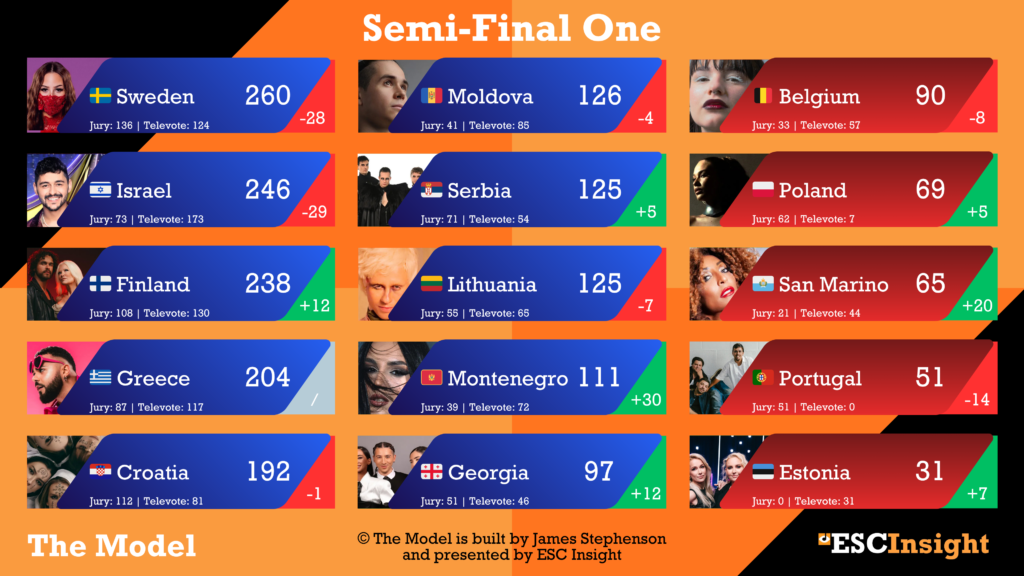
Semi-Final One from The Model – 23/03/2026 (James Stephenson)
As always, we begin with Semi-Final One. In these weekly updates, there won’t be an exhaustive breakdown of every country’s performance – instead, I’ll try to focus on the biggest changes and stories from each update.
Despite the tweaks to the backend, the frontend results are quite similar. ‘My System’ is still projected to be the favourite to win the first semi-final, although Felicia is now forecasted to score 260 points, 28 down from last week. Israel drops by a similar amount in second place, while Finland, Greece and Croatia follow as they did seven days ago. Finland, though, is the only entry to gain points week-on-week from the top five. Much like last week, Israel is projected to win the public vote, while Sweden leads with the juries.
The biggest adjustment comes in the qualification race, where we have a new song in The Model‘s Top 10: Montenegro. Last week, ‘Nova Zora’ by Tamara was just four points shy of qualifying. This week, they have gained 30 points to reach 111 and ninth place in this semi-final.
The change to the system has helped countries without a strong Eurovision track record. Montenegro, who haven’t qualified since 2015, is one of the biggest beneficiaries. Coincidentally, when Montenegro reached the Grand Final that year, it was also held in Vienna.
Tamara entering the Grand Final means that one country must exit. However, despite being in tenth place last week, Georgia has retained their position here. That means Belgium, represented by Essyla with ‘Dancing on the Ice’, is now forecast to come in 11th by The Model, seven points short of qualifying. If this result happened at Eurovision, it would mark Belgium’s third consecutive exit at the semi-final stage.
Throughout this semi-final, the positions of each country have shifted. Moldova and Serbia have each picked up a place, with both passing Lithuania in this projection. And, towards the bottom of the leaderboard, Poland and San Marino have moved up one place, while Portugal has fallen to 14th. Estonia remains in last place, although there is hope for Vanilla Ninja: they are seven points better off than they were in last week’s projection.
Semi-Final Two
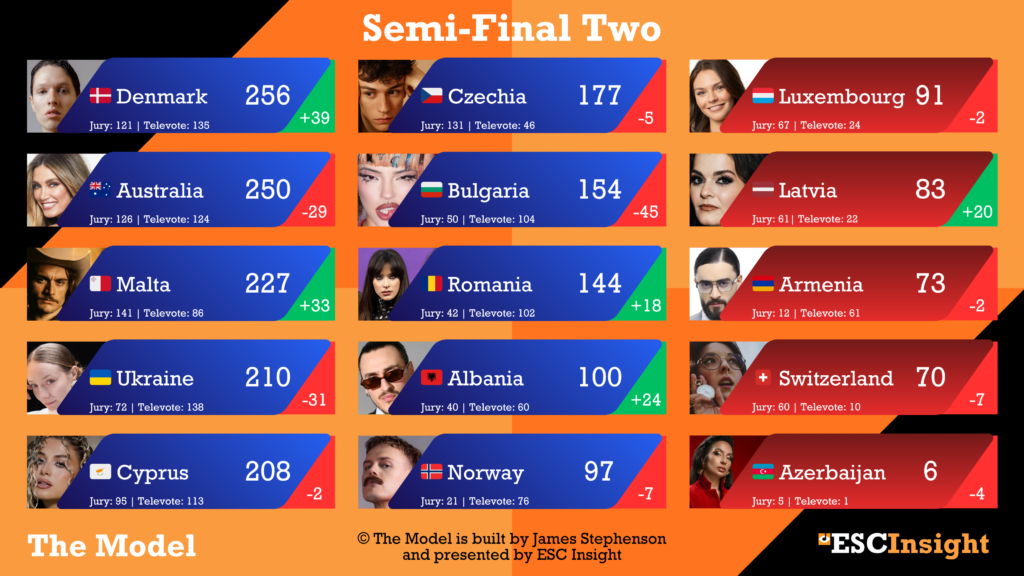
Semi-Final Two from The Model – 23/03/2026 (James Stephenson)
While the first semi-final has seen some shuffling, The Model projects far bigger changes in Semi-Final Two. We have a new projected leader, a new qualifier, and only three countries hold the same position in the standings that they did seven days ago. This Eurovision Song Contest, then, looks seriously unpredictable.
So, who is the new song at the summit of this semi-final? It’s Søren Torpegaard Lund for Denmark. His song ‘Før Vi Går Hjem’ rises from third last week to the top, scoring 256 points. That’s a 39-point increase on last week and, much like Montenegro, Denmark has benefited from the change in methodology. While they made the final last year with Sissal, who Søren beat in the DMGP superfinal, Denmark’s four previous misses have helped them climb in this version of The Model.
Denmark’s climb has pushed Delta Goodrem and ‘Eclipse’ into second place, with Australia losing a lot of their points directly to the Danes. Behind them, the biggest climbers in this semi-final are Malta. Aidan rises three places into third, and his song ‘Bella’ is now projected to win the jury vote here with 141 points.
Overall, Malta has risen by 33 points, while Ukraine falls by 31 points and two positions into fourth, although Leléka is still seen as the televote favourite.
In the mid-pack, positions shuffle around: Cyprus falls by one place, Bulgaria by two, while Czechia shifts up from seventh to sixth. After Romania, who stay in eighth despite an 18-point increase from last week, we have our second new qualifier of this update.
This one is an even bigger shift than Montenegro, too: Alis from Albania has risen three positions to ninth, with a score of 100 points, taking his song ‘Nân’ into the Grand Final. With Norway holding onto the final qualifying spot, Albania’s climb means that Luxembourg is now projected to miss out. ‘Mother Nature’ from Eva Marija has only lost two points in this update – but Albania’s climb has seen it lose its place in this simulation.
The Model is projecting the race for the Eurovision final on Thursday night to be really tight, too. Even Switzerland, who sit in 14th place in this update, is only 27 points behind Norway in tenth – this is set to be close.
Grand Final
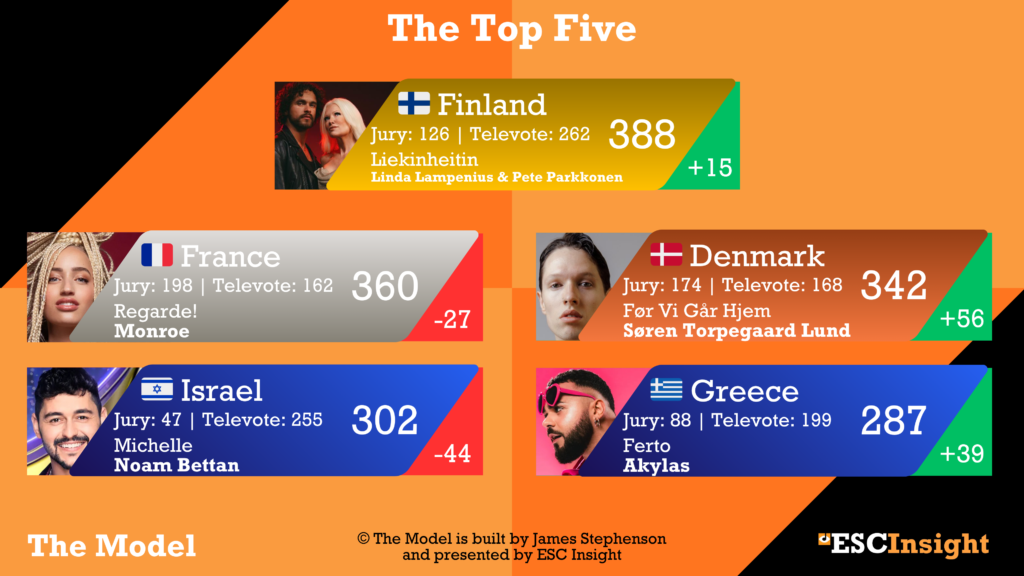
The Top Five from The Model – 23/03/26 (James Stephenson)
How about that new leader?
Many were surprised last week when The Model didn’t project Finland first. Given its large lead in the current betting odds, it’s been seen as the favourite in the fandom for some time.
Although the methodology change this week has made a difference, Finland isn’t actually the biggest beneficiary – far from it. Finland’s Eurovision track record in recent years has been impressive, most notably with ‘Cha Cha Cha’ in 2023 and ‘Dark Side’ in 2021, achieving high places. What’s made the difference is a decline in points for France and an even bigger one for Sweden, with ‘My System’ losing 138 points and dropping to sixth, completely off this graphic.
‘Liekinheitin’ still has a similar points spread then, with 262 televote points carrying it to a victory despite a very low 126 in the jury vote. Although there are two fewer nations giving out points in 2026, that would still put Linda & Pete lower than ‘Cha Cha Cha’ with the juries. There have been rumours that Linda Lampenius, a world-famous violinist, wants to play her instrument live at the Contest – you would imagine that the jurors would very strongly take that into account when giving their points.
What’s notable about this projection, though, is not just Finland – it’s the pack of contenders circling them. By my estimations, as many as eight countries have at least a slim chance of taking the Eurovision Song Contest crown at this moment in time – the wide points spread suggests a potentially chaotic voting sequence in Vienna.
‘Regarde!’ from France is seen as the biggest challenger by The Model for now. It has the most jury points in this projection, although 198 would be the lowest score for a jury winner in Eurovision’s modern voting system by some distance. To win, France will have to put together a jury score at least in the ballpark of Finland’s 262-point televote.
‘Før Vi Går Hjem’, though, appears to have the benefit of consensus. Much like Felicia and Sweden when they won last week’s simulation, Denmark could benefit from relatively equal support from both voting bases. 174 jury points and 168 televote points is a great foundation for success – but at this stage, Denmark may be relying on underperformance from others to become the first Eurovision song to triumph without winning the jury vote or the public vote since Duncan Laurence in 2019.
‘Michelle’ and ‘Ferto’, who place fourth and fifth, will both have to rely on a strong televote to claim victory. Israel won the televote last year, of course, but recent history has shown a trend of the juries being less likely to lend them their votes. Greece’s Akylas definitely has a chance of hoovering up a huge televote, too, but unlike Baby Lasagna, Joost Klein or Tommy Cash, is this the fun song that will earn serious jury support to win?
The Model also has Ukraine’s ‘Ridnym’, currently in eighth, as a stronger public vote contender. However, that song scores much more strongly with the juries across the data, meaning it could have a better chance of impressing there and generating the consensus it needs. Sweden’s song definitely has that consensus, but Felicia’s problem may be fighting out her Nordic neighbours on both sides of the vote.
The potential dark horse? It could be Delta Goodrem. ‘Eclipse’ plays more to the juries, giving it an edge, and a recent performance at the Nordic Eurovision Party has already generated strong buzz for Delta’s live vocals. If the betting odds and the fans react positively, this could be a song that climbs up and carries a real threat. It could also make the field even more congested, meaning fewer points on offer and a much tighter Eurovision voting sequence.
I don’t know if all of that will happen. What I do know? This race is going to be a rollercoaster.
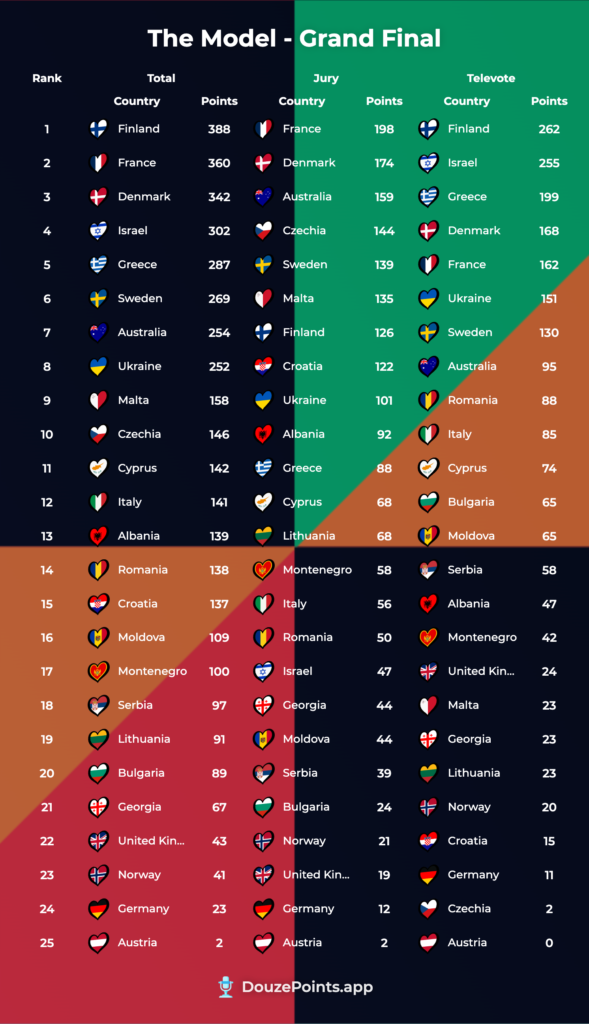
Full Split Results from The Model – 23/03/26 (James Stephenson / DouzePoints.app)
With The Model’s latest update, Finland has replaced Sweden at the summit – and that could change again. Weekly updates will show the rise and fall of entries as we learn more, including seeing live performances, learning show running orders, and discovering the all-important stagings.
If you don’t want to miss any regular weekly updates, read The Model on ESC Insight every Monday from now until the Eurovision Song Contest 2026. And, if you want to find out more about The Model works or just nerd out about the numbers, we have something special for you.
For the first time, The Model has a companion podcast! ‘Inside The Model’ takes you deeper into the numbers with all the updates, analysis of songs as you’ve never heard before, and guest appearances from some of the most notable names in Eurovision. Our latest episode with ESC Insight’s Samantha Ross is out now, where we analyse why Finland’s hit the front, the chasing pack of Eurovision contenders, and we have a Q&A about how The Model works!
Finland leads – but who will next week? See you then for the next update from The Model.