




The Model, a Eurovision Song Contest prediction tool, has picked out Sweden as the current favourite to win if the competition was held today.
Designed by James Stephenson, and now appearing on ESC Insight, The Model has returned to predict the Eurovision Song Contest 2026 – and will be making weekly updates to its forecast from now until this year’s shows.
In its first forecast, announced live last night on the ESC Gabe YouTube channel, The Model has Felicia and her song ‘My System’ in the lead – but in a Contest that could be tighter than almost any in recent memory. Felicia is projected to score 407 points for Sweden in this prediction, but France and Finland are only 20 and 34 points behind in second and third place, respectively.
Although it’s early days, it appears as many as eight songs could have at least a remote chance of the Eurovision crown.
In this first update of The Model, we’ll analyse:
- How Sweden could have a route to Eurovision victory
- The first projections of each of the semi-final qualifiers
- Why Eurovision 2026’s voting could work differently to previous contests
What Is The Model?
The Model was built to answer a simple question: “If the Eurovision Song Contest was held today, who would win?” To do that, The Model turns opinion into data in the lead-up to the Contest to create weekly updates on how the race to Vienna is shaping up. The tool has frequently been more successful in predicting the Contest than betting odds, fan polls, or any other indicator.
This year, The Model is bigger than ever before, with new updates released every Monday from now until Eurovision 2026 on the ESC Insight website, where the results will change and evolve as this year’s Contest comes closer. A new companion podcast, ‘Inside The Model’, is also launching on the ESC Insight feed, providing weekly prediction updates, unique song analysis, and special guest appearances from the world of the Contest.
Now, it’s time to dive into what The Model says would happen if the Eurovision Song Contest were held today, March 16, 2026.
The Model, for Monday March 16, 2026
Semi-Final One
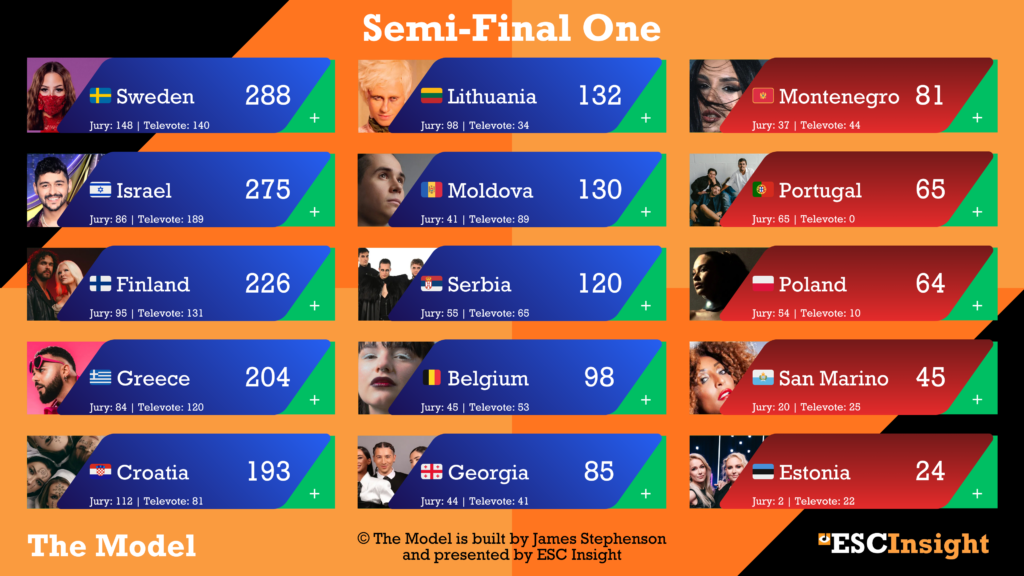
Semi-Final One from The Model – 16/03/2026 (James Stephenson)
We start our first forecast of 2026 with Semi-Final One of the Eurovision Song Contest in Vienna. As with Thursday, 15 entries are competing for ten spots in the Grand Final: according to The Model, it’ll be a close race across the leaderboard.
At the top of its projections for Tuesday, we find Felicia. Sweden leads the jury voting (back for 2026 – more on that later) with 142 points in this projection, while also scoring 140 from the televote. It appears that Sweden might not be just the televote juggernaut many expected; The Model‘s calculations see ‘My System’ has relatively equal appeal with both national juries and the voting public.
Following Sweden is Israel, with Noam Bettan’s ‘Michelle’ surging into second on the back of the kind of high televote numbers that Eden Golan and Yuval Raphael have received in the past two years. The more notable story is Finland, who find themselves third in this semi-final projection – ‘Liekinheitin’ from Linda Lampenius & Pete Parkkonen is the significant favourite with the betting odds. However, in this projection Finland only takes 226 points overall, and even finishes behind Sweden in the televote, which many think will be Finland’s major strength.
Akylas’s ‘Ferto’ is in fourth place for Greece on 204 points, with Croatia projected to come fifth in this semi-final through a strong jury performance for ‘Andromeda’ by Lelek. Both of these songs show the power of appealing strongly to either side of the vote. ‘Ferto’ is seen by The Model as having far more appeal to the public vote, while ‘Andromeda’ goes the other way and is viewed as a jury darling. Their points almost mirror each other.
The rest of the qualifiers: Lion Ceccah is forecasted to ride a wave of jury support into sixth for Lithuania with his song ‘Sólo Quiero Más’, Moldova make it to the Grand Final on their return to Eurovision after a year’s absence – ‘Viva, Moldova’, indeed – and Serbia is also forecasted to make the final with metal song ‘Kraj Mene’.
Ninth and tenth place, however, are less confidently projected. Belgium takes the former spot with ‘Dancing on the Ice’ projected to get enough support from both bases to get over the line, while The Model has Bzikebi’s ‘On Replay’ as being the most likely to snatch the final qualifying spot for Georgia: but by only four points.
And, according to The Model, that leaves five songs who are currently forecasted to fall short of Saturday’s final in Vienna. ‘Nova Zora’ from Montenegro is four agonising points short from being the country’s first qualification since the Contest was last in Austria, and behind them Portugal’s ‘Rosa’ and Poland’s ‘Pray’ both have good jury scores, but poor public votes. Portugal, in particular, scores 0 points from the public vote in this projection.
Senhit and ‘Superstar’ are predicted to fall into fourteenth for San Marino – with or without Boy George – and Vanilla Ninja from Estonia are seen as a firm last place for now with ‘Too Epic to be True’ on only 24 points.
Semi-Final Two
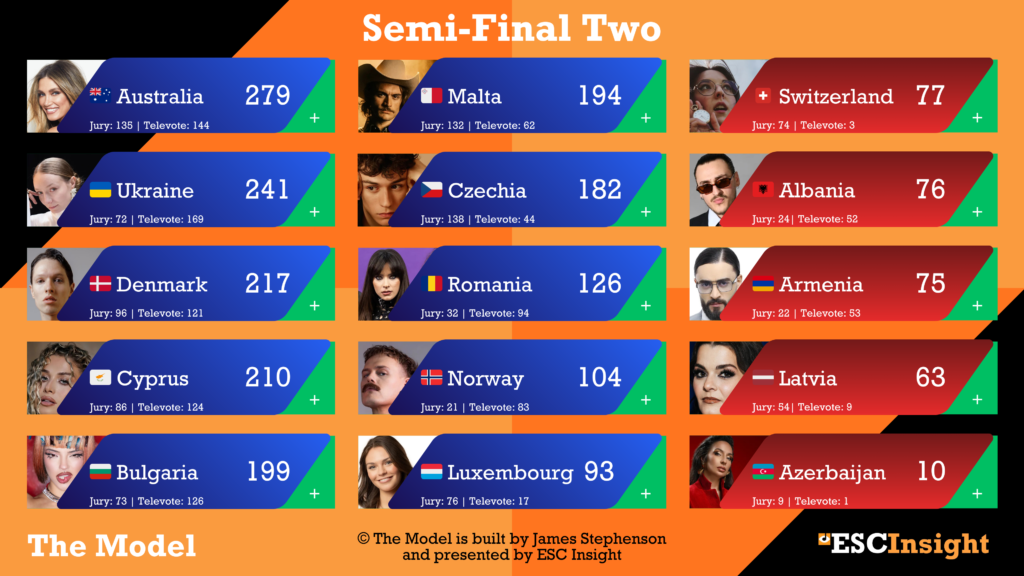
Semi-Final Two from The Model – 16/03/2026 (James Stephenson)
Now, we shift our attention to Semi-Final Two. So far, it appears this show will be more open than Tuesday’s, with most of the betting favourites competing that evening. That means the points are more spread out across the board, and the qualification race appears very difficult to predict.
The Model’s prediction for the winner is another potential surprise – it has Australia out in first. Delta Goodrem is one of the bigger stars to enter Eurovision this year, with one of the best vocals, and it seems like a real return to form for the Contest Down Under is coming. Her song ‘Eclipse’ is projected to be jury runner-up in this semi-final with 135 points, paired with an impressive 144 points from the public, to lead on the night with 279.
Ukraine is the projected runner-up, with Leléka and ‘Ridnym’ winning the public vote in this semi-final with 169 according to The Model. And, much like the first semi-final, the odds favourite from this show is in third. That’s Denmark, with ‘Før Vi Går Hjem’ from Søren Torpegaard Lund expected to face a similar fate to Finland in midweek. Denmark loses out to Australia on both jury and televote, but a lot of that can be explained by Denmark losing key allies like Sweden and Finland in this semi-final.
Denmark scores 217 points in this projection, and fourth-placed Cyprus is only seven behind as ‘Jalla’ shows its potential strength in Vienna. Behind Antigoni is another solo female with a pop song in Dara; she’s forecasted to take Bulgaria back to the final comfortably with ‘Bangaranga’, which gets more points from the public than Denmark in this simulation.
In fact, The Model predicts that all three returning countries to the Contest this year will make the final. That would mark not just a great return on re-investment, but reflect the Contest’s move eastward, with four of the five boycotting nations in 2026 coming from Western Europe.
Two songs that look to be real jury magnets take the sixth and seventh spots in this semi-final projection. ‘Bella’ from Malta and ‘Crossroads’ from Czechia are both seen as having much more appeal with the juries than with the public, and have aggressive points splits even in a semi-final. In fact, Czechia is the surprise projection to win the jury in this semi-final with 138 points. Both songs are male solo ballads, with Aidan and Daniel Zizka the men forecasted to take their nations back to the final after multiple years away.
Despite controversy around its lyrics, Romania is projected to make it through in eighth with the punk-rock track ‘Choke Me’ from Alexandra Căpitănescu for now. Behind them, though, the numbers begin to get extremely tight, with just 39 points between ninth and fourteenth place.
At the moment, The Model sees Norway and Luxembourg as the last two qualifiers. Jonas Lovv’s ‘Ya Ya Ya’ is projected to make it on the back of strong televote support, while Eva Marija’s ‘Mother Nature’ benefits from an impressive jury showing to sneak into Saturday in this forecast.
If that projection held true, that would mean Switzerland misses its first final since 2018. Veronica Fusaro would be in unlucky eleventh place with her song ‘Alice’, currently 16 points away from getting through. And, behind Veronica, it’s astonishingly close: Albania’s Alis is a point behind with his emotional ballad ‘Nân’, with ‘Paloma Rumba’ from Armenia only one further point behind.
While Latvia is projected to come fourteenth, 63 points is a really strong showing for a country in that position, and Atvara is definitely in with a chance of qualifying with her song ‘Ēnā’. One song The Model is not confident in, though, is Azerbaijan’s. ‘Just Go’ from JIVA has faced accusations on social media of AI use, denied by the country’s broadcaster, but a score of just 10 points in this projection means they look to have a lot of work to do.
Grand Final
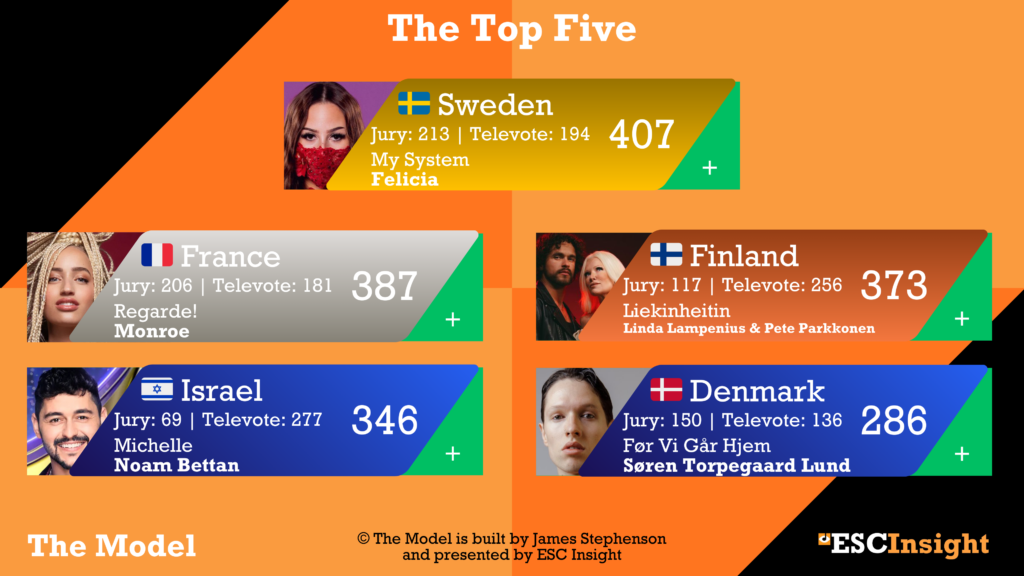
The Top Five from The Model – 16/03/26 (James Stephenson)
Let’s cut to the big question. How could a song that is sixth in the odds as I write this be the projected winner of the Eurovision Song Contest?
To answer that question, we need to understand what type of Eurovision this is, and how that changes what the path to victory can look like.
In previous contests, the path to victory was pretty simple: you could be very strong in either the jury vote or the public vote, but you needed support from both bases. In 2023, for example, this was the reason that Loreen could win with 340 jury points, but Käärijä couldn’t with 376 points from the public.
However, that truth is more accurate in contests with strong favourites. That year, in particular, always felt like a dead heat between Sweden and Finland for the crown. Today’s Eurovision has fewer countries and fewer points available, and the recent trend has been for those points to be spread out more across the line-up. Because of this, there is more room for songs that have larger splits in support to do well – see Switzerland last year, for example, which got a Top 10 finish despite getting no points at all from the public.
Adding to that, the public vote has become compressed. The consistently high public vote scores for both Ukraine and Israel in recent years means that there are simply fewer points on offer. The biggest losers of that are the big public vote favourites, and in 2026, that is Finland hands-down. Finland’s projected to get 256 points from the public vote in the final, which is a high score. However, with Israel projected to score more points by The Model at the moment, that is the difference between 256 and a potential 300+ score if they weren’t up against them.
If the public vote is compressed, then it’s more important than ever to play well in the jury. Nemo and JJ have rode jury victories to the Eurovision crown despite their public vote scores not being groundbreaking. For The Model, France is the song that has the best chance of following that path to success. ‘Regarde!’ is the clear contender from the newly-named Big Four, and The Model actually sees it as having more consensus support from both bases than the last two winners. In theory, this is a perfect combination for victory – but it’s 20 points short of Sweden. Why?
Consistency. The new keyword for Eurovision Song Contest success.
Finland will score a lot of 12s in the public vote. France will score many with the juries. But what The Model shows is Felicia doesn’t need to win by hoovering up douze pointe – the narrow path to victory ‘My System’ could straddle is based on picking up the lower points, almost all of the time.
While opera is getting more popular at Eurovision, the genre will always put off some. And, when it comes to Finland’s entry ‘Liekinheitin’, The Model sees a clear weakness in its ability to pick up jury votes. These songs, then, have roadblocks to the crown; Sweden has the opposite. Expected support across both bases, and with dance-pop, the most reliable genre in the Eurovision Song Contest. That means, in a year closer and more spread out than ever, 12s aren’t enough anymore. Who’s always there getting the 4s, the 5s, the 6s and 7s? That could be the answer to this year’s winner – and, right now, that answer is Felicia.
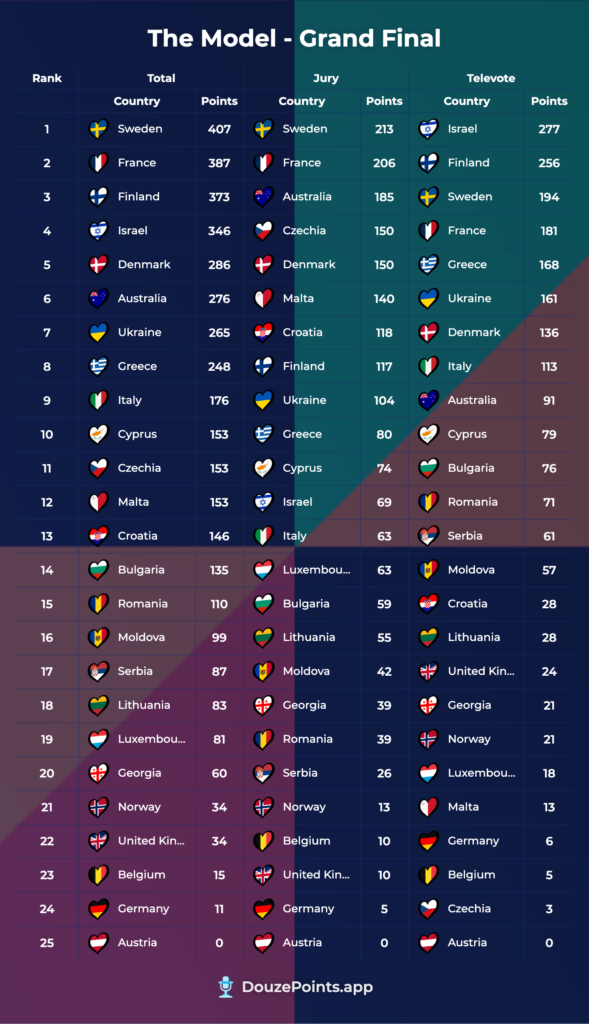
Full Split Results from The Model – 16/03/26 (James Stephenson / DouzePoints.app)
Further down the list, there are several stories that The Model is forecasting. There’s Italy, who are predicted to come in ninth if Eurovision were held today, with 56-year-old Sal Da Vinci leading the charge with his infectious ‘Per Sempre Si’. There are big splits between Malta and Czechia: powerful jury performances and poor public vote showings. And, perhaps most notably, The Model calculates that Look Mum No Computer can do what nobody in the United Kingdom has done in three years – score a televote point at Eurovision!
If you want to see what this result would have been like to experience on Grand Final night, you’re in luck. For the live reveal, we turned The Model’s first projection into a voting sequence. You can watch the numbers go up here:
Those are all stories that The Model will be charting as the race to Vienna gathers pace. With the first forecast in place, Felicia and Sweden are on top – but that could change. Weekly updates will show the rise and fall of entries as we learn more information, like seeing live performances, learning show running orders, and discovering the all-important stagings.
If you don’t want to miss any regular weekly updates, read The Model on ESC Insight every Monday from now until the Eurovision Song Contest 2026. And, if you want to find out more about The Model works or just nerd out about the numbers, we have something special for you.
Eurovision Insight Podcast… Inside The Model: The Race to Eurovision 2026 Begins
For the first time, The Model has a companion podcast! ‘Inside The Model’ takes you deeper into the numbers with all the updates, analysis of songs like you’ve never heard before, and guest appearances from some of the most notable names in Eurovision. You can listen to the opening episode now, featuring an appearance from ESC Gabe as he reacts to The Model’s first forecast moments after presenting it.
Sweden leads – but who will next week? See you then for the next update from The Model.