




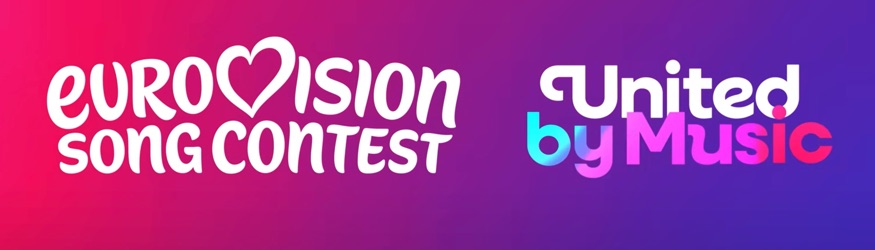
The Eurovision Song Contest is changing. It changes every year, but some things have been constant over the last decade. When we last visited Austria in 2015, the Eurovision logo was updated. As we prepare to head to Austria once more, the EBU has announced that the logo will once more be updated… but this is more than a tweaked font.
Why has the EBU taken its long-established identity and made the contentious decision to change the brand?
The Eurovision Song Contest’s Brave New World
Speaking to ESC Insight ahead of the launch, Martin Green and the team behind the rebrand noted some of the key reasons for rebranding the Song Contest.
These include connecting to new audiences around the world, especially the online audience, and unifying Eurovision’s identity across multiple media channels. From the organisation’s perspective, it certainly creates a more secure foundation if you are going to expand the brand in the future. Perhaps there’s also an unspoken bonus of looking to move on from the controversy of the last few years?
The new look, Martin Green says, is designed to be “bold, playful and full of heart”. Obviously, the bright blues and pinks pop from the screen, and the twist on Eurovision’s heart logo gives fresh focus. Not only is the aim for this to be “clearer on digital platforms”, it will be a uniting and potentially more prominently used logo going forward, as the objective is to “bring our family of projects all into one space, and protect the brand globally for EBU members.”
United By Presentation
The media landscape has changed since the last rebranding in 2015. Since then, how brands interact with the online world has become even more critical. A strong and recognisable identity is needed, and it needs to work in many locations. The brand’s logo has to work as a tiny YouTube thumbnail on a phone, right up to spanning a performance stage nearly 70 metres wide. It must appear as designed in square, vertical, and horizontal orientations, and as both 2-D and animated formats.
As the online world evolves, so must a brand. Arguably, it would be more damaging to the Song Contest if the brand did not change with the times.
Stronger Protection
The new brand also takes ownership of various elements that can be protected, most notably in the new font. Singing Sans has been developed exclusively for the Eurovision Song Contest brand, and we’re going to see it a lot. I’d be interested to know if a design patent for the font will be applied for to gather some legal protection around its use.
The various assets used to identify the Eurovision Song Contest are used by many, from the EBU and the host city, the broadcasters, and the broader media. No doubt there will be a refresh on the guidelines for using the brand in marketing, reporting, and promotion. These may be tightened up as the public sees the Song Contest grow into new areas and become more than an annual show.
Progress Is Eurovision’s Middle Name
The EBU is planning to make the seventieth edition of the Eurovision Song Contest a keystone in the rejuvenation of the Contest—a rejuvenation given more impetus following the strategic changes approved by the Reference Group after a wide-ranging consultation in the summer of 2024.
Pairing this milestone edition with the new branding sends a signal that the Song Contest is changing. With the brand changing across all of the old- and new-media properties is a unifying action that thematically reaches beyond the JPGs and GIFs and into the fabric of the Contest itself.
With the EBU looking to go beyond the borders of one night on European television, then a new brand can also heighten the connection between these new endeavours and the classic chansons of the Contest.
One potential issue around the new brand may be the identity of the host city. While the key information will be lifted underneath the wordmark—last season Basel 2025 would have been prominent—the individual brand and theme for a Contest may be diminished in favour of the EBU’s all-encompassing look. That will be useful if you are on a tight budget for hosting but does reduce the individuality of broadcast.
The branding isn’t the only area where a steady consistency has replaced the more vibrant and volatile Contests of the early 21st century. It is another step towards a more corporate approach, though, which some in the community fear will lead to a more clinical Contest.
Thankfully, for everyone with the heart tattoo your friendly artist just needs to thicken the lines a bit and tweak the outside shape. That should only take an hour or so.
The Impact On The Community
In essence, this rebrand is being promoted as a modernisation of the Eurovision Song Contest identity; the core product underneath remains the same.
The relatively recent rebranding of the BBC followed a similar process. According to its own research, “audiences think some of our services look old-fashioned and out of date . . . They want a modern BBC that is easier to use and navigate to find the content they love and enjoy”.
This style of rebranding is seen as one of the most accepted types of rebranding, as noted by Anna Frisk & Andreas Kovacek in their paper ‘The Power of Change, a Study Of How Rebranding Influences Consumer Attitude’:
“Since nothing in the core offering had changed, this type of rebranding was regarded as acceptable. Even though they felt some disappointment in the loss of the nostalgia-filled packaging, the participants felt that it was necessary and that it would probably happen again in the coming years…All in all, this was the most accepted type of rebranding, and it had no noticeable influence on our participants’ attitudes.”
One of the strengths of the Song Contest is the community that has built up around the Contest, a community that is active all year round. For many, their social identity online heavily features the Contest. How much can a brand change impact how the community identifies with it?
A recent study on the rebrand of Dunkin’ Donuts to Dunkin (Meghan Lynne Gaskill (2019) ‘Social Identity Theory and Rebranding: The brand formerly known as Dunkin’ Donuts’) suggests that there will be levels of nostalgia for the older brand:
“These participants experienced a slight negative shift in brand perception based on Dunkin’ Donuts’ rebranding to Dunkin’, suggesting that the rebranding had a negative impact on social identification with the brand.”
It’s relatively easy to measure the impact on a retail brand such as Dunkin’. Have the sales held up? In the case of this rebrand, Gaskill found that, because the product had not changed (coffee was still coffee, donuts were still donuts) there was no change in the purchasing behaviour:
“Because there was no reported change in purchasing habits and brand loyalty, social identification was not impacted in this manner based on Dunkin’s rebranding. “
There is going to be some loud and vociferous pushback from the Eurovision Song Contest community to the new brand, but the Song Contest remains a product that is selling something; with a bit more emotion than a donut. The community’s reaction is surely going to follow the same lines with the same results.
Love Still Shines A Light
As mentioned, the Eurovision Song Contest is an ever-changing beast. That’s obvious in the visual presentation on television, but also in the visual presentation of the brand and the logo. From the heavily Sergio Leone spaghetti western look of the first logo in 1956, through the radial lines of the sixties and seventies, to the introduction of the heart in 2001, and beyond, the Song Contest has always changed its look.
Yet through all of that, the core of the Eurovision Song Contest remains. Music will connect the countries and the continents, friendships will be forged, everything around our favourite show will evolve… with our heart at the centre.
Further Reading
- Anna Frisk & Andreas Kovacek (2024) “The Power of Change: A Study of How Rebranding Influences Consumer Attitude”, Kristianstad University Faculty of Economics.
- Meghan Lynne Gaskill (2019) “Social Identity Theory and Rebranding: The brand formerly known as Dunkin’ Donuts,” Virginia Polytechnic Institute and State University.
- Dr. Kishore Kunal (2023), “The Impact of Corporate Rebranding on Customer Perception: Evidence from the Textile Industry‘ ( Journal of Informatics Education and Research, Vol 3, Issue 2.