




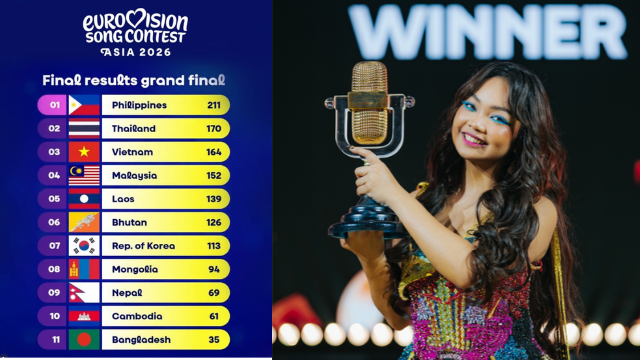
The final results of Eurovision Asia (Photo: eurovisionasia.com)
The Philippines Win
Congratulations to the delegation from the Philippines for their victory at the Eurovision Song Contest Asia.
‘Sobra-Sobra’ was the winner with both jury and televote.
With the juries, ‘Sobra-Sobra’ received douze points from half of the participating nations, ten points clear from Vietnam, with Malaysia one point behind.
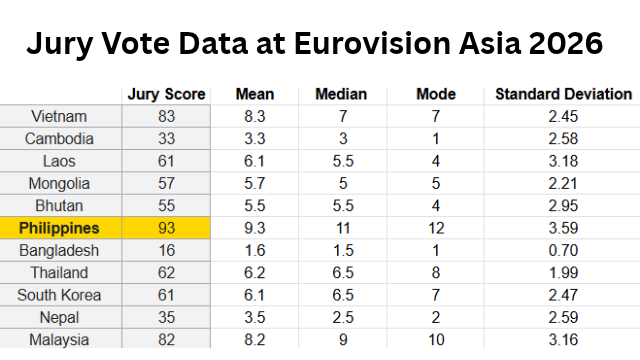
Despite that strong support, in terms of point distribution per country the Filipino entry is recorded as having the highest standard deviation of all songs. The standard deviation is a measure of how spread the data is, and low rankings from three countries (Vietnam, Malaysia and Thailand) pulled the Philippines back despite all other participants placing ‘Sobra-Sobra’ in the top two.
In the end it was Thailand, Vietnam, Malaysia that ultimately placed second, third and fourth at Eurovision Asia in its debut year.
CARMELLE also stormed the televote, scoring 118 points from a possible total of 132. While, at the time of writing, no breakdown of points awarded per country has been made available, a possible configuration is that the Philippines scored five sets of 12 points, five sets of 10 points and a solitary set of eight points – which would add up to 118.
This means the Filipino entry received 89.4% of the maximum televote total. Only Ukraine’s victory in 2022 (93.8%) is more in the history of the Eurovision public vote.
Thailand’s Agreeability
While Bangladesh was a distant last on the scoreboard, with the highest jury placing having ‘Tumi Ele’ third-last in their ranking, it’s notable the next lowest standard deviation score is for the Thai entry ‘Aroma’. By convention, we would expect songs of much agreement in ranking to be better contenders on the jury side of the scoreboard, and those that are more divisive to be better in the televote.
A good comparison here would compare the entry from Thailand to that of Laos, as ‘Bae’ scored just one jury point less than ‘Aroma’ but with a larger standard deviation, having received one douze points from the Vietnamese jury but just two points from Nepal. The Thai entry was ranked between 3rd and 6th by nine of the competing juries.
However the televote results defied the statistical expectation, as it was ‘Aroma’ that joined the Philippines in getting over 100 points from the public.
Other than the obvious “the public liked the Thai entry” rationale, we propose two theories that would make this more likely to happen at Eurovision Asia compared to other shows. Firstly the voting system required people to vote for at least three entries. If people at home are anything like jurors were, the Thai entry would be sneaking into many viewers 3rd or 4th place rankings – traditionally enough to miss out on a televote – but in this system a huge beneficiary of support votes.
The other theory is that there was a significant difference in the performance from jury show to public broadcast. Daou’s microphone fell off during the performance, but they still tried their best to deliver an emotive performance. Could that mishap, and his perseverance during the song’s climax, have brought more support votes for the Thai participation than the jury ranking may suggest?
How Did The Online Vote Look?
This debut of the Eurovision Song Contest Asia was a debut of the new voting system, where votes were cast online with each user receiving eight votes for free, as long as they were split amongst at least three songs, before having the option to buy more votes after that.
We at ESC Insight were curious how the distribution of points would be different at Eurovision Asia using this system. Here, we’ve compared this system to the Semi Finals of Eurovision 2026, albeit only the top 11 in the televote rankings in those shows, as well as the top 11 at Junior Eurovision 2026 as well.
The results of that comparison are shown in the following graph.
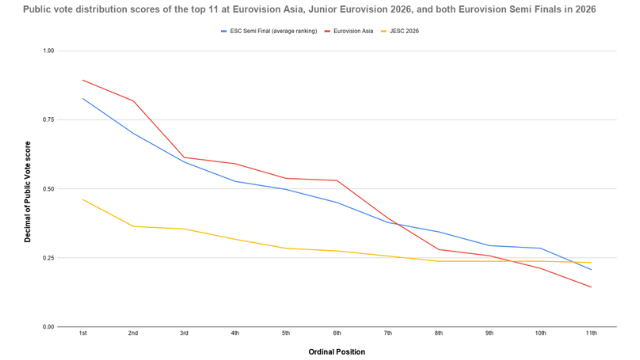
Distribution of the public vote differences for the top 11 at Eurovision Asia, JESC 2026 and the 2026 Eurovision Semi Finals (Image: Ben Robertson, ESC Insight)
This comparison shows the distribution of televote points between the Eurovision Asia, Junior Eurovision and this year’s Eurovision Semi Finals.
Junior Eurovision, like Eurovision Asia did, has an online voting system where one has to vote for three songs. The main difference between Junior Eurovision and Eurovision Asia is that the Junior Eurovision runs on a proportional voting system across all voters, whereas votes in Eurovision Asia are divided up country-by-country and Rest of the World.
This creates the traditional 1-12 Borda count system that is Eurovision folklore. It is therefore little surprise that Junior Eurovision’s distribution is significantly flatter than the other two shows.
What is notable though is that it appears Eurovision Asia’s system makes the televote even more spread than at the Eurovision Song Contest. The gradient of ESCA’s points distribution is steeper than the gradient of this year’s Eurovision semi-finals, meaning the better songs scored more points at the top, and the bottom was pushed further down.
We did anticipate with this voting system that you would be likely to witness more televote cohesion as good entries that might place 2nd or 3rd in somebody’s ranking also receive votes, creating stronger agreement between voting bases.
However, before jumping to conclusions on that for any possible application at the Eurovision Song Contest, we need to consider some differences first.
Firstly, using the jury vote as a small proxy of behaviour of Asian public voters, there appeared to be little obvious voting patterns between neighbouring countries, which would reduce any overall cross-continental correlation.
Secondly we have to also consider that there was a clear gulf in competitiveness between the top and bottom of the table at Eurovision Asia. While ‘Bangaranga’ did much better with the televote than ‘Mother Nature’ did this year, ‘Mother Nature’ placed eleventh with the Semi Final televote, not last, and the comparative difference between top and bottom of the leaderboard in terms of song quality must be considered.
Nevertheless, if Eurovision Asia is foreshadowing a future for the Eurovision Song Contest, we can cautiously expect the televote to have more sway than before. It could be argued that is necessary – the last four years have seen the jury winner ultimately result in being the winner of the Eurovision Song Contest.
The last note on the jury/public vote split to note that the correlation of jury scores to public vote scores is a value of +0.81. That shows that jury vote and public vote was highly aligned – more than at any Eurovision Song Contest since separate jury and public voting was created. The same caveats as above about song quality apply, but does enabling public voters to easily and seamlessly vote akin to a juror and distribute various points…turn the public vote more into a jury ranking after all?
Either way, Eurovision Asia has produced a fascinating result. Now the question is whether Eurovision Asia, and this voting system, will return again in the future.