




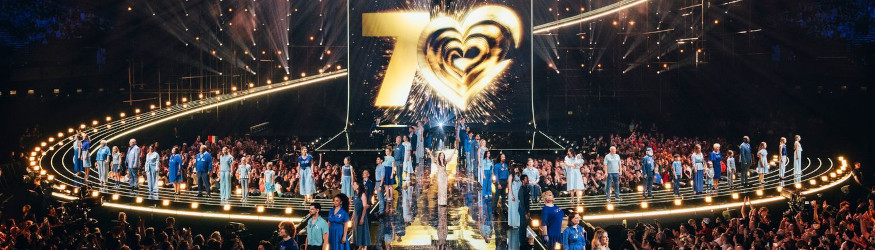
At its heart, the shows this year are love letters to the fans after seventy years of music and community. Brief interludes and the interval will show testimonials from lovers of the Contest, including previous contestants, crew, fans, and more, as well as lessons from “Professor Eurovision” in history and statistics, plus trivia from classic ESC entries. Those little moments of embracing the contest’s decades of institutional memory are all over the place, from welcoming back past legends to particular moments in the Moldovan and Greek staging that will make you go…

We’ll have fifteen songs vying for the usual ten places in Saturday night’s Grand Final, all hoping to garner favour from both the televoting public and (for the first time since 2022) the juries from the nations performing tonight. We welcome Moldova back into the fold, following its one-year absence. In addition, we’ll see exhibition performances from Italy and Germany, although they will not be voted upon. If you’re watching from any other nation beyond the seventeen you’ll see tonight, you are welcome to vote, although your votes will be aggregated into the “Rest of the World” tally.
When it comes to the reveal of those points, by the way, it appears that the producers have reverted to the classic announcement process, where our hosts will simply list out the lucky ten qualifiers, as opposed to the format piloted last year where three hopeful acts were shown on a tense split-screen, waiting on tenterhooks to hear their fates. We may miss the drama, but this will keep the show’s timing streamlined and prevent dwelling on a delegation’s stress and agitation.
Familiar Faces
For the fans among us, there are more than a few familiar names on the roster of performers in this show. We’ll open the show with a true evergreen, L’amour est bleu, performed by Vicky Leandros herself in the city that hosted the contest back in 1967. Even though Vicky would end up winning the contest in 1972 with Après toi, her first Eurovision song, despite becoming a massive international smash, didn’t even make the podium here in Vienna.
Later on, during our interval act, we’ll see a piece featuring last year’s Australian representative, Go-Jo, helping differentiate Austria from his home country. It should be noted that Australia made its competitive debut at the Contest in 2015, the last time we gathered in Vienna. (It should also be noted that Australia will be performing in the second Semi-Final, so any issues of promoting an act in contention should be minimised.) Looking at both him and Vicki, we’re reminded that you don’t have to clinch a trophy to come home from Eurovision as a winner.
When it comes to the actual songs in competition, we welcome back Senhit, the two-time Eurovision representative for San Marino (in 2011 and 2021, plus the cancelled 2020 contest), as well as Vanilla Ninja, the Estonian pop-rock group who represented Switzerland in 2005. Alicja was Poland’s intended singer for the cancelled 2020 contest, so it’s wonderful to see her finally get her shot on the international stage. Georgia’s trio Bzikebi were the winners of the 2008 Junior Eurovision Song Contest, and the now-28-year-old performers have grown up quite a bit since Bzz…. Meanwhile, eagle-eyed viewers may recognize the face and voice of Moldovan backing singer Aliona Moon, who not only supported Pasha Parfeni in 2012, but also represented the country in her own right in 2013 with O mie.
For the audience who are tuning in without that fanatical knowledge of Eurovision’s back catalogue of characters, two names may stand out. Fans of instrumental music may recognize Finland’s featured performer, violinist Linda Lampenius (also known as Linda Brava), whose nearly fifty-year career has spanned the worlds of pop, classical, and jazz, and brought her to appearances on reality TV shows in both Finland and Sweden, as well as a guest role on Baywatch, and even a profile in Playboy back in 1998. Coming up later in the running order will be Boy George, the frontman of 1980’s pop powerhouse Culture Club, providing a “wait-is-that-really-him?” cameo for San Marino’s entry Superstar alongside the aforementioned Senhit.
…and some Hidden Ones
Even with all of these lovely faces gracing our screen this week, this Semifinal also features two somewhat obscured visages. Lithuania’s Lion Ceccah performs his Sólo quiero más in full silver makeup that would make Jack Haley envious. Lion’s performances in previous Lithuanian National Finals have highlighted his ambitious and boundary-breaking aesthetic, often incorporating elements of drag into his costuming and makeup. Reflecting the song’s themes of finding one’s humanity in a world full of falsehood, Lithuania’s song is presented by a robot yearning for an existence beyond his programming. Let’s hope the ending is a bit more like The Wizard of Oz than R.U.R…
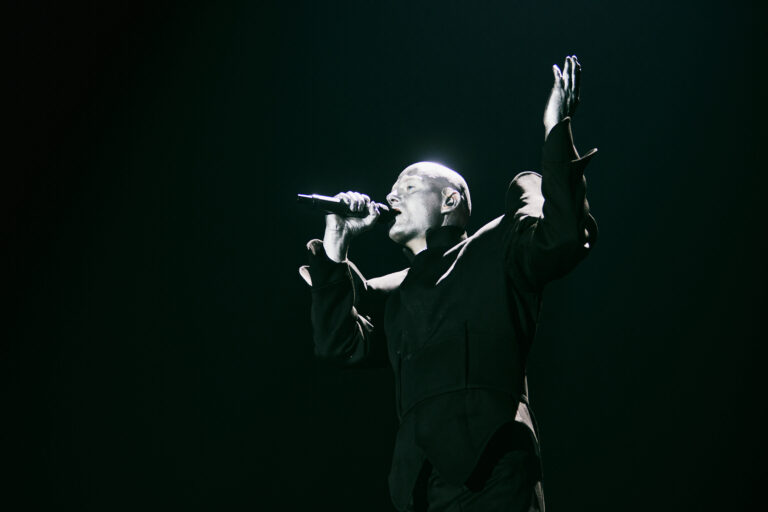
Believe it or not, this is a colour photo. Lithuania’s Lion Ceccah (Photo credit: Alma Bengtsson, EBU)
Meanwhile, in Sweden, singer Felicia opts to perform My System with her face partially obscured, either by a mask that covers her mouth or by a pair of oversized sunglasses. Before releasing music under her own name, she was previously known as “Fröken Snusk” and performed in a full balaclava, and after parting ways with the project last year she has maintained a level of secrecy. She’s been open with her struggles with anxiety and concerns over her privacy, and appearing without showing her full face allows her to perform while still maintaining the security she’s needing.
Strings of My Heart
Since the Eurovision Song Contest sunsetted the usage of a live orchestra following the 1998 event, onstage instrumentation has been purely decorative. Despite the stage being graced by artists who are deeply skilled in their musicianship, the music that audiences hear have been purely backing tracks since the final notes of Ne zori, zoro faded out in Birmingham.
This trend, however, was shattered last year when Italy’s Lucio Corsi played a harmonica held up to his vocal mic during his performance of Volevo essere un duro, bypassing any technical requirements and giving us the first audible live instrument on a Eurovision stage in nearly thirty years.
This year, Finland’s Linda Lampenius has taken things a bit further, having received special permission from the EBU to mic up her violin and play her portion of Liekinheitin live. As the instrument isn’t directly plugged into an amplifier, but rather simply mic’ed up, the violin doesn’t deal with the same issues that an instrument like an electric guitar would have.
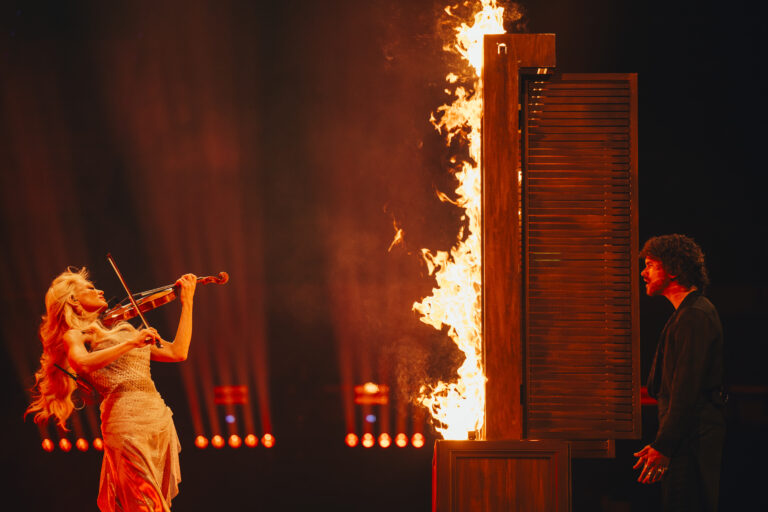
Linda Lampenius & Pete Parkkonen performing Liekinheitin for Finland during the First Rehearsal at Wiener Stadthalle, Vienna 2026 (Photo Credit: Sarah Louise Bennett / EBU)
This does fly in the face of previous musicians lobbying to do the same thing in previous years, like Slovenia’s Tinkara Kovać requesting that she be able to play her flute live in 2014, for example, or Albania’s Bledar Sejko wanting to play his guitar solo in Identitet live in 2013, but it will be very interesting to see how this paradigm shifts moving forward. This will be especially noticeable as at least two other acts this year, including Portugal and Luxembourg, will be miming their onstage violin performances. Will viewers pick up on the difference? Stay tuned…
Finland isn’t the only country to push the envelope when it comes to elements of their performance. I don’t want to give anything away, but keep your eyes open for some impactful staging from Croatia’s Lelek, Greece’s Akylas, Lithuania’s Lion Ceccah, Poland’s Alicja, Serbia’s Lavina…and this is just in the First Semifinal! Even the songs with somewhat “straightforward” staging utilize creative camera angles in ways that keep presentations from feeling stale. People looking for a traditional “park and bark” may find themselves disappointed.
Love (and Vocabulary) Unlimited
While countries participating at Eurovision have the freedom to perform in any language that an artist may choose, the lion’s share of the songs we generally hear at the Contest tend to be either in English or in one of the native languages of a participating nation. This year, however, we see an uptick in countries dabbling in completely unrelated to their homeland. This year’s Greek entry, Ferto, has lines in Spanish, French, and English (plus the universally-used, but Japanese-derived word sashimi), Lithuania will include Spanish, German, French, and Italian alongside English and Lithuanian, and Moldova has a veritable linguistic buffet in Viva, Moldova!. Satoshi throws around phrases in Latin, Spanish, French, English, Italian, and even Hawaiian. We’ve seen Israel performing partially in French as recently as last year, and they’ll do the same with Michelle here in Vienna. It should be noted, though that none of these songs break the record for the highest number of languages ever heard in a Eurovision song, twelve, from Norway’s, It’s Just a Game:
The trend of linguistic diversity also extends to Italy’s Per sempre sì, as Sal Da Vinci switches to Neapolitan at the end of its final chorus. This may be the first time we’ve heard the minority language at Eurovision since Peppino di Capri performed Comme è ddoce ‘o mare in 1991.
Needless to say, this is a wild Semi Final with something for just about everyone. Wherever you’re watching, and whoever you’re supporting, enjoy the show!