



The Model, a Eurovision Song Contest prediction tool, is projecting Finland as the winner of Eurovision 2026 if the contest was held today.
In the final update before rehearsals begin for the Contest, ‘Liekinheitin’ by Linda Lampenius & Pete Parkkonen has obtained its highest points projection yet. The Model forecasts Finland to finish with 420 points in the Grand Final on 16 May, giving the country a 62 point lead in this simulation.
The top five remains the same as in previous weeks, but each country in it has grown its points totals slightly. This is because of a small tweak to the methodology around the proportionality of the voting, which I will elaborate on shortly, that gives a slightly higher percentage of votes to the favourites across the juries and the public vote.
This week’s update also takes into account all the new data fed into the odds and various fan metrics in the past few days, as well as the beginning of Eurojury – although there are still many countries’ points to be announced yet.
In this final update before Austria:
- Which countries are in the best positions ahead of Vienna?
- Which songs are gaining momentum at the right time?
- How will the race for Eurovision evolve during rehearsals week?
What Is The Model?
The Model was built to answer a simple question: “if the Eurovision Song Contest was held today, who would win?” To do that, The Model turns opinion into data in the lead-up to the Contest to create weekly updates on how the race to Vienna is shaping up. The tool has frequently been more successful in predicting the Contest than betting odds, fan polls, or any other indicator.
This year, The Model is bigger than ever before, with new updates released every Monday from now until Eurovision 2026 on the ESC Insight website, where the results will change and evolve as this year’s Contest comes closer.
Our weekly companion podcast, ‘Inside The Model’, is also on the ESC Insight feed, providing weekly prediction updates, unique song analysis, and special guest appearances from the world of the Contest. This week, we’re talking about the most ironically undersung part of the Contest at times – singing. We’re joined by experienced vocal coach Zoe Stibi to talk about vocal technique, vocal rest, and why the Eurovision Song Contest separates experienced singers from young ones – and what that could mean for the results in Vienna.
Under the Hood
This week, I’ve made two changes to The Model – both of which are closely related to each other.
One of the hardest things to accurately predict at the Eurovision Song Contest is something I call ‘proportionality’. It is the rate of votes the top-performing songs get as a proportion of all the points available. The winning total of a song is a good indicator of proportionality – ‘Amar Pelos Dois’ definitely had a higher proportion of the vote than ‘Running Scared’, for example – but this also feeds into the points of the other high scorers. This varies year-on-year.
In 2024, the proportionality of the Contest was quite high. The main favourites all scored big points across countries, with ‘The Code’ securing the highest jury support expressed proportionally of any Eurovision Song Contest entry. Songs like ‘Rim Tim Tagi Dim’, ‘Teresa and Maria’ and ‘Mon Amour’ all scored high points. In 2025, however, scoring was much less proportional – ‘Wasted Love’ won for Austria, but would have finished behind all of those other songs in 2024.
This year, The Model has been projecting extremely low proportionality so far. Because of this, I felt it needed a minor tweak. In past projections, there was a modifier in the formula that calculates the points totals from each country that was designed to bring their score down based on their probability of success. However, I’ve made the decision to remove the modifier.
The difference isn’t huge, but in a version I ran with only this change, Finland went up to 437 points – I felt, at this stage of the Contest build-up, that this was too high. Because of this, I made a second change to offset some of this, but in a different way.
There is another metric within The Model to allow for ‘tactical voting’. This is when a country that is in contention to win may not vote for a rival song in order to increase their winning chances. As the majority of this offset also affects the favourites, I’ve increased its strength to offset the benefit of the increased proportionality within the system.
In the semi-finals, the first change is included without the second, as tactical voting is not included in the semi-finals due to the fact winning the semi-final is effectively meaningless.
What this means, in practice, is that top songs get more points from more countries, but can actually lose points with their rival countries – something much more like Eurovision voting behaviour in the real world. So, while the points make The Model seem more predictable, the real process is anything but.
And with that, this is what The Model forecasts would happen if the Eurovision Song Contest was held today, 21 April 2026.
Semi-Final One
Semi-Final One from The Model – 27/04/2026 (James Stephenson)
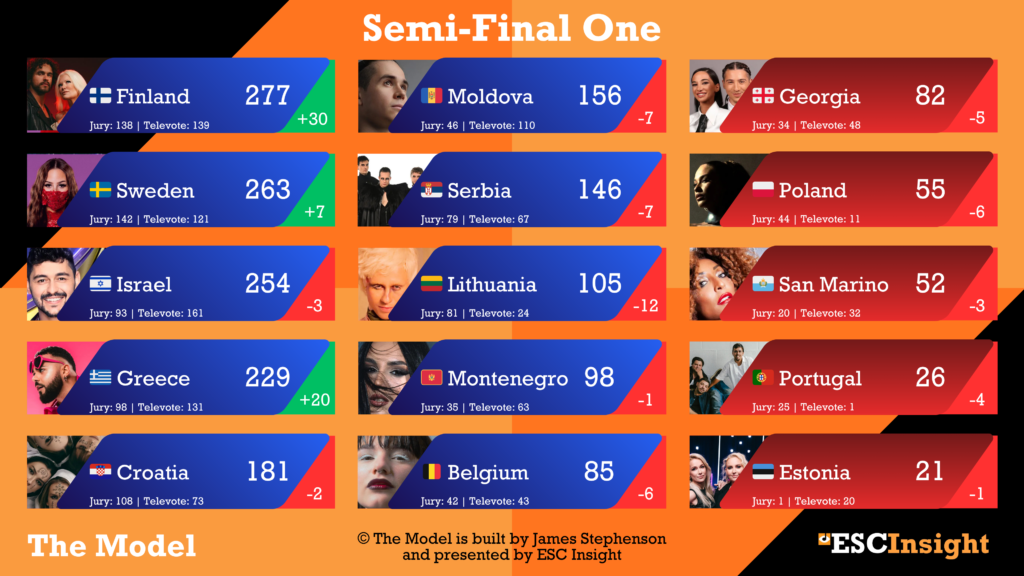
In Semi-Final One, we can see the effects of that change in proportionality put into practice. Only three songs have gained points, and they have done by big totals. Finland, Greece and Sweden now have higher projected scores with The Model, and they’ve taken their points off of everybody else in the show.
What this means is that we have a brand-new leader in this semi-final – for the first time, ‘Liekinheitin’ leads the way. With 30 more points than last week, Linda and Pete are now scoring 277 points in this simulation, and it is virtually dead-even between the juries (138) and the public (139). Felicia maintains second place for Sweden, but now up to 263, while Israel has taken a small fall of three points to drop to third in this semi-final – although ‘Michelle’ is still expected to win the public vote here.
Greece is a strong climber, too, with ‘Ferto’ up 20 points week-on-week to 229. Behind them, though, is a sea of red tracker figures. Croatia has kept its fifth place that it has had all season long in The Model, only falling by a couple of points, and most countries have only fallen by single digits. However, Lithuania in eighth has taken the biggest hit, with Lion Ceccah losing 12 points compared with last week’s projection. Moldova, Serbia and Montenegro have all held onto their places, and still look handy to reach the final.
In the race for the final qualifying spot, Essyla and Belgium is still holding onto tenth. However, Bzikebi and Georgia are one point closer this week than last. With a gap of just three points, this is going to be incredibly difficult to call in Vienna. And, behind them, Poland and even San Marino don’t appear to be out of the picture for a spot. San Marino’s performance is definitely driven by Boy George curiosity for me, while vocal coach Zoe Stibi was extremely effusive about Alicja’s vocals for Poland on Inside The Model this week. That could be a sign of stronger jury potential.
Portugal remain in 14th, even falling by four points week-on-week. There’s a lot of Eurovision fans (including myself, with my fan hat on) that think that Portugal could once again be the surprise qualifier, much like NAPA were with ‘Deslocado’ in Basel. But the data doesn’t show it for now – ‘Rosa’ is in the bottom five in most fan polls, meaning that it doesn’t seem to be a song that is the hidden darling of the pack just yet. Then again…neither were NAPA.
Semi-Final Two
Semi-Final Two from The Model – 27/04/2026 (James Stephenson)
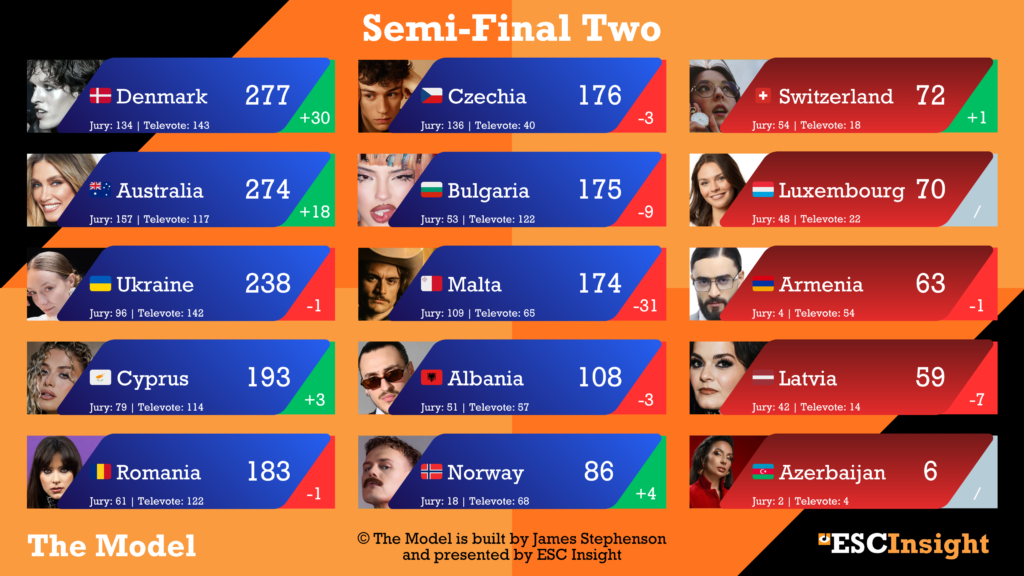
In Semi-Final Two, there is a similar trajectory taking shape. Once again, we have a new, first-time semi-final leader and big points increases for the main contenders. However, the movements of each country in this semi-final are a bit more varied, and continue to suggest that this semi-final will be the more difficult to call of the two.
Leading the way now for The Model, then, is ‘Før Vi Går Hjem’ from Denmark. Søren Torpegaard Lund is now projected to score 277 points – the very same as Finland on Tuesday – with 134 from the juries and 143 from the public nearly as even, too. With Søren currently leading the early stages of Eurojury, it’s clear eyes are on him – I had the chance to speak to the man himself about this, as well as creating the world of ‘Før Vi Går Hjem’, for ESC Insight recently.
Behind them by only three points is Australia. Denmark has climbed 30 while Australia has climbed 18, and ‘Eclipse’ from Delta Goodrem is still The Model’s favourite to win the most jury points in this show. Further back, we again see the same red tracker figures – but there are splashes of green right across the board. Behind Ukraine, only down by one point and in a very firm third place, ‘Jalla’ from Cyprus has gained by three points to 193, while ‘Choke Me’ from Romania has climbed into the top five in this semi-final for the first time.
Czechia and Bulgaria have all had minor falls, but Malta’s is surprisingly major: down 31 points in this semi-final. ‘Bella’ has had more fluctuation in its betting odds than most countries, and its moved around quite a bit from projection to projection. Rounding out the qualifiers are once again Albania in ninth place and Norway in tenth, with Jonas Lovv four points better off this week even though this update should have reduced his song’s total.
Switzerland is another country that is up on points, with ‘Alice’ starting to establish itself within The Model as the main challenger for a top 10 spot. Behind Veronica Fusaro, Luxembourg, Armenia and Latvia all have chances of making it, but there are concerns. The Model projects ‘Mother Nature’ and ‘Ēnā’ as weaker ballads than its main rivals for now, while it thinks the juries will ignore ‘Paloma Rumba’ almost completely. In such a ballad-heavy semi-final, the points totals will be incredibly split, and that could lead to surprising results on the night.
Grand Final
The Top Five from The Model – 27/04/26 (James Stephenson)
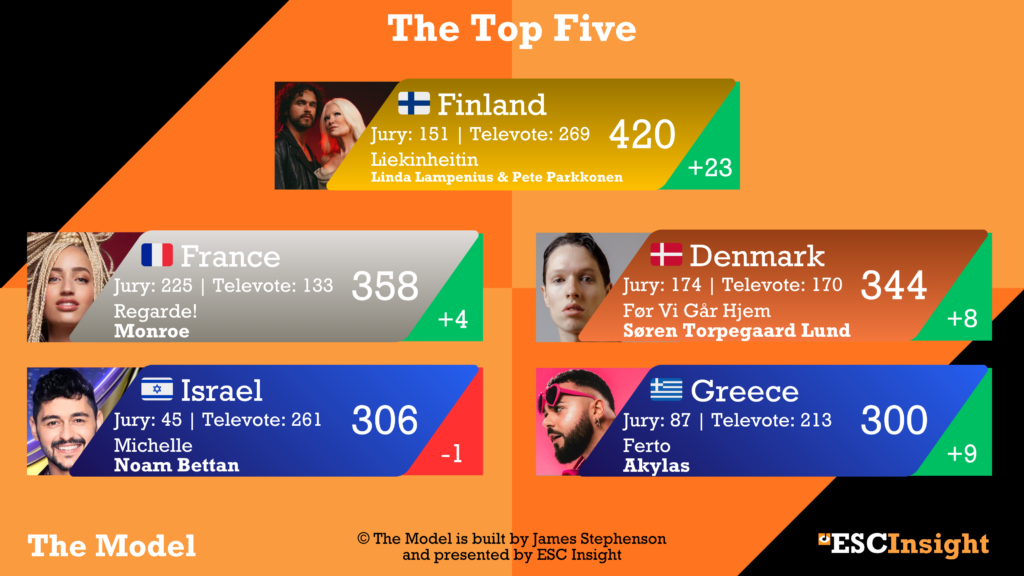
Let’s get into the Grand Final, then, where we see Finland at the front by its biggest margin yet. 420 points, in this Eurovision Song Contest, is a highly competitive score.
Finland has mainly benefitted on the jury side this week, with almost all of the gains coming from there. ‘Liekinheitin’ has been seen by many fans as a song with even appeal across juries and public vote, but The Model has been projecting other songs as stronger on the jury end e.g. France, Denmark and Australia. Finland’s gain here is a very good sign.
Behind ‘Liekinheitin’, the same pack of contenders all seem to be in range. But, mainly driven by the proportionality change, the margins between them are now extended. Finland’s lead over France, with ‘Regarde!’ still keeping its runner-up spot, is now 62 points, the biggest The Model has projected yet. Monroe gained four points week-on-week, but that’s one of the lowest of the contenders – in fact, I’d say that’s an effective drop.
A factor behind this seems to be the early results from Eurojury. While it’s still very early days (with only 12 countries’ results out as I write), the early scores coming in seem to favour Denmark and Australia’s chances with the juries over France. Remarkably, Finland is even higher than France in those scores for now.
While you should take those with a healthy pinch of salt, they do indicate some issues for the French team. Denmark has closed the gap to second place as a result, and if Søren maintains this pace, he could climb. With some bookmakers, Denmark had overtaken France this morning.
Israel remains fourth, and Greece remains fifth, with ‘Ferto’ holding off ‘Eclipse’ by single-digit points to keep its spot in the graphic for weeks now. And, further down the list, the top ten also stays the same week-on-week, with Ukraine, Sweden, Romania and Czechia completing that for now. At this stage of the Contest, the changes are minor – that’s because everyone is now eagerly anticipating one essential component becoming clear.
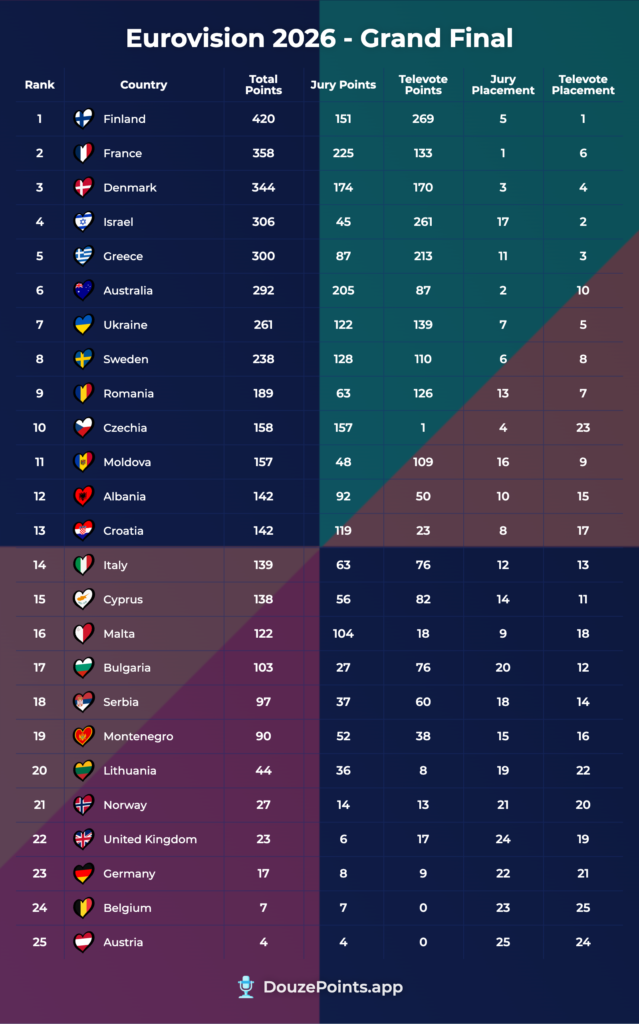
Full Split Results from The Model – 27/04/26 (James Stephenson / DouzePoints.app)
Practice Makes Perfect? The Eurovision Rehearsal Schedule
The stagings will have a massive impact on The Model. And, from Saturday onwards, we’re going to start getting an idea of what they are. This week, delegations will be getting on flights across Europe to Vienna as the rehearsal schedule begins. And, if you haven’t followed the rehearsals before, I actually thought it might be a good idea to provide a little bit of a guide.
Based on our understanding of the schedule, things kick off on Saturday. The songs in the first half of the semi-final will get 30 minutes on stage each – usually enough for three full run-throughs, with the last one usually including any effects or pyro the team has forked out their budget for. We don’t see these rehearsals at all: the only thing you’ll see is still images from them, as well as descriptions from the Eurovision Song Contest digital team.
We’ll be in that loop for four days, with the second half of the first semi-final on Sunday, and then Monday and Tuesday being reserved for songs in the second semi-final. The second rehearsals begin on Wednesday, and go on through Saturday. Each country gets 25 minutes for its second rehearsal, as by this point most technical issues should be ironed out, allowing run-throughs to happen with fewer interruptions. From Wednesday onwards, the Big Four and Austria will also start rehearsing, with their first and second rehearsals packed into a smaller schedule.
Sunday is a day off for the production crew, but not for the artists as they go to the opening carpet ceremony. And, from Monday onwards, things get serious: the dress rehearsal for the first semi-final is in the early afternoon, where members of the press get to see the performances in full for the first time, and then the first show with a paying public is in the evening. Unlike in previous years, the night before counts, too: that’s when the juries will be giving 50% of the points for the show.
For The Model, and those of us who track the Contest, this is the critical period for gathering data and information. Stills and descriptions of the rehearsals can give us some indication, although these can lead to large odds swings as fans hype themselves up over something that may be totally different on camera. It’s difficult to determine which is which at this stage.
The day before each show is the biggest, though. Jury show performances won’t just matter for predictions, as this year they’ll count for half the score. And, that night, the Eurovision Audience Poll (which I am again involved with for ESC Insight) will interview audience members as soon as they come out of the Wiener Stadthalle to find out their favourite entries. Early the day after, the day itself, The Model will make its final projection – the final prediction.
With The Model’s latest update, Finland remains in front – but that is set to keep changing. Next week, we’ll have our first update as rehearsals for the Eurovision Song Contest 2026 begin, and the last before we head to Vienna. So get excited: the answers we’re desperately waiting for will be coming soon.
Remember, The Model will make weekly projections from now until the contest, updating with new information throughout. If you don’t want to miss any regular weekly update, read The Model on ESC Insight every Monday from now until the Eurovision Song Contest 2026.
And, if you want to dive deeper behind the numbers, ‘Inside The Model’ is back this week. I chat with vocal coach Zoe Stibi about just how vital vocals are at Eurovision, and how the best singers manage their vocals to make sure they nail it on the night.
Finland’s in front – but will they stay there? See you then for the next update from The Model.