





We started the Eurovision Audience Poll in 2023. The idea started to formin 2022, when I witnessed the huge reaction to ‘Trenulețul ‘ in Turin that took myself and many others by huge surprise in public rehearsals, as it eventually finished 2nd in the televote that year. We also knew from Melodifestivalen, where OGAE Sweden runs a similar poll each week of the tour, that it is a much-anticipated part of the circus and also a solid indicator of what succeeds on the Melodifestivalen stage.
But the final driving force to put the wheels in motion to start this project came in response to the decision to limit press access to the arena to only the second on-location week in the host city. The Eurovision Audience Poll was our answer to missing days of media speculation on performances and to producing content that would reach as wide a public as possible.
We all know that nothing excites our community more than speculation about who might be winning. And the Eurovision Audience Poll helps with that speculation.
A Reasonable Results Proxy
The Eurovision Audience Poll, we believe, is a decent indicator of success at the Eurovision Song Contest. In the past three years of running the Audience Poll the winner of the Eurovision Song Contest has finished 2nd, 1st and 4th overall in the Grand Final Poll. The poll had a landslide victory for Käärijä in 2023, mirroring the public vote storm that Finland received on Saturday night, with the 29.2% vote share of Käärijä’s an Audience Poll record for the Grand Final. However, in 2024, it was jury darling Nemo that stole the show in the Audience Poll, just pipping Croatia’s Baby Lasagna in a runaway top two that ultimately mirrored the actual top two in Malmö.
The headlines will suggest that the Audience Poll was a poor proxy in 2025, as Sweden’s KAJ, Finland’s Erika Vikman and Spain’s Melody, all top three on our Friday night survey in Basel, weren’t in winning contention come the final scoreboard. However, something should be considered here – their very narrow winning margin. The 2025 Grand Final Audience Poll saw KAJ victorious, but with only 11.8% of the total vote. Yes JJ was 4th place on the Audience Poll that night, but only 4% points behind. The gap from 1st to 4th in previous years was 15% in 2024 and 21% in 2023.
We might not have had the order correct in 2025, but we did show a Song Contest of wide opportunity, one that resulted in a low scoring Eurovision Song Contest winner.
In those same three years, the Audience Poll has managed to successfully predict eight out of ten qualifiers in each of the six Semi Finals that have been contested. Of those songs, in the Semi Finals every song that received at least 7.5% of the public vote qualified.
We have got the following qualifiers incorrect in each show.
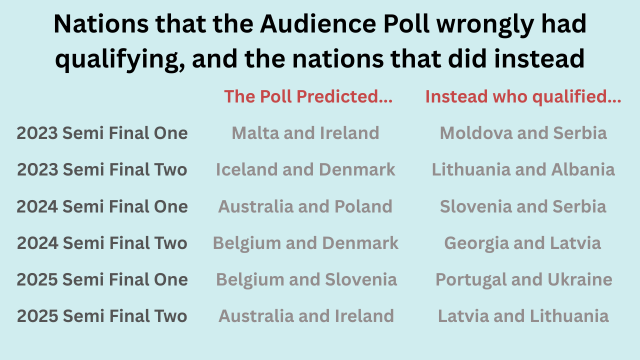
Audience Poll qualifications, predicted vs actual (Image: Ben Robertson)
Looking at our audience poll failings, there are two trends I see where the Eurovision Song Contest results differ from our Audience Poll rankings.
Let Me Be Your Tempo
One immediate failing that I see within the Audience Poll are the times where we witness the most upbeat, danceable and concert-feeling performances captivating the live audience more. I look here at entries like ‘Laika Party’, ‘Milkshake Man’, ‘Power’ and ‘Sand’ – called by the Audience Poll as qualifiers, but instead we witnessed entries like ‘Bur man laimi’, ‘Tavo akys’, ‘Descolado’ and ‘Hollow’ surprising the Audience Poll results table.
This is understandable, not just are the uptempo songs more likely to captivate a live audience, but there’s a reasonable expectation that the audience coming to attend a Eurovision jury show are coming for a party and a good time. The Eurovision live audience is a good, but nowhere near perfect, replication of the type of people that vote at the Song Contest itself the following day.
We have also noticed this trend at Sweden’s Melodifestivalen, where the Audience Poll process has become a year-on-year tradition run by OGAE Sweden. Our deep analysis of Sweden’s Publikundersökning, published in 2023, noted how “gentle ballads will without much exception pass the poll by, while the uptempo crowd pleasers tend to overperform.”
A Continent Divided
The other statistic that I’m immediately struck by is how much the not-qualifying-in-reality list is dominated by countries that are western sphere influenced, whereas many of the songs that did not make it are instead eastern european. Twice has the Audience Poll called qualification for Ireland, Belgium, Australia and Denmark, and twice has Latvia, Lithuania and Serbia surprised the Poll by qualifying.
I wanted to assess if this was a wider trend across the entire Audience Poll data, compared to the final Eurovision rankings. To do this analysis, I ranked the Eurovision Audience Poll songs from first place to last place, and compared this list to the ranking from first place to last place in Eurovision televote scores. We did this by percentage, so a drop of five places in a 25 song final is the equivalent of losing 20% of your ranking, as does a drop of 3 places in a 15 song Semi Final.
We used televote here because for 2024 and 2025 we did not have jury scores public, as they were not used in the 100% televote only scoring system. However it is good to note that, using Spearman’s Rank correlation between the ordinal ranking of jury points and seperately to televote points, the correlation of the Audience Poll is actually higher with juries (average of +0.43) compared to televoting (+0.27). At best, that suggests a moderate correlation of Audience Poll rank order compared to the rank order we witness in the competition, with much more noise coming through the data.
Back to the data analysis, this graph shows the country-by-country over or underperformance in Eurovision televote compared to the Audience Poll results since 2023. The more negative the value on the graph, the more the Audience Poll undervalues your score.
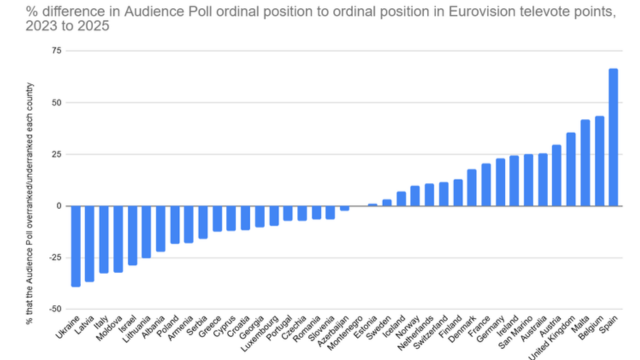
Audience Poll differences, predicted vs actual (Image: Ben Robertson)
This graph shows this trend incredibly clearly. The 17 countries on the right hand side of this chart, that is the 17 countries that the Audience Poll has been seen to overreward compared to Eurovision televote scores, are all countries we can describe as Western. Spain leads the way with a huge 67% overrepresentation in the Audience poll compared to actual Eurovision televote position.
Why We Have A Division At All
On the flip side, Ukraine is the country most underperforming in the Eurovision Audience Poll. Last year the Eurovision Audience Poll had Ziferblat’s ‘Bird of Prey’ ranked lowly in 13th position in the Semi Final, despite eventually winning that show. The Grand Final Poll was similar, ranked 24th on our Friday night survey but finishing 6th with the public scores on Saturday. Other underrated nations in the Audience Poll include Latvia and Moldova, and it is notable here that Italy is also an underperformer, breaking the otherwise clear East/West divide. Perhaps that Sanremo style doesn’t cross over to the Eurovision attending public…
Why would there be an East/West divide in the Audience Poll? One factor could of course be the demographics of those attending the show. Attending the modern Eurovision Song Contest is an expensive endeavour, pricing out much of the continent from a visit. It means in the past there were significantly more fans from nations like Ireland and Belgium than there would be from Moldova and Ukraine. I certainly remember conducting our very first Eurovision Audience Poll in Liverpool that a significant number of votes for both Malta and Ireland that night came from fans dressed up to support their nation – these voters – and many of those supporting Spain in the past, were partisan in their opinion no matter what they saw live.
The same can be said about the actual audience themselves. In the last three years the Song Contest has been held in Liverpool, Malmö and Basel. We know this year in Vienna that the most number of tickets have been sold to Austrians, totalling 42% of total tickets sold. Perhaps this western bias also comes from the local population and their musical tastes, rather than being purely from those attending the Contest from different nations.
I would also argue that the Audience Poll was also prone to voting higher songs that may are just geographically based, but also stylistically liberal in their craft. I note how the 2025 Grand Final Audience Poll saw all three of Spain, Finland and Malta reach the top top, all in their own unique way confident statements of strong feminine empowerment. This ’diva’ effect of the Audience Poll is another effect to consider.
Biased, But Valued
We are set to begin the Eurovision Audience Poll for a fourth year. This year ESC Insight will be collaborated on the poll with ESCXtra, That Eurovision Site and 12 Points From America, as well as local support from the Merci Cherie Podcast and the team behind ESC Gabe’s YouTube channel are also supporting our data collection initiative.
We will have results out after each first public rehearsal, should everything go to plan we aim to have results available around 00:30 CEST for the Semi Finals and 02:00 for the Grand Final. We will release the results on our social media pages of all the sites (Facebook and Bluesky for Insight), as well as on www.eurovisionaudiencepoll.com and live on ESC Gabe’s livestream.
And when those results come out, now you know exactly how many pinches of salt you need to take. Two. One for each uptempo Western qualifier the poll predicts while forgetting slower songs from the East.
Let the Eurovision Song Contest begin!