





We were watching the results come in across Europe at the end of the Eurovision Song Contest 2025. At the time of the televote reveal, with Austria on 256 points from the juries and Sweden on 126 points, the betting exchanges had the race to win Eurovision as a head-to-head tie between a visit to Vienna or Stockholm for the seventieth anniversary.
That quickly changed as the scores dripped in from televoters. Firstly, Israel scored a humongous televote of 297 points, enough to take second place. Soon after came Estonia, with a televote score of 258 points to ‘Espresso Macchiato’, lifting Estonia to just one point behind Israel and ultimately third place at Eurovision.
Those were the top two in the eventual televote by a distance. Nobody else managed to break the 200 point barrier, with Sweden third on a less-than-expectation 195 points.
Anyway, as said, I had placed a bet, and I assumed that bet had won comfortably. That gamble was a bet on Estonia to place in the top three at the Eurovision Song Contest on the 13th May. Those of you with eagle eyes will note that the Eurovision Grand Final took place on May 17th.
The punt in question was that Estonia was going to finish in the top three of the Eurovision Semi Final. A 100 percent televote Eurovision Semi Final at that. Instead in that very show on Tuesday night the scoreboard was not representative of what we saw on Saturday night. The Semi Final was won by Ukraine, with The Netherlands in second place and Albania in third. Estonia in the end came 5th, even behind Sweden, despite destroying all of them on the scoreboard on Saturday.
This leads me to my question. Is this absolutely topsy turvy Semi Final scoreboard normal in the Song Contest, or is this an anomaly. If the latter, is there a reason why?
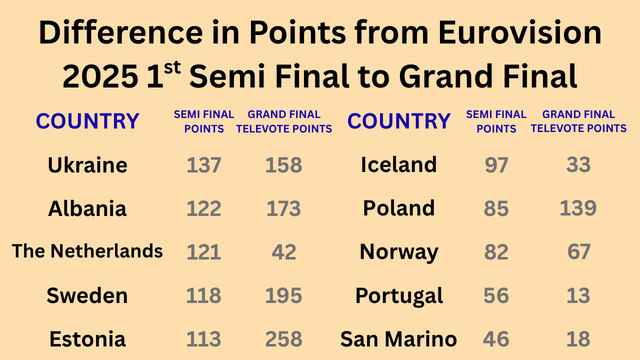
Difference in Semi Final and Grand Final points, Eurovision 2025 (Ben Robertson)
In terms of a study, the above points table isn’t one that leads to any accurate analysis. The biggest problem here in this analysis is that there are double as many countries voting in the Eurovision Grand Final. It could very well be the case that Estonia hoovered up douze points from a bunch of nations that simply were not competing on Tuesday night, and could make all the difference. Instead the points spread of ‘Espresso Macchiato’ on the Saturday night came with only a slight difference between the different groups, 100 points from the televote of 1st Semi Final nations, and 149 points from those in 2nd Semi Final nations. In addition seven points came from San Marino’s constructed vote, as well as two points from the Rest of the World vote, which for the purpose of our statistical study we will not be investigating on this occasion.
What is insane to consider about those 100 points that Estonia received from this group of countries is that, if we look at their votes in the Semi Final itself, taking away 4 points from the Rest of the World and 10 from San Marino’s constructed vote, then Estonia in the Semi Final ended up on 99 points. This is despite in the Grand Final there being far more songs to choose from for voters, better quality songs one assumes by filtering out the non-qualifiers, and a running order position of 3rd on Grand Final night that should in theory be an absolute stinker.
And the only country to receive more than 100 televote points from this cohort of nations was indeed the ultimate televote winner Israel. Estonia had leapfrogged all others from the same possible blocks of countries.
There is one obvious reason behind this. That reason is that, as we head into the Grand Final, the show attracts a significantly larger audience, and songs like ‘Espresso Macchiato’ appeal much more to a casual audience. The difference between the Semi Final and Grand Final isn’t just time, it’s the significantly larger and more diverse viewing audience.
To find out if there are other patterns like this for similar songs, I think we need more data.
Five Years Of Eurovision Semi Finals
In analysing five Eurovision Song Contests from the pandemic hit 2021 edition to today, our aim is to look at the difference in relative televote rankings between the songs that qualify to the Grand Final from the Semi Final to the Grand Final.
Our methodology for this is as follows:
- Rank the ten qualifying songs from 1st place to 10th place in terms of their televote score in the Semi Final from countries that voted in both shows (for countries that qualified from that Semi Final, they instead are ranked 1st to 9th, as you can’t vote for your own participating country)
- Convert that ranking into points, Eurovision style, for those nations in each show (i.e. a ranking of 1st place gives 12 televote points, 2nd place grants 10 televote points etc).
- Compare the points scored in this constructed, qualifiers only ranking, from the Semi Final to the Grand Final.
The key stat we are looking for here is the average points gained, or average points lost, as we go through from Semi Final to Grand Final. Strictly compared to the other songs in their Semi Final and their televoters, which songs gained points heading into Saturday night, and which songs lost out.
Firstly, let’s assess those songs that have increased their relative ranking from Semi Final to Grand Final.
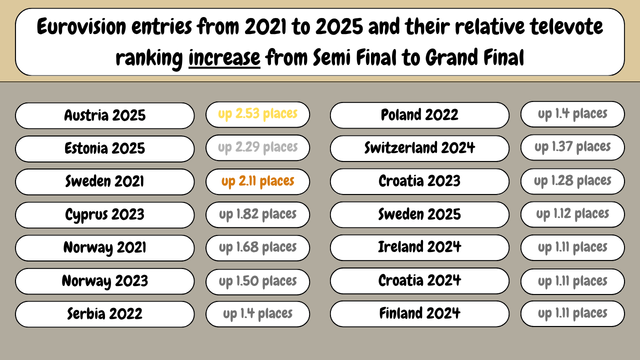
Ranking difference in Semi Final and Grand Final points, Eurovision 2021-2025 (Ben Robertson)
As expected, Estonia 2025, ‘Espresso Macchiato’, is one of the songs featured at the top of this list. However it places in 2nd place in this ranking to an even more notable example. The 2025 Eurovision Song Contest winner, ‘Wasted Love’, ranks at the top of this scoreboard. Despite ultimately winning in Basel, Austria scored 103 points in the Semi Final, placing 5th place on the Thursday evening behind Greece, Finland, Latvia and Israel. While readers may note that Austria’s eventual route to victory was a strong result with Eurovision juries, that televote improved dramatically from 5th place in a 16 song Eurovision Semi Final to 4th place in a 26 song Eurovision Grand Final. Within the same voting nations as competed on that Thursday night broadcast, all but three of them ranked Austria higher relative to the other Semi Finalists just two days later.
Outwith those top two in this ranking, can I see two distinct patterns in many of the other songs that appear on this list. Firstly, I can see that a significant group of these songs are those that appeal to a more casual, perhaps a more Saturday night Eurovision audience, than those that watch make up its strong community that follows all week long in May. This includes songs like ‘Voices’, ‘Fallen Angel’, ‘Queen of Kings’ and ‘No Rules’ which in this methodology is seen to get a relative boost in televoting support on Grand Final night. The other examples are those where running order makes a significant impact. ‘In Corpore Sano’, ‘Mama ŠČ!’ and, once again, ‘Voices’ by Tusse come to mind as good examples here. Questioning my vision for ‘Voices’ here? Feel free to, but Tusse’s Eurovision entry is the most a Eurovision entry has ever sounded like an Idol winners debut single, and the audience for that style is bigger outside the bubble than inside.
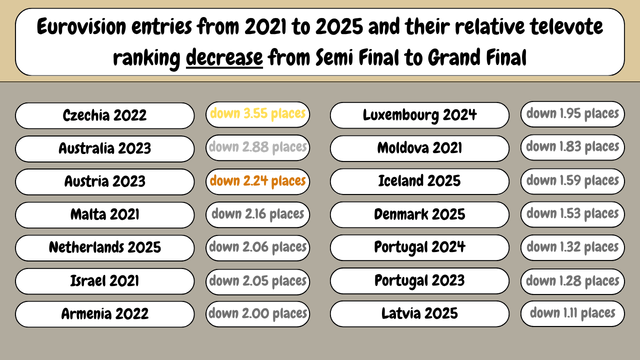
Ranking difference in Semi Final and Grand Final points, Eurovision 2021-2025 (Ben Robertson)
The converse statistics shows which songs dropped off most after qualifying to the Grand Final. With a drop of 3.55 places average per nation, huge considering that each country is only ranking 9 or 10 songs in this study, we have Czechia’s entry from 2022 ‘Lights Off’. This hits a trifecta of issues that we can explain this drop with. Firstly it has the most extreme change in running order, going from drawn last in the Second Semi Final to opening the Grand Final. Furthermore, ‘Lights Off’ possessed the vibe of a cool, sophisticated and at the time modern pop song that screams a Eurovision fan favourite. Finally, the compounding of issues for the Grand Final ranking comes from the relative strength of that Second Semi Final. Only Sweden and Serbia from that show ended up reaching the top 10 in the 2022 Eurovision Grand Final, as Grand Finalists like Italy, Spain and the United Kingdom all placed there, as well as four other songs from the First Semi Final.
Now, obviously we should have eliminated this particular issue in the relative strength of each Semi Final in our data collection, because we are only assessing the relative change in rankings from those voting in both shows. However Czechia is a prime example of a nation that lacks any sort of loyal vote at the Contest, without a strong diaspora that other central European nations can mobilise. While other nations that qualified from that Second Semi Final, for example Poland and Romania, may have scored a lower televote than Czechia in the Semi Final, they roared ahead in the Grand Final, as Czechia voters switched to other, ultimately more competitive tracks yet Poland and Romania’s televote held firm.
All this is true for the other podium placements on this table, as well as pre-Rotterdam favourite ‘Je me casse’ from Malta – worse running orders in the Grand Final compared to the Semi Final, and losing relative strength in the much stronger Grand Final playing field while other more reliable televote-supported countries received more votes on the Saturday night.
Can we learn anything about this for future predictions?
Conclusion: The Saturday Metamorphosis
What we observe in the data across the last five years is a consistent metamorphosis between Tuesday night and Thursday night to Saturday night. The Semi-Final is not a miniature version of the Grand Final. Sure the songs are the same, but the viewing figures for Tuesday’s midweek showdown are much smaller, however they are likely an audience more knowledgeable and passionate, and they have less songs to choose from compared to the marathon that is the Eurovision Grand Final.
We have been able to spot songs through modern Eurovision history that offer a very specific casual appeal, those with immediate hooks or something instantly impressive, such as our ‘Espresso Macchiato’ or ‘Wasted Love’, that are statistically prone to a relative surge when the audience size booms on Saturday. Conversely, fan favorite entries that dominate our community’s discourse or the EuroClub dancefloor often see their relative power diluted.
A Psychological Layer: The Strategic Voter?
There is also a sentimental thought experiment to be had here. In a world where we don’t see the Semi-Final scores until the contest is over, are savvy fans subconsciously voting tactically?
It is worth considering in this modern era if “the bubble” shifts its weight behind “at-risk” favorites on Tuesday night to ensure they make the cut, only to move their support back to the heavyweights once the trophy is on the line. For the entries from Albania and the Netherlands at Eurovision 2025, both of which placed higher than Sweden or Estonia in that First Semi Final scoreboard, were those high scores in part caused by fans tactically using their hard-earned Euros to vote for songs that weren’t necessarily guaranteed to make it to the Saturday night, knowing ‘Espresso Macchiato’ and ‘Bara Bada Bastu’ had no threat to their qualification chances?
We can be simple and assume audience expansion as the cause of these shifts, but this safety net voting could explain why certain sure things appear to underperform midweek, only to roar back to life when it matters most. With a modern day Eurovision community nowadays surrounded by more predictions and proxies than ever before about who is set to qualify or not, is that creating a world where an increasing number of fans are voting tactically with their heads at the Semi Final stage, before voting with their hearts for the Grand Final?
When we finally see the 2026 Semi Final data in Vienna, now with juries making up almost half the total score once again, can we expect that fans voting in the televote may be emboldened by their safety net to be even more disloyal and tactical in their Semi Final voting choices than ever before? The modern day Eurovision Song Contest commands year-on-year increase in internet reach, and with that, at least within the core few million following the Contest on social media, that means the voting audience of today is more aware of where their votes will go further compared to a generation ago.
My losing flutter is a reminder that in Eurovision, the most dangerous thing you can do is assume that Saturday night performance is the same as within the Semi Finals. Yes there are things like the size of the voting audience, the type of voting audience, and a different running order that play a part, but perhaps in modern Eurovision there’s another force at play. Are our Semi Final night voters going into those midweek shows with a whole different voting agenda to the big day itself?