



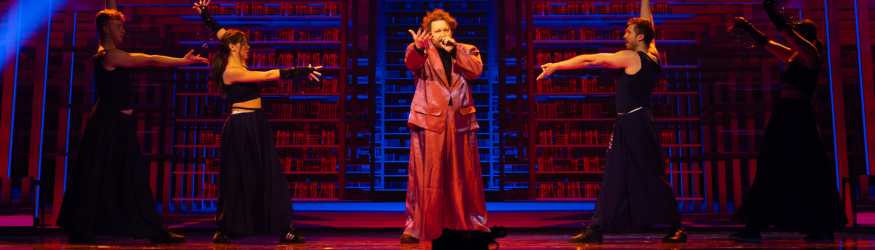
About 30 minutes after you lose a National Final, you’re waiting for a Bolt Taxi at the side of the road.
Before then, it’s an experience like little else. You’ve got a table in the green room with your name and voting number on it, free wine and shiny glasses. You’ve got a performance in front of hundreds of thousands of viewers on your country’s biggest TV station. You’ve got your whole team with you, hands all held together, waiting for your name to be called.
But when it doesn’t, it doesn’t. You don’t react at first, not too much – you just take it in. You might be surprised. You might be emotional. But the show has moved to the next stage without you, and your dressing room today is someone else’s tomorrow.
Then you’re waiting for a cab in the cold, making your way home. Just like everyone else.
HRT Studios, Zagreb, Croatia – Semi-Final 1, Dora 2026
That was my experience on Thursday 12 February. The day before, I had flown to Zagreb, Croatia for a unique opportunity – the chance to follow a competing artist in a National Final up close. I arrived to get my delegation pass and go backstage, where I planned to be for the whole weekend.
The artist I was following was Fenksta. This was his second crack at Dora, Croatia’s national selection, after a very successful debut with the song ‘Extra’. Despite long odds, the song made the final and earned an impressive 9th place. That was despite ‘Extra’ initially being on the reserve list, and the production team behind it therefore having to pull the whole package together in little more than a couple of weeks.
This time, then, expectations were raised. The new song, ‘Memento Mori’, marked a shift for the rapper. The lyrics went from Croatian to English, and the costume and hair became more polished. This was no longer a plucky underdog, but an established artist. He worked with more experienced songwriters (Emma Gale, a writer of last year’s Dora winner, ‘Poison Cake’, was credited). He had a more experienced team, more confident from pulling it off once before.
All signs pointed to success continuing – but that was only what we thought. What makes competing in a National Final scary is that it’s the moment your opinions come into contact with reality. When the voting sequence comes, there’s nowhere to hide – you’re either in or you’re out.
Here’s my experience of my day with Team Fenksta – and what I learned about losing a national final.
The Calm Before The Storm
There’s a temptation to think of the Eurovision Song Contest as being a dream, a luxury experience. Perhaps you wake up in a fancy hotel room paid for by the broadcaster. You get a nice coach to the arena, with a padded seat bearing your name. Maybe you’ve got personal assistants making sure you have everything you need. And, when the night’s over, someone makes sure you get to bed for a good night’s rest.
The truth? National Finals are nothing like that. They are the real Eurovision.
I woke up on a sofa at ‘Memento Mori’’s lead dancer and choreographer, Iva’s apartment in Zagreb. On the other side of the flat, Daniel Stridh and Jakub Ratzka, some of my best friends in the Eurovision community and key production team members for Fenksta’s entry, were stirring in bed.
We spent our morning making up whatever breakfast we could get our hands on, collecting all of the stuff we needed, and hauling it from here to the studios of HRT in Zagreb, where Dora is being staged this year.
There was nobody to greet us or help us with our equipment at the door. We got signed off by a security warden, then made our way around the block to the backstage door. We found Fenksta’s dressing room, which we’d retained following last night’s dress rehearsal. At this point, it’s 12:00 noon – just over eight hours before showtime. The final countdown had, slowly, begun.
Counting The Hours Backstage
There’s a temptation to think of the show day as being hectic – but really, that’s not true either. By now, the hard work has already been done. The song, the performance, the dancing – that’s already been rehearsed within an inch of its life. As Iva told me in the afternoon, she didn’t need to tell her dancers what to do by this point – in her words, “they had it within their bodies”.
So there’s a lot of downtime. Most of the 12 artists and their teams kept to themselves, preparing in their own ways. Before the final rehearsal, which began at 1:30pm, everyone start to break out into game mode. The dancers from Noelle’s ‘Uninterrupted’ do their stretches in skin-tight bodysuits. Ananda works on her song ‘Dora’’s high note from her dressing room.
Fenksta? He smiles with us, cracks jokes, and says hello to just about anyone he sees – he’s calm.
In the downtime between the rehearsal and the live show, things are pretty mundane. We pop out to the on-site Koznum to make sure the dancers have enough snacks to get them through the day. One of the main things we do is film interviews with the team ahead of a new episode of Eurovision Uncovered which will chart this journey in even more detail.
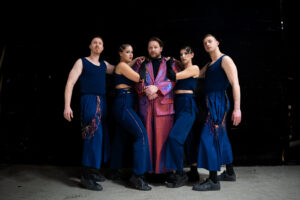
Fenksta and his dancers about to go on stage (Daniel Stridh)
The Green Room – It’s No Party
The tension only builds about an hour or so ahead of the show. We’re led into the green room, where artists’ teams get to sit, 45 minutes before the broadcast. By that point, only the performers on stage are allowed to stay in the backstage area – we collect their phones from them before we leave, removing any distraction and pressure that might get into their heads. By this point, I’ve no doubt that Fenksta and his dancers are ready anyway.
In the green room itself, the atmosphere goes from tense to jovial by the time Dora starts airing. We all end up getting into it – clapping our hands hard for Lima Len’s ‘Raketa’, which is an absolute banger, and lip-syncing as dramatically as possible to ‘From Ashes to Flame’, the powerful Alen Đuras ballad. Suddenly, eight songs have gone, and Fenksta’s up in slot nine.
The team and I all have a little moment before it starts. Call it prayer, call it hope, but mostly it’s nerves. Watching a National Final performance with the team that crafted it is nothing like being curled up on the sofa. As a viewer, you’re taking it all in – but from this angle, you already know everything that’s coming. You’re just wishing to whatever higher power you prefer that each dancer hits each mark, that the vocal is clean, that the pyro goes off where it’s supposed to.
That all happens. Screams and cheers from our sofa, only beaten by the noise everyone makes as Fenksta and the dancers come in. Our spot is right on the far-side wall of the studio, so Fenksta gets the chance to high-five about half of Croatia by the time he slumps onto our couch. The dancers all get a drink of water – Iva pats everyone’s sweat down with a napkin. The hard work is over now.
As the votes come in, the exhale continues. Fenksta’s back to his base settings – he’s an extremely funny guy who doesn’t take himself seriously at all, and that’s very refreshing. Even the camera operators seem to be happier when they get us into shot. We get a chance to briefly chat with one of the presenters, Iva Šulentić, during an ad break. She’s stunned that I’ve come all the way from England for this, but seems happy I have.
Waiting on a Name
But when the moment of truth comes, what’s felt like a pretty slow-rolling day suddenly becomes a whirlwind. Seeing it from this perspective completely alters the experience. Every staggered pause the hosts make is an eternity, yet the whole thing feels like it’s rushing by you in an instant. With each announcement, another table rises in a wave. With each next one, we reassure ourselves: “they were always going through”, “no surprises there”.
As someone who takes solace in numbers, they’re not offering me much. With each new artist taking a spot in the inal, the statistical likelihood is just going down. Eventually, we’re at the last name – now or never. Cold Snap, the band that performed after Fenksta and had a dressing room right next to ours, flew upwards in celebration when the time came. The Fenksta team and I just looked around at each other, wild eyes at empty faces, trying to process the disappointment.
TV is a fast-moving business – Eurovision competitions feel even faster. We saunter out of the green room shell-shocked. Fenksta, who’s taking their defeat incredibly gracefully, seems less affected than most of the other artists hugging him and saying he should have made it. For the rest of the team, there’s little sadness – just surprise. We all make sure we have everything: this dressing room won’t be ours when we go out through the back door.
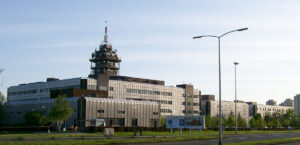
HRT Studios Zagreb – and the road we waited on (Wikimedia Commons)
Waiting for Reality on the Side of the Road
And that brings us right to where we started. In so many ways.
Whether it’s in Croatia, Bulgaria, Sweden or Romania, the dream is the same for every artist who tries to win the Eurovision Song Contest. And, in every one of those countries, almost everyone will come up short. Thousands of dreamers, every year, think they’ve got the song Europe wants to hear more than any other. Thousands of dreamers, every year, are eventually disappointed.
You might say that’s a cynical way of looking at it. It is. But that’s only if you frame Eurovision as a competition. What I now know, more strongly than ever, from seeing this up close is how completely untrue that is.
Eurovision is a community of normal people aspiring to something extraordinary. It’s Dan and Jakub, going from contest fans to visual artists and lighting designers who can hold their own at this level. It’s the dancers, who support each other and give each other strength. It’s Iva, the dancer who’s made her sofa my bed despite us never having met in person before this week. She lets us know she’s picking up a work shift at 8am. National Finals are not coronations for kings and queens.
Instead, they are where people try, and try together. And, even if they fail, they come back and they try harder. To paraphrase a movie I love from the 1980s about baseball you may know, Eurovision is erased like a blackboard, rebuilt, then erased again.
But the songs, and the journeys their makers go on with them, are permanent. The results, the TV lights and the glamour are transitory – being here in the moment is what matters.
When the cab – finally – comes to pick us up and take us away from our TV fantasy, it’ll deliver us into a real world that’s no different. But everyone who’s worked on this entry has put something fantastic into it.
So let’s keep losing – because without those who lose, what would Eurovision mean?