





Last Friday morning, I woke up with a knot in my stomach. It was the start of a day I hoped would never come, but had known deep down was coming for the last eighteen months: Israel would not be excluded from the Eurovision Song Contest.
As I write this article with a deep sense of sadness, I am considering what love of the Eurovision Song Contest I am holding on to and what I am letting go. For the first time since I began following the Song Contest in 2012, I won’t be turning on the television in May to follow the three live shows.
I’ve taken this decision directly following the events of Thursday, December 4th, and the decision to pass voting reforms that included the default position of Israeli broadcaster KAN’s inclusion on the entry list for Vienna 2026.
ESC Insight has several articles that analyse the events of the meeting in Geneva, going into great depth on the consequences for Eurovision as a brand. This article is intended to be something different; it’s my personal reflection on how we got here, what happens now and what I feel able to do moving forward.
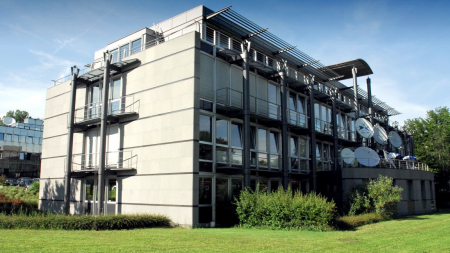
EBU Headquarters in Geneva (Image: EBU)
One Night In November
There are many aspects of last week’s events in Geneva that did not surprise me. It did not surprise me that the conversation went on longer than expected; everyone in the room knew the future of the Eurovision Song Contest was in their hands. It did not surprise me that some broadcasters were opposed to KAN’s participation in the Contest, and some were very pro-participation… but most were somewhere in the middle. It did not even surprise me that, to wave through participation in Vienna next May, the vote on the sensible reforms was bound to hinge on whether Israel would be competing.
There was no way for delegations to vote for the reforms without accepting that Israel should be present at Vienna 2026. What surprised me was how comfortable the result turned out to be. Whatever best laid plans or secret deals or politicking went on behind the scenes, the result was emphatically in favour of the reforms and therefore emphatically in favour of Israel remaining at the contest. I salute the broadcasters from Spain, the Netherlands, Ireland and Slovenia for having the courage of their convictions to stand by their decision to boycott even after the results of the vote. Eurovision won’t be the same without them.
So What Now?
There’s a massive part of me that feels happy that this is all over now.
Having recently lost my grandmother to dementia, grief is a familiar feeling. I won’t be able to enjoy watching a Song Contest in which Israel can still participate, promote, and perform as they did in 2024 and 2025; that realisation was immediately clear following the events in Basel. Understanding that this is now happening will take much, much longer to sink in.
This Contest was more than a TV show to me; it was a demonstration of the power of international collaboration and cooperation to create a spectacle that was bigger, brighter and better than the sum of its parts. It was the music and the artists, and the discovery of languages, cultures, histories, and narratives through the songs that broadcasters selected and showcased on this grand international stage. It was the travel to different parts of the continent to experience new places, see the show I loved in various guises, through different lenses and discover new dimensions of the music I listened to with local contexts and ideas.

Eurovision Bus Stop, Liverpool 2023 (Photo: Ewan Spence)
Most importantly however, it was the incredible community that we remain and always will be – a group of outcasts and misfits who rarely felt cool or mainstream or like they belonged until they discovered the way that a song in a foreign language performed on a technically impressive stage in front of an electric arena crowd beamed around the world to hundreds of millions of people can move, interest, engage and inspire you in ways that nothing else can.
With the exception of this community, the Song Contest I fell in love with showed its true colours on Thursday. Like any difficult breakup, the healthy thing for me to do is to back away and take some space from anything directly related to the present-day Contest. I will still enjoy the history, I will still enjoy all the music and memories I have, I will even continue to enjoy National Finals like Melodifestivalen, Melodi Grand Prix and Sanremo – all larger than life shows which have their own context and heritage distinct from Eurovision.
Beyond that, I have realised that I need a new hobby to fall in love with, and that truth leaves me absolutely heartbroken.
Until Next Time?
I still hope and believe that one way or another, the EBU will find its way back to the original soul of the Eurovision Song Contest.
I don’t want to have enjoyed my last Contest. I don’t want to have written my last article or recorded my last podcast about the show I love. I especially don’t want to lose the friendships that have turned the Contest from being a show I enjoy to a core part of my personality.
For those of you who feel similarly to me, I hope these words have reminded you that you are not alone in your feelings and that although this is uncharted territory for all of us, we will stumble our way through it together. For those of you who disagree with the sentiments I’ve expressed in this article, that’s okay – our community is what it is because of the beautiful diversity of perspectives it consists of, and in the same way I respect your opinion, I hope you can respect mine.
Finally, for those of you planning to watch or attend Eurovision in Vienna next May, I hope it brings you the same joy, passion and love that any other edition of the Contest would; please dance, sing and jump on behalf of those of us who feel like we can’t.