




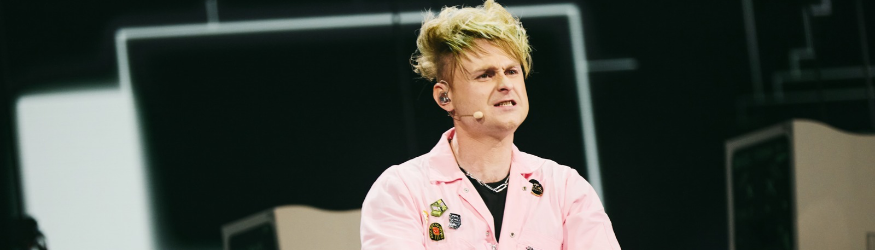
The government has announced today that the UK’s dire performance at the Eurovision Song Contest will be discussed by MPs. The discussion will bring together professionals from the BBC and music industry experts to give evidence to a committee of cross-party MPs at a hearing that will be held in the coming months. They will also receive relevant written submissions, so here I am getting in there early.
Why are they doing this?
Caroline Dinenage, Chair of the Digital, Culture, Media and Sport Committee said:
“We want to get to the bottom of who chooses our entrant, on what basis and whether our dismal record of achievement in recent years [Sam Ryder to one side] is the result of bad song choice, weak performance… or something else”.
There’s no denying the UK’s experience at the Contest has been rough; we’ve come last three times, been on the bottom half of the scoreboard pretty much every year bar one, and received nul points every year in the public vote since 2024, as well as a nul points overall for James Newman in 2021.
But, contrary to popular belief, it’s not because everyone hates us and the challenge of doing well at Eurovision is not insurmountable. We can crack this. But it’s not just about next year’s Contest, it’s a five-year or more project that requires investing in the future of UK talent.
What the UK needs to do
Regular readers will know that I am frequently a bit of a cheerleader for the UK at the Eurovision Song Contest. Even when the odds seem stacked against us, I have advocated for us. Sure, Olly Alexander’s disappointment came as a surprise, but even then I found reasons to be cheerful.
The last two years have revealed some fundamental flaws in how we’re doing it, however. I’ve been talking to artists and professionals involved in Eurovision for the past few years, and here’s a rundown of where I think the UK keep going wrong and what we need to do to change things.
1. Let the artists be artists
We don’t have a lack of musical talent in the UK. In fact, we’ve sent some very popular, interesting and creative people to represent us over the past few years. The recurring problem, however, has been the song.
Both Look Mum No Computer (2026) and Remember Monday (2025) had a catalogue of songs to choose from but were encouraged to partner with Scandi songwriters with previous success in the Contest to pen a “song for Eurovision”. The resulting tracks sounded like nothing like the rest of their album and took the artists away from their usual voice and point of view.
This issue has been going on for years. It was explored way back in 2018 by Vice Magazine in The Secret Challenges of Representing the UK at Eurovision, which followed that year’s contestant, SuRie. The author pointed out,
“We pick mediocre songs and hand them to singers who, if SuRie’s experience is anything to go by, we refuse to treat as artists”.
The exception to this was in 2022 when Sam Ryder was appointed, with a song he had already written for his upcoming album. ‘Space Man’ was quietly released a few weeks before he was announced as representing the UK and had time to be playlisted on several radio stations and gain chart momentum before people knew it was for Eurovision. Crucially, it sounded like him.
When I spoke to Eurovision 2024 winner JJ last year, he explained that authenticity is worth a lot in today’s Contest. Artists bringing a song that feel like a true representation of themselves are what the voting public (and juries) demand. He told me: “Bring something where the artist can shine. I’m confident the UK has that and can bring something great.”
2. Think beyond Eurovision
Success isn’t just about how many points you get in the Eurovision Song Contest; it’s also measured by how your artist and song perform afterwards.
The most famous example of this is Rosa Linn, who represented Armenia in 2022. She achieved a lowly 20th place in the final, but became a viral success after the Contest, charting in numerous countries globally. ‘Snap’ still stands as one of the most streamed Eurovision songs of all time.
You don’t have to succeed in the Contest to do well afterwards, but what you do need is a great song that audiences connect with, and opportunities to come up with them.
Our songs typically don’t even chart in the UK, let alone abroad, and that’s the problem. We’re not sending the right songs and we’re not giving young artists the chance to develop them. The small venues they ought to be performing at, where they can test out their songs on an audience, are closing down. Smaller or up and coming artists can’t afford to tour. Kate Nash has talked a lot about this: she’s funding her tour by selling adult content online.
This isn’t just about Eurovision. It’s about creating an ecosystem where artists like Rosa Linn, JJ and Sam Ryder can be found and nurtured until they get that big break and write great songs.
3. Give new genres a chance
The UK has a bit of a genre problem in that we always seem to select “safe” songs; i.e. ones that will get playlisted on BBC Radio 2. We won’t take a risk on a niche genre – but sometimes that’s what you have to do to stand out and win.
When Switzerland won with a drum’n’bass/opera/rap/pop mash up in 2024, they weren’t playing it safe.
A few months ago I spoke with Connell Bower from UK industrial metal band Fleisch. They have mounted a campaign since 2023 to represent the UK at Eurovision that has garnered significant attention online.
“There’s been a real mix of people that are all for it even if they’re not necessarily into our style of music; they want to see the UK trying something different. We’ve also got some who are really, really opposed to it, sometimes unfairly because they’ve just looked at photos of the band, assumed what we sound like and immediately said no without actually listening to the songs”.
Connell argues that there are many sounds that originate in the UK and for which we are known internationally that are not represented at Eurovision currently.
“The UK is the birthplace of heavy metal. So, it should be at least considered as a serious contender. We sometimes look at it in a very UK-centred way and don’t see the mass appeal of rock and metal across the globe. We need to look at it as a viable, credible thing to choose. As long as the song, the performance and the staging are right, it can be spectacular”.
It’s not just metal: my personal pet project is to get UK garage represented at Eurovision. There’s been a lot of noise recently about how Gen Z is bringing back garage – noughties UK garage track ‘Do You Mind?’ by Kyla was named TikTok’s song of the summer this year and Misteeq have just come off a sold-out comeback gig at London’s OVO Arena (although they’ve subsequently split up, boo hoo).
Nobody else makes garage like we do: this is a UK centric, predominantly working-class genre. It deserves a platform too, as do many other genres that have their roots in British culture. We have so much more to offer to Europe than Radio 2 pop.
4. Keep it simple, stupid
When you have a great song, the staging doesn’t need to be too complex, and you don’t have to spend a fortune to get a great result.
The UK has consistently come undone with its staging in recent years. In 2024, Olly Alexander’s risqué display, while artistically interesting, was perhaps slightly too adult for a casual Saturday night audience. It also left him too much to do on stage, affecting his vocal performance.
In 2025 Remember Monday displayed incredible vocal ability, but the upturned chandelier and satin headboard didn’t allow for audiences to really connect with the charismatic performers on stage.
And what about Look Mum No Computer in 2026? Well poor old Sam was left breathless leaping over school tables and pushing furry robots around.
If you have a great song and concept, you don’t have to spend a lot or add too many props to the stage.
Case in point: Bambie Thug for Ireland 2024. They spent just €73,438 on staging for their song, Doomsday Blue (a drop in the ocean compared to figures of up to €300,000 spent by other countries). It looked expensive because of the cinematic way it was put together, and matched Bambie’s unique, distinctive artistic concept. It produced Ireland’s best result in 24 years, achieving a sixth place finish.
Start with the song and the artist, build the concept around them, don’t give them too many props to handle on stage and, if you don’t have much to spend, keep it simple and let the song do the talking.
5. Build it and they will come
To be successful at the Eurovision Song Contest,, we can’t just be thinking one year to the next. We need to plan for the future, invest in young talent and find those future stars.
Finland was in a similar predicament to the UK up until recently and my advice to those MPs and BBC professionals looking to reverse our fortunes is to go there and see what their broadcaster Yle has done.
After winning the contest in 2006, Finland struggled with consistency, failing to qualify for the Grand Final six times in the years up to 2019. That’s all changed in recent years, however.
Over the past five years the country’s performance at Eurovision has seen significant improvement, marked by three top-ten finishes. They were the pre-Contest favourites to win in 2026 (ultimately finishing fourth) and achieved a second place in 2023.
What changed? Well, in 2012 the country’s broadcaster Yle introduced Uuden Musiikin Kilpailu (UMK), Finland’s national selection for the Eurovision Song Contest. Much like its celebrated neighbour Melodifestivalen in Sweden, UMK invites musicians with unpublished demo songs to compete in a televised competition that is judged by an international panel of jurors and the public, with the winner then going on to represent the country at Eurovision.
It provides a platform for new artists to perform and build an audience in their home country and, crucially, funding to create music, videos and find their style. It took years to build, but it’s paying off. And what’s more, UMK artists consistently storm the domestic charts, turning their Eurovision national selection into the country’s biggest annual hit-factory.
At the UMK final last year, Finland’s 2025 contestant Erika Vikman expressed surprise that the UK wasn’t performing better at Eurovision. “Many countries don’t respect this Eurovision thing much, but they should!” she told me.
Her advice?
“Build it and they will come”. Create opportunities for artists, venues, spaces for them to perform their songs. “British people are crazy, you have ideas, you have courage, so just put it together and do it!”
6. Don’t rely on the public to solve it right now
Every conversation about what the UK can do to improve our standing at the Eurovision Song Contest will feature someone saying, ‘look at Melfest in Sweden, why can’t we do that and let the public vote?’ I’ll tell you why: we can’t be trusted!
Firstly, we’re not the ones voting at Eurovision, it’s other countries. It’s important for us to like our song and for it to chart here, but it’s not just about us.
Second, our perception of the Contest has been coloured by years of Terry Wogan’s acerbic commentary positioning Eurovision as a bit of a joke, and BBC trailers that make it look like a lot of shouting, feathers and glitter…I mean, there is a lot of that, but there’s so much more to it!
If you give the UK public vote right now, they’ll vote for an artist that represents what they think Eurovision is, not what it actually is today.
So on one hand, yes; we need a UMK/Melfest style platform where artists can showcase their songs and build a domestic fan base. On the other, however, we’re a few years away from achieving that.
First we need to shift perceptions of what this Contest is today and what this opportunity means for a young artist. That takes work.
We got part of the way there with Liverpool 2023 and the fantastic cultural investment programme that happened alongside it. That was undone slightly by our bad performance since then. But we can get back there by investing in arts and culture, championing young talent and thinking about the next five years, not just the next Contest.
Invest for success
In summary then:
No, we’re not a hopeless case. No, nobody hates us. No, this isn’t about Brexit at all. No, this isn’t just a Eurovision problem.
This is about the state of the music industry in the UK, the opportunities we create for young talent, how open we are to new music, the way we fund and champion our artists, and the artistic freedom we offer them.
If we invest in artists, music and culture, we’ll see results. If MPs know what to ask for, they might just get it.