



The Eurovision Song Contest is one of the last true live television spectacles. In 2025, 166 million people watched the Song Contest worldwide — an extraordinary figure in an era where audiences increasingly consume entertainment on demand. There are now very few programmes that genuinely feel unmissable in the moment.
Fifteen years ago, that kind of live audience wasn’t unusual. The X Factor regularly dominated Saturday nights, peaking at 19.4 million viewers in the UK alone for the 2010 final — the year Matt Cardle won (remember him?) and One Direction finished third. As we now know, Harry Styles became a global superstar while the band conquered pop culture. So how has Eurovision managed to retain that same sense of occasion while so many other entertainment formats have faded?
Living A Live Life
Unlike modern reality shows that drifted towards catch-up viewing and streaming clips, Eurovision is built around immediacy. The voting windows, scoreboard drama, unpredictable live performances and social media frenzy make it feel essential to watch live. More importantly, the Eurovision team understands something many entertainment formats have forgotten: every performance is designed specifically for television.
The X Factor relied on long-form storytelling — weekly narratives, emotional VT packages and contestant backstories built over months. Eurovision has none of that luxury. Artists have just three minutes to establish identity, deliver a concept and create a moment powerful enough to cut through instantly.
As a former Senior Producer on The X Factor, I’m fascinated by how Eurovision achieves this. Which performances truly translate through the lens? Why do some stagings explode on television while others fall flat in the arena? Do bold, larger-than-life personalities have the same impact as memorable reality TV contestants? And just how much can staging elevate an already strong song?
Inside Vienna And The Gold Circle Experience
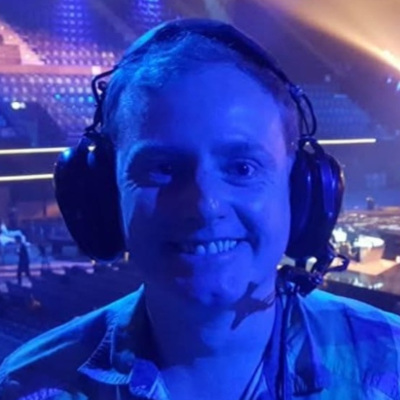
This year, I was lucky enough to secure Gold Circle tickets for the Grand Final Preview, giving me the opportunity to experience Eurovision from inside the arena itself. Watching from that close changes your understanding of the contest entirely.
Eurovision is not a radio competition — it’s visual storytelling on a massive scale. Camera direction, lighting, choreography, costume and staging all work together to construct a three-minute television narrative. The countries that consistently perform well understand this instinctively. Every camera cut is deliberate. Every lighting cue reinforces emotion. Every visual choice sharpens the identity of the act within seconds.
The biggest difference between being inside the Gold Circle and watching at home is scale and atmosphere. In the arena, you physically feel Eurovision. The crowd energy is overwhelming. The bass vibrates through your chest. Flames radiate heat across the room. You become part of the spectacle itself.
Interestingly, the arena is also incredibly forgiving vocally. Crowd noise and live acoustics soften imperfections in a way television never does. At home, the broadcast mix isolates every vocal line with clinical precision. Suddenly you hear every breath, every strain and every slight wobble. A vocal that sounds flawless in the arena can feel exposed on TV.
However the arena offers something television never can: proximity to human detail. Standing close to the performers, you notice beads of sweat, shaking hands and adrenaline-fuelled intensity. It’s visceral and chaotic in the best possible way. Television, meanwhile, is controlled. Your experience is shaped entirely by the director’s choices — the camera angles, the cuts, the pacing and the sound mix. The strongest Eurovision entries understand this completely and prioritise the viewer at home above everything else.
Liekinheiten’s On-Screen Storytelling
This year’s favourite, Finland’s ‘Liekinheitin’, is a perfect example of staging engineered specifically for television. The performance understands scale, intimacy and escalation.
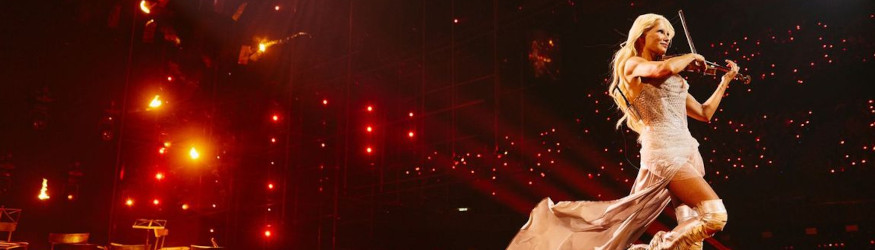
Extreme close-ups on Pete Parkkonen trapped behind the “confessional” create an immediate sense of vulnerability and emotional claustrophobia. The red and orange lighting palette makes the shots feel hot, suffocating and cinematic. In contrast, the wide shots of violinist Linda Lampenius, surrounded by sweeping camera movements and dramatic wind machines, suddenly open the performance out into something epic.
When flames engulf the confessional, the camera circles both performers on either side of the fire. The speed of the movement combined with the intensity of the lighting creates one of those unmistakable Eurovision moments that feels designed to dominate social media clips within seconds. Then comes the big final reveal. As the camera slowly pulls back from the empty confessional, Pete and Linda are finally shown together for the first time. It’s a clever visual payoff: his emotional vulnerability colliding with her fierce, almost defiant energy. The violinist becomes just as visually commanding as the vocalist, and when they finally perform face-to-face during the climax, the camera direction delivers genuine emotional release.
Watching this from the arena was fascinating because my experience was completely different from the one being created for television. I wasn’t focused on the broadcast screens or following the intended narrative. Pete was actually performing behind me on the opposite side of the confessional, so I could barely see him. Instead, my eyes were drawn entirely towards the violinist and the sheer theatricality of her performance.
However, the atmosphere was electric, and I could feel the heat from the flames and smell the smoke filling the arena. It was immersive in a way television can never fully replicate. But paradoxically, the storytelling itself was clearer on TV.
Ferto’s Bag Of Television Tricks
The Greek entry, Ferto, is a multi-sensory explosion of fruit-machine emojis, scooter antics and surprise reveals. It’s pure unadulterated fun — the 21st-century lovechild of Sonic the Hedgehog and Eurovision mashed together into three gloriously bonkers minutes.
Television production techniques are used to the absolute max here. From the kaleidoscopic silver tunnel to the fireman’s pole, Akylas never stops entertaining or surprising the audience. The team even use a visual trick that makes him appear to walk through a sea of swirling emoji graphics in full 3D. On television, it looks incredible.
In the Gold Circle, however, the illusion completely disappears because you can see the mechanics behind it. From the arena floor, it’s obvious he’s simply standing in front of a screen. Likewise, I couldn’t properly see Akylas inside the kaleidoscopic tunnel from my viewing position, and the fireman’s pole section was partially blocked too. The climax of the song features Akylas moving through four strikingly different set environments which feels wildly inventive on TV, but from the arena I could only properly appreciate one of them.
This is a performance designed first and foremost for the television audience. Yet despite that, Ferto was still one of the most enjoyable arena experiences of the night. The atmosphere reached fever pitch as Akylas flew down the runway on a scooter while pyrotechnics exploded on either side of him. It’s pure visual spectacle — chaotic, ridiculous and completely Eurovision.
Australia’s Star Power Is Everywhere
Delta Goodrem delivered a genuinely showstopping vocal performance with Eclipse. She’s a seasoned professional who instinctively understands how to work both the camera and the arena simultaneously.
If Eurovision were purely a singing competition, Delta would be right at the top of the leaderboard. The gold visual motif throughout the performance feels rich and expensive, while the final moment — as her podium slowly rises towards the ceiling — gives her the aura of a triumphant goddess ascending into the heavens. It’s memorable, commanding and has all the hallmarks of a classic winner’s performance.
But interestingly, it feels like an X Factor winner’s performance. That’s both its strength and its weakness. If this were a 2004 X Factor final, Eclipse would probably walk the competition. But Eurovision in 2026 rewards individuality, unpredictability and visual originality above straightforward vocal excellence. While Delta absolutely delivers star quality, the song itself feels slightly dated compared to some of the more daring entries surrounding it.
A Deep Dive For Denmark
The Danish entry, For Vi Går Hjem, is another performance clearly constructed through the lens of a television camera rather than for the arena audience. Grey-blue lighting creates an underwater world as dancers twist and contort within a claustrophobic Perspex box, like figures trapped beneath the ocean surface. When Søren performs above them, the camera shoots upward through the transparent floor as he appears to “hit” the water. On television, it feels intimate, raw and cinematic.
In the arena, however, you become aware that you’re missing parts of the narrative because you’re no longer being guided by the director’s eye. Yes, the big screens help, but it’s not the same experience as watching the performance fully constructed through camera language.
Some Eurovision performances simply make more emotional sense on television than they do in the room.
Is Staging The UK’ Achilles Heel?
Over the years, the UK has spectacularly struggled with this balance. Time and time again, decent songs have been let down by staging that feels safe, vague or oddly small-scale. Too often, UK entries come across as competent rather than memorable.
Last year’s What The Hell Just Happened? by Remember Monday perfectly demonstrated this problem. The trio were strong performers, but the staging never pushed the concept far enough. The chandelier centrepiece felt decorative rather than integral to the performance.
The song is supposed to capture the chaos of a wild night out remembered through the haze of the next morning’s hangover. I wanted one of them hanging from the chandelier kicking off a six-inch heel while another dramatically revealed a fake tattoo to camera. I wanted mess, danger and visual chaos. Instead, the performance felt oddly restrained. The staging, camera direction and overall presentation never fully committed to the song’s personality.
This year’s UK Entry, Eins, Zwei, Drei is weird, playful, slightly absurd and crucially memorable. That immediately places him in a different category from many recent UK entries, which often felt polished but cautious. At first listen, Eins, Zwei, Drei almost sounds like a novelty song. But Eurovision history repeatedly proves that quirky performances can do extremely well when delivered with total conviction.
The German title and Europhile references cleverly tap into Eurovision’s pan-European sensibility. Lyrics about “counterfeit pounds” and wanting euros feel cheeky, self-aware and mischievous rather than cynical. Of course, there’s always a risk that some viewers may find it too knowingly British – but that tension is partly what makes the entry interesting.
In the grand final preview, Eins, Zwei, Drei, starts so well in the arena. The conveyor belt running across Sam’s desk is cheeky and playful, and when he plugs in the TV-headed dancers it’s genuinely funny. But once the performance moves beyond the opening concept, it starts to lose momentum. Why is Sam suddenly wandering across office desks? Both in the arena and on television it looks strangely flat. And when you compare it with the genuinely madcap staging of Greece, the UK entry suddenly feels a little underwhelming.
Sam absolutely has a concept and a strong visual identity, but the performance never fully develops those ideas. Repeatedly pretending to play a synth simply isn’t enough. Where’s the escalation? Where’s the visual payoff? Where are the pyrotechnics? Honestly, the UK could learn a lot from Greece.
Bold Characters Win Eurovision
With only three minutes to sell a song, character becomes everything. Just like reality television, Eurovision rewards performers who are instantly recognisable and impossible to ignore. The acts that stay with audiences are usually the ones that feel fully formed from the second they appear on screen. Over the years we’ve seen this with artists like Netta or Conchita Wurst — performers with a clear visual identity and undeniable point of view.
In 2026, this matters even more because audiences react instantly. Clips circulate across TikTok, X and WhatsApp within seconds. If a performance doesn’t land immediately, it risks disappearing completely. This year, Serbia’s Lavina opens with a close-up of a black clawed hand which instantly establishes Kraj Mene’s identity: dark rock theatre with a heavy gothic edge. In contrast, Antigone – previously known from Love Island – leans fully into bombshell glamour with Jalla. Her performance shimmers with heat, confidence and summer energy.
What makes the UK’s Eins, Zwei, Drei so interesting is that, for once, the BBC has actually sent an act that feels genuinely distinctive. Sam Battle has a Damon Albarn-esque quality mixed with mockney eccentricity and the chaotic inventiveness of Doc Brown. As an artist who builds instruments from retro electronics, he arrives with a strong visual identity before the performance even begins. Ultimately, we won’t truly know how well this identity lands until the public vote arrives.
Arena Sound vs TV Audio
What fascinates me most about experiencing Eurovision from the Gold Circle is how differently the contest operates in the arena compared with on television. Inside the arena, sound becomes physical. The PA system fills the entire space with natural reverb while thousands of fans scream around you. Vocals sit inside the soundscape rather than on top of it. It’s euphoric and immersive but rarely precise.
Television is the exact opposite. At home, every microphone is isolated and carefully mixed for clarity. Engineers use compression and EQ so vocals cut cleanly through the track. The result is sharper, cleaner and far more exposed. That’s why some performances feel vocally stronger in the arena than they do on television — there’s nowhere to hide in the broadcast mix. Conversely, certain performances that feel underwhelming live can suddenly come alive on screen because the camera direction and controlled audio mix shape the emotion more effectively.
And that, ultimately, is the key to Eurovision. It isn’t a concert that happens to be televised. It’s a television show that happens to have an audience. Every decision from lighting and sound to choreography and camera movement is designed primarily for the millions watching at home. From a production perspective, the camera is the real audience. The acts that understand this and treat their three minutes as a complete piece of television are usually the ones that succeed.
This year, Finland, Greece and Australia have absolutely mastered that formula in very different ways. Liekinheitin delivers artistic intensity and cinematic drama. Ferto is a hyperactive visual funhouse. Eclipse relies on pure star power and vocal authority. Of course, Eurovision history proves that none of this guarantees victory. The UK has already seen established names like Bonnie Tyler and Blue struggle to connect with the scoreboard despite huge recognition.
Three Live Minutes To Win
So could Delta Goodrem finally secure Australia’s first Eurovision win? Will Finland’s artistic ambition translate into votes? Or could Greece’s sheer visual chaos become the performance everyone remembers the next morning? That unpredictability is exactly why Eurovision still works. And perhaps that’s the real secret to its success: in an age where almost everything is available instantly, curated endlessly and watched later, Eurovision still feels gloriously live.