




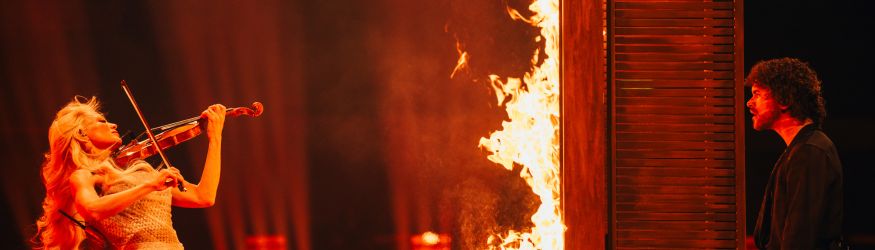
Linda Lampenius is the star of Finland’s Eurovision entry this year. While her duet partner Pete Parkkonen is the one singing throughout the three minutes, telling his lustful story in abruptly horny Finnish, it is Pete’s role that plays second fiddle in this story. For it is Linda that he is lusting over, with Lampenius’ violin melody the one that struts like a peacock showing her confidence and power in this to-be-or-not-to-be relationship.
Linda Lampenius has made it clear that it was her who approached Pete to be a part of the song, rather than the other way round. For all of Pete’s successful career within Finland with 4 albums and touring pedigree, it is Linda Lampenius’ musical experience which features a who’s who list of collaborators that showcases not just global fame but also proven star quality. This caught uneducated myself unaware while at UMK this year conducting our own Audience Poll on the ground in Tampere, with more respondents in the arena referring to their favourite act as ‘Linda’ rather than ‘Pete’ or song title ‘Liekinheitin’.
Now at Eurovision, with ‘Liekinheitin’ a strong favourite for the crown, that makes Linda’s goddess-esque strut of power down the catwalk easily one of the Song Contest’s most anticipated moments. With the decision made to allow Linda to play live that anticipatition increases tenfold. Yes we are talking about one the most well known and well-routined concert violinists in Europe to grace our stage, but the extra pressure of performing live and the sound quality risk makes the moment significantly more edge-of-your-seat, more risk-enducing entertainment than it needs to be for a TV production. It doesn’t need to be live to be iconic and impactful – but Linda Lampenius’ choice takes this Contest into new territory.
The Decision Making Process
At Finland’s Uuden Musiikin Kilpailu, Linda Lampenius and Pete Parkkonen’s performance was choreographed to the millisecond in a number already fit for the Eurovision stage. For that performance, while Linda did play the violin live, audible to the first few rows of the arena, it was not mic’ed up or amplified in any way.
Eurovision for much of its history has been a show with live music, created by an on-location orchestra, but during the 90s the Contest slowly evolved to allow non-orchestral instruments, backing tracks, and eventually by the turn of the century a requirement that all music was to be pre-recorded. This expanded to include backing vocals in 2021, in a move made to make organisational logistics easier in the face of uncertain COVID-19 restrictions, yet the rule remains to this day allowing backing vocals not on the same tone as the lead singer to also be pre-recorded alongside the rest of the music.
While discussions appear to have taken place from March, the announcement of Finland’s successful request to allow Linda Lampenius to play live came only in this upcoming Eurovision week. After the second rehearsal on stage, Finnish broadcaster Yle stated that they had been given the go ahead from host broadcaster ORF and the EBU to play live.
Understanding The Decision Making Process
Being asked to make a statement on this rule change, the European Broadcasting Union stated that within their full rules document (note, this is not anything covered by the public summary of Eurovision rules available online), the EBU reserves the right to allow artists to use”live audio capture of instruments exceptionally…where artistically justified.”
As far as we are aware, for the 2026 Song Contest this discretion has only been given to Linda Lampenius. Why? The Director of the Eurovision Song Contest had a straight forward answer. It was only the Finnish delegation that formally submitted this request to the EBU.
It is only for us to speculate on the behind-the-scenes conversations and discussions that have allowed Linda’s musical moment even more in the spotlight this week. But it was a discussion that led to a plan, one where it could be trialled and tested in Helsinki and in Vienna as an experiment, with a backup agreed in the worst case scenario. It could also be argued that Linda Lampenius’s gravitas as a performer was also a consideration, with decades of experience with a violin in hands, there is no safer pair of hands in Contest history to take this historical step.
Finally, the final point in this discussion is to return to the EBU’s point about the artistic merit of Linda playing the violin live. For other named artists at this year’s Song Contest there is opportunity to artistically emote through their lyrics and melody. For Linda, a named artist on the performance but not singing even a single note, reducing her part to purely miming makes the named artist effectively a dancer. I paid much attention to Linda’s violin part on Tuesday’s show. Could I tell it was different? Yes, if I focused on it. What I was hearing was an intensity on her violin strokes that a studio version would edit out, and dare I say I preferred what I heard on Tuesday compared to the National Final. Just being slightly more dramatic and determined timbre Linda played did add a value on stage.
Fairness and the Future
It has not been public knowledge before that the EBU, within their own private version of the Eurovision rulebook, had this discretion available to artists for their performances with any instrument. Sure, we remember how Lucio Corsi smoozed his harmonica into Italy’s number last year, but the assumption there was, with it being the same microphone as his singing, there wasn’t anything that could stop such innovative musicianship.
I’ve been covering the Song Contest for ESC Insight since 2012, throughout those years this question popped up repeatedly from different acts, with the answer always being around us that music had to be pre-recorded. We do not have knowledge as to when this rule came into its current form, but we do not know of any delegations submitting any such formal requests previously, to be trialled during rehearsal week, similar to what Finnish broadcaster Yle has managed to pull off.
During the pandemic I studied a course co-ordinated from the British Council on policy change. My main takeaway from that course was that, it isn’t about the right ideas, but finding the right time to make policy change happen. Without a Linda Lampenius and her epic catwalk moment, and a confident Finnish delegation behind her, itt’s likely we’d never had this watershed moment.
Now we have that pioneer who has opened the floodgates, and this is healthy for the Song Contest. In my eyes it is fully conceivable that, as commentators across the continent inform their audiences of Linda’s live violin playing, musical talents from Soroca to Scotland will prick up their ears. And no matter whether Linda and Pete take their favourite status to eventual Eurovision victory, I am confident this story and freedom will encourage other more serious musicians to consider being a part of the Song Contest.
What I do hope happens next is that the EBU Reference Group ensures a thorough evaluation of this rule going forward. The rules about live instruments have no reason to exist away from the public version of the rules – the version that prospective future artists consider if they might want to take part in this showcase in the future. It isn’t TV executives at delegations who will care passionately about the ability to perform live, but instead is the performers themselves who want to know what creative freedom they can offer in front of millions across the continent.
Yes, setting up live music is an additional challenge for arguably negligible little TV audience benefit, but if an act and broadcaster can do so within the 40 second postcard window then it shouldn’t be the host broadcaster’s nor EBU’s right to deny the request. Ultimately, the risk that a performance doesn’t sound good live, with an instrument or with a live vocal, lies with that artist and competing delegation rather than the host broadcaster and EBU. One compromise for a future fairer playing field could be to use an old Melodifestivalen rule where one instrument would be allowed to be played live over a backing track, making sure live instrumentation doesn’t become an overbearing headache for organisers.
When the Eurovision Song Contest began in the 1950’s, there were two goals. One was to ”encourage the creation of original songs and stimulate a spirit of international competition.”
The other aim was to ”test the limits of live television broadcast technology.” While back in the 1950s that might have meant more about satellite links across the continent for radio and TV broadcasts, today that refers to everywhere on and around the Song Contest which pushes the boundaries of what is possible for a TV broadcast. Performing that music live is one way of constantly pushing that boundary.
In the world of sports we have numerous examples of pioneers that ended up getting rules named after them. The Bosman in football, the Duckworth-Lewis in cricket, the Buster Posey rule in baseball – these are all rule tweaks that transformed their sport and are still referred to by the name of their key individuals today.
I suspect we’ll be talking about The Lampenius rule for years to come.