




Introduction
As the Eurovision Song Contest marks its 70th year, the institutional armor of the European Broadcasting Union is being tested by a public, and an academic community, unwilling to accept the Song Contest’s neutrality. This report from the ninth Eurovisions Academic Conference in Vienna reflects the core tension expressed by those present, directly or indirectly covering the political issues slamming into Eurovision today.
Drawing on institutional perspectives from ORF and fresh data from the conference’s Science Slam, we examine how the “United By Music” permanent slogan has shifted from a celebratory brand to a problematic command for artists and broadcasters alike. By reviewing the discourse surrounding Israeli participation and the evolving habits of political activism among the community and beyond, this analysis suggests that the Contest’s traditional shield of objective neutrality is increasingly incompatible with today’s hyper-connected geopolitical landscape. We conclude by asking whether the EBU can survive the transition from being a broadcaster’s tool to a platform for an increasingly activist audience.
The Institutional Brink: Public Value vs. Populism
Public value was the theme of this year’s Eurovisions Academic Conference. While this broad theme took the conversation in numerous different ways, such as public service’s value for democracy, technological innovation and issues of representation – much of the conversation at Eurovisions this year was focused on the political challenges of Eurovision today and for public broadcasters around the continent.
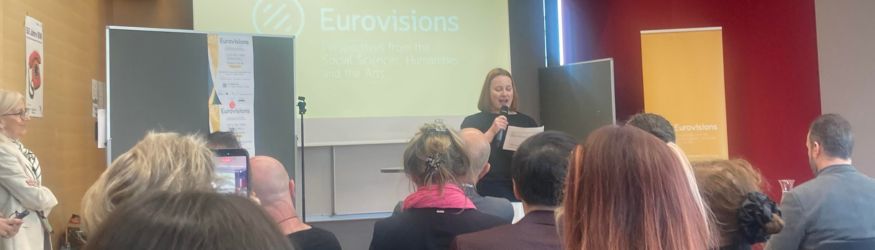
The introduction presentation to Eurovisions 2026 was from ORF’s Konrad Mitschka. Mitschka’s role within the Austrian public broadcaster is to head up their Public Value Co-ordination Centre, which sets out policy for and evaluates how well the ORF meets their public service requirements. Mitschka describes public service media as being “on the brink of existence” because of competition from newer media forms, especially social media giants like Facebook and Tiktok. Mitschka explains that in this ever-divided world it is easy for populism to flourish, as media channels exist in a space “virtually the opposite of public value.”
At the Conference I asked Mitschka to expand on this point, relating it to the same challenges Eurovision has today, in the threat of a populist agenda using Eurovision as a platform. Konrad was relaxed about this topic, reminding the audience that Eurovision survived through being hosted in dictator-led nations in its history. “It worked for 70 years”, Konrad concluded. “Everyone will always want to instrumentalise something so successful.”
Data and Disconnect: Voting Patterns and Fan Identity
Eurovisions holds a Science Slam each year, an entry-level academic presentation opportunity for newer researchers. One of the year’s eight presentations was focused on the relationship of geographical and political voting throughout the last fifty years of the Eurovision Song Contest.
That study by Güttinger et al. did discover voting patterns between neighbouring countries described as “tiny” compared to the whole Contest, so not alone decisive of if any nation does well or not. Their study found that many of these voting blocs were unstable, changing through time suggesting a less static bias system in Song Contest voting. However their research did spot some political events that caused some spikes in voting attitude change, such as Russia’s invasion of Ukraine, Brexit and German reunification which were seen as events which were seen as triggers for voting patterns to make a step change. But even these spikes, and any perception of voting being political, were also not seen as static over the lifetime of the Contest’s multi-generational history.
I put it to the team that one flaw of their study is that they only researched the impact of jury voting. This meant these multi-generational trends could be observed, but it also meant that it doesn’t measure possible politically influenced voting that exists on the public vote. At the Science Slam the team gave their “gut feeling” that, while jury voting might be more connected to a government direction at the time, any spike from the public vote would be “more based on public opinion” and support at that time.
What is interesting with this is public opinion on where the political issues should be within the Song Contest. Fellow Science Slam participant Max Bauer researched the development of the Austrian Eurovision fan community over time, noting how there has been an increase in those describing themselves as a Eurovision fan since Conchita’s win in 2014. His research into the Austrian fan community saw that music was the number one most important reason people self-identified as a Eurovision fan. However his research noted that, in recent years, the spectacle of the Song Contest was an increasing factor.
Bauer’s research noted that for younger fans, and also for the lesbian community identifying as Eurovision fans, the political impact of the Song Contest was more important than to other groups. Bauer’s outlined how this created a division between groups given Eurovision’s current geopolitical tension, and that for many fans they seek a place for dialogue and emotion. However, certainly within online forums, Bauer notes that often many discussions that go into the political space about the Contest are shut down, despite noting how important that can be for the Contest’s newer generation.
Neutrality and “Reading Between the Lines”
The political discourse around modern Eurovision was also researched by Science Slam participant Luise Poppe. Poppe’s study was an in-depth look at how three Austrian publications had covered the Israel-Gaza conflict in the scope of their Eurovision coverage. Poppe noted how all publications covered the event and discourse in an “objective and neutral” way, with any opinion on the topic limited to column pages.
Poppe did note though that she felt there was a difference between the coverage from host broadcaster ORF, compared to big publications such as Kronen Zeitung and Der Standard, since JJ won in Basel. Poppe believed that, with ORF’s requirement to host Eurovision 2026, that led to ORF’s coverage becoming “really neutral”, referring to the same messaging as the EBU, in contrast to that of those more independent news sources.
While the media coverage was uniformly neutral, Poppe noted that it was possible to “read between the lines” without breaking this neutrality approach. The use of the word, Normalerweise, best translated as usually, was one word that, indirectly, created doubt for the reader without making the article appear negative to any viewpoint.
“United By Music”: An Aspiration or a Problem?
The Eurovisions Academic Conference culminated this year with a round table conversation to tackle the big issue head on, how does Eurovision’s place in Europe and the latest turbulence directly around the Song Contest impact on its issue to be United By Music.
Jack Shepherd of Mid Sweden University was on the panel. From his research perspective, he noted how United By Music evolved from a one-off slogan for the British/Ukrainian co-host to be the permanent slogan the year after. Jack described that slogan choice as, rather than one that would continue to unite the delegations, participants and general public, as ultimately being “problematic.”
I asked Jack to expand on his reasoning for this statement after the Conference session.
“Like many people in this room attested to, Eurovision does unite and does unite by music primarily. But from a sort of organizational perspective. I would call it perhaps insensitive given that at that time. If you remember in November 2023, that’s when they decided to [announce] this, and right then you had this war in Armenia in Nagorno-Karabakh, so the ethnic cleansing of Armenians. You obviously saw October 7th the month before. I mean the idea that we would as a continent be united by music was kind of ludicrous at that time. It felt out of place and I think nowadays that it’s set up a problem for the organization.
Because with a slogan like, for example, ‘All Aboard’ means you can’t go wrong with that. And there’s no real standard to meet up to. In my research I’m looking to see if people are united by a rulebook or are we united by values? And I think that’s something [the EBU] haven’t quite worked out, which side of that they’re on.”
And when those slogans speak of a higher public value of Eurovision which is too explicit, and lean too much into a higher power, the sense of purpose they confer can be limiting rather than enabling. This is my response when listening to Bamlak Warner, the panelist who, alongside studying for a Master’s in Cultural Management, came second in the televote at this year’s Austrian National Final.
Warner told the story of her time at a songwriting camp for said Austrian selection.
“I stood in-front of the microphone and thought to myself, United By Music. 70 years. I have to make a song for this show, and I’ve never been in this position. And it dawned on me, we’re not united by music right now. Then I went into this loophole, what are we all?
Maybe not united by music, we’re not just one thing.
That’s how the song got to be, I wanted to have this very political statement in my song and criticise it directly. If I could be music, and see what is happening on Earth. Make it go away, unite us all, and make peace now. [The slogan] is a command, which is the opposite of what art does. When has creativity been a demand? I didn’t go deeper into that rabbit hole because it scared me.”
Klaus Unterberger, head of ORF’s Public Value Management, did offer an alternative view to this United By Music critique, describing how increasingly that “society is split up into individuality” and that for him United By Music was “not a command, but an inspiration, to remind us.”
However, Shepherd reminded us that, despite intentions, this branding was “heavy” for the Song Contest. Shepherd also expressed by having one constant Eurovision slogan, we missed the opportunity for alternative slogans each year, which “had value about creating discussions”. The example Shepherd gave was how the 2019 slogan Dare To Dream was “instrumentalised” by Israeli NGO Breaking The Silence, offering tours by former Israeli Defence Force soldiers telling the story of Israeli occupation in the West Bank on daily tours, with soldiers telling stories about what they were not comfortable with.
The Evolution of the Public’s Voice
One other conversation topic we had with Shepherd was about what is missing from the current debate about the Eurovision Song Contest in navigating these geopolitical challenges. While Shepherd noted the historical perspective, and how Eurovision has navigated eras of conflict and dictatorship across the continent before, Shepherd notices that modern society wants to tackle these issues in a different way than before.
“The difference is the reaction of broadcasters and partly the reaction of the public. [The public] are now more involved in politics, but not in a traditional sense. Traditionally we used voting and we used politicians as our way to enact politics. Now people are enacting politics in very different ways through consumerism, through commenting online, it’s not really politics as we traditionally knew it. That’s led to a change in broadcasters who are now pushing for the admission or exclusion of countries that never happened before.”
Some of Shepherd’s current research is into the travel to country’s labelled as dictatorships, and what he describes as an “unreasonable expansion of moral concern” on those who are travelling as mere tourists. For Eurovision, he ponders if social science can research into complicity, giving the thought experiment of wondering how fans attending Eurovision today are complicit what is happening on the ground in Gaza.
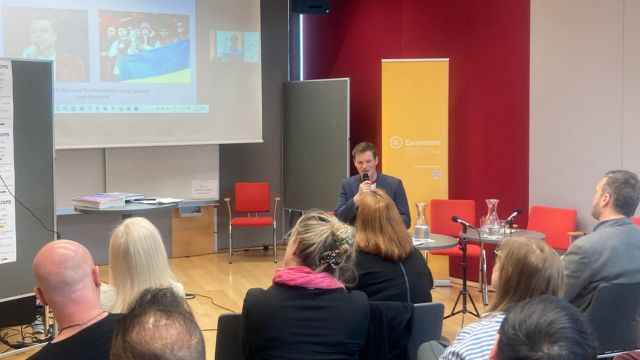
Jack Shepherd presenting at Eurovisions in Vienna (Photo: Ben Robertson, ESC Insight)
Conclusion: A Rulebook in a World of Values
This year’s Eurovisions highlighted a fundamental shift in the Eurovision ecosystem. As Jack Shepherd poignantly noted, the EBU is currently caught between being an organization united by a “rulebook” and one united by “values.” The Song Contest has been this place of togetherness for the better parts of 70 years, above all else. But in 2026, the data and the discourse suggest that the neutral ground is shrinking, with the Song Contest attracting a fan base that is younger, and more wanting to directly engage in the geopolitics that have crashed into the Contest’s space in recent years.
From the artists like Bamlak Warner feeling the weight of a slogan that feels like a command, to the younger fans for whom the political impact is as vital as the music, the public value of the contest is being on one side ever more explicit, but also ever more critiqued. While institutional figures like Konrad Mitschka may find comfort in the contest’s long history of survival, the modern reality is that the public no longer waits for politicians or broadcasters to define the narrative. They enact their politics through their screens and their votes,
If Eurovision is to remain “United By Music,” the EBU and its broadcasters may need to decide if that unity is a static rule to be enforced and sounds like a command to the next generation, or if it can find a different way to become the enabler that it intends to be.
The Eurovisions Academic Conference on the Eurovision Song Contest takes place each year in the Eurovision host city. More information on that is available at eurovisions.eu. One is able to rewatch the Conference online vid their YouTube channel.