





Let me take everybody back to the Eurovision Song Contest of 2016, now coming up for its tenth anniversary. We saw interval acts to remember, with the Grey People tribute to the refugee crisis, Justin Timberlake’s megahit ‘Can’t Stop The Feeling’ world premiere and ‘Love Love Peace Peace’ imprinting itself in all our hearts. Stockholm shone in an off-season heatwave with fans welcomed on a scale like never before seen, building a EuroClub for thousands outside the Royal Palace and a Eurovision Village located as centrally as ever could be. And this all culminated with a voting sequence that was arguably the most dramatic in Song Contest history to date as Jamala pipped jury favourite Dami Im and televote favourite Sergey Lazarev to bring the Contest to Kyiv.
One notable statistic about the 2016 Eurovision Song Contest comes from the songs that performed that year. Of the 42 participating nations that year, only three songs, ‘Loin d’ici’, ‘Ljubav je’ and ‘Dona’ featured no English language during their three minute performance.
Of these three songs, only one, ‘Loin d’ici’, reached the Eurovision final, joining the Italian and French entries that complimented their native language entries with English text, as well as eventual winner ‘1944’. That’s four songs out of twenty-six daring to sing anything not in English.
This year couldn’t be more different.
The 2026 Eurovision Song Contest features 16 songs that are fully in English, compared to 14 songs that are fully in different language. 5 songs, including Azerbaijan’s ‘Just Go’ and Malta’s ‘Bella’ are bilingual, sprinkling English language lyric combined with their Azeri and Maltese respectively.
Not only is this a striking statistic, it looks somewhat likely that the 2026 Grand Final will be one of Eurovision’s most linguistically diverse of the century. In these cautious pre-rehearsal times we note that four songs fully in English, from San Marino, Poland, Estonia and Belgium are expected with betting markets not to quality in Vienna. Furthermore Semi Final Two odds anticipate Armenia, Switzerland, Luxembourg and the aforementioned Azerbaijan as songs with English language lyrics with strong chances to miss out.
Should this play out in Austria as betting markets conclude before rehearsals, that would result in a Song Contest Grand Final of 25 songs, of which only eight were fully in English and four other tracks using English alongside other languages. And we saw shift as well last year, with only ten of the songs in the Grand Final in Basel featuring any English language text.
The huge shift from English language dominance to one where other languages now have a parity in the competitive field of Eurovision is a journey that is now not just a one year blip, its a trend that’s taken a decade to get here.
That leads us to ask, why has this trend hit Eurovision the last ten years, and what does it mean for the competition itself?
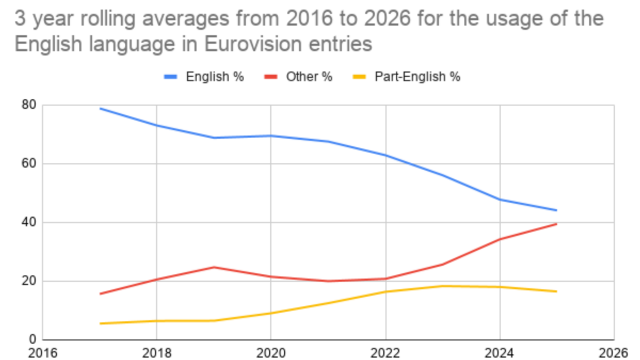
Rolling average of languages sung at Eurovision (Ben Robertson)
Proof That Language Is No Barrier
Growing into the Eurovision world through the late 2000’s into the 2010’s, the belief was that the English language was the way to go for the best way to qualify and eventually win the Eurovision Song Contest. ‘Molitva’ won the 2007 Eurovision Song Contest, but since then to 2016 only two songs, ‘Nije Ljubav Stvar’ and ‘Grande Amore’, have been able to squeeze onto any imaginary Eurovision podium.
That glass ceiling was shattered spectacularly the year after, after Salvador Sobral won Eurovision with a still record high score of 758 points, scoring 382 points from the juries and 376 points from the public. When Salvador spoke after winning Eurovision with a critique for “fast-food music”, I’ve always interpreted that victory speech as a rebuttal against this feeling that music has to put into a certain box or checklist to succeed, such as language.
Since Portugal’s Eurovision victory have we had six different tracks in non-English languages hit podium positions, including the entire top three from 2021 and of course 2022 winner ‘Stefania’. Modern Eurovision has shown that you do not need to be in English to be a success. If anything, language helps a song to embrace a cultural identity that makes a song’s character more voteworthy.
‘Cha Cha Cha’ is about a particularly Finnish self-depreciating reflection of cultural norms, ‘Soldi’ speaks of Mahmood’s relationship with his father, and ‘Tout l’univers’ grasps an artistic flair which harmonises with the French language. Yes, I am talking with an opinion here, but all of these tracks would be significantly less authentic and dramatically weaker competitively should they have been performed in English. That isn’t the case with every song in Eurovision history, but many of these songs stand out as being more powerful for their native language choice.
The Democratisation Of The Pop Music Industry
One huge difference that we have seen for the past ten years of pop music is how the streaming industry, which was competing with radio as the important platform back in 2016, has now significantly overtaken radio as the driving force within the music world. As well as streaming’s increasing dominance, the music scene has now also witnessed a huge social media growth, with songs blowing up on apps like TikTok and Instagram without touching the mainstream music industry first. No wonder these last ten years have seen a wave of K-pop and Latin domination in the music industry.
While we can all question the true fairness of algorithms that feed us content, this does still lead to a world where the gatekeeping of success is now less protected by the old-school powers than ever before. It means that if you have a successful concept in that space you are able to create your own views/streams and eventually points on the scoreboard by reaching fans old and new much more directly. We’ve had songs in modern National Finals surprise in how much they came to life on social media, carrying them through to success at the Song Contest.
And what we have increasingly evidence of working in the Eurovision space are songs and performances that are not simply just ones made for international radio appeal. Instead we witness deeper opportunity to carve certain niches that traditional stakeholder media wouldn’t dare to promote directly without proof it worked. Here is a space where you, the artist, can directly create your own character and narrative and drive that to a wider population. That doesn’t need a language – especially now in a world of much improved instant translation – allowing artists to be their own self in their own language significantly more easily and more successfully.
The Soft Power Of A Language Choice
Going back a decade, we were still in a world where the ability of the upcoming generation to speak English was a show of integration and inclusion into a shared Eurovision space.
That is no longer a defining point of view. Across European school curricula ensure English is on the timetable almost universally, meaning that among this generation of artists and songwriters it is no longer anything special, or anything to show off, that you and your entry can command three minutes of lyric in the English language.
Instead what there is to show off is something that can’t be expressed in universal tongue. Songs like ‘De Diepte’ or ‘Deslocado’ are prime examples where the whole tonality of the song, the way the messaging flows and the way the story is told, has a dynamic and cadence of which the language itself is part of the expression. And without getting political, Europe today has much more discussions about identity, not just on a European level, but one on national and regional levels as well. It’s not just that we are seeing more national languages at the Song Contest, but also regional ones, as public broadcasters allow their Eurovision or National Final participations to mirror different parts of their own nation’s culture more, rather than always expressing an outward-looking approach.
We have evidence that you can perform on the Eurovision scoreboard in any language, but those choices have more meaning in today’s world of instant translation than any scoreboard success. Representation is also a victory in itself.
How Does This Change The Competition?
The number of entries solely in the English language have been declining in percentage terms since each year since 2021, with 2025 the first year that the number switched to under 50 percent of all competing entries.
Now part of the theory that singing in English was an advantage harks back to the days when Eurovision had language rule restrictions and was only decided by the juries, a world where Ireland scored seven victories and the United Kingdom almost all of their 24 podium positions. Of course it is simplistic to assume that this is purely down to singing in English, but the correlation between the free language rule being implemented and the fortunes for Ireland and the United Kingdom dramatically turning worse at Eurovision makes this correlation hard to seperate.
Last year saw just 13 of the competing entries being submitted in solely English. We saw a Contest where heavy favourites Sweden, singing in Swedish, stuttered to a 4th place finish, as Austria and ‘Wasted Love’ won Eurovision. The televote top two were Israel’s ‘New Day Will Rise’ and Estonia’s ‘Espresso Macchiato’. Both the televote top two were only part in English, but the content and context was very understandable no matter where you came from in Europe. Arguably all these three did better than expected on the night, as other deemed contenders like ‘maman’ and ‘Ich Komme’ perhaps placing slightly lower than many were suggesting in Eurovision week.
I also note that for both ‘Wasted Love’ and ‘Espresso Macchiato’ that these songs saw the highest recorded boost in points from Semi Final to Grand Final in Eurovision from data we collected from 2021 to 2025. Could language be a factor? Could the saturation of diverse language tracks at Eurovision still be a barrier for some voters, meaning more voters gathered around English language big hitters for the Grand Final? This could perhaps explain some of the anomaly in these songs Semi Final to Grand Final performances.
This year in 2026 we could see a Eurovision Grand Final with just eight entries fully in English. And it is especially notable that the current favourites in the betting market include four non-English language entries in those offered from Finland, Denmark, France and Greece.
Diversity is great for the modern Eurovision Song Contest. But on the scoreboard are we heading back to an era like the mid 90’s where those English language entries are set to receive a boost to their ranking because of their understandability in a collective noise of different cultures? Does this Eurovision make up help Delta Goodrem’s ‘Eclipse’ secure extra televotes that has been Australia’s weak side of the scoreboard in the past? Does this allow Felicia’s ‘My System’ to pick up points from across the continent and stay in contention? Are the market underestimating the impact of ‘Viva, Moldova’, performed in a plethora of languages yet universally understandable nevertheless?
We are entering a Song Contest where lots is unknown. In the last ten years has Eurovision’s language diversity dramatically increased. But has Eurovision’s voting population caught up with that change? At least amongst those more casual Grand Final voters…I’m not sure they have.