




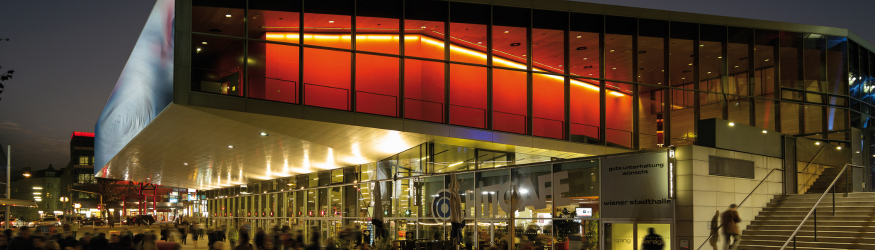
The Eurovision Song Contest last reached Vienna 11 years ago. Coming on the back of Conchita Wurst’s win, it was a victory not just for Austria but one that symbolised progressive values and empowerment being represented across Europe.
For hundreds of years, Vienna has been one of Europe’s grandest and most extravagant cities. Located on the great Danube river, it is culturally synonymous with classical music, grand palaces, and architecture befitting a city that commanded a vast empire for generations.
When the Song Contest rolled into town in 2015, much of that grandiose history was on show, but it wasn’t what captured the headlines. The world’s media picked up on a specific story to show a different side of Vienna to the masses. As part of a widespread takeover of the city, pedestrian crossing lights around the Wiener Stadthalle were altered to feature same-sex couples.
Vienna remains one of the continent’s tourism heavyweights, one of the most visited capital cities in the world, but much of that traffic is driven by imperial history rather than the city’s progressive leanings. Speaking in 2015, then Managing Director of Vienna’s tourist board Norbert Kettner spoke about how Eurovision would have “a huge impact on the image of an open, modern and tolerant city.”
Eleven years on, the question is what the Vienna Tourist Board wants to share this time around to brand their city internationally.
A Team With Experience
The board has the perfect guide for this transition. Helena Steinhart is responsible for International Media Relations within the Tourist Board, and for Vienna 2026, she leads the coordination of the Entertainment Program for visitors. Her perspective is unique because she was already part of the team in 2015, then responsible for marketing Vienna to English-speaking nations like the United Kingdom and Australia.
Helena explains that the 2015 strategy was about utilising the Eurovision Song Contest not to change what Vienna was, but to “embrace the opportunity to show a different side.”
“What we did was correcting a misconception of what Vienna is,” she says. “Vienna is an open-minded, liberal capital city. Dynamic, young and full of arts and culture not just linked to the Habsburgs or coffee houses. We wanted to have that visibility. This is the reason we were so eager to host this again.”
It raises the question of what Vienna hopes to gain from a second hosting. Helena emphasizes that destination marketing is not something that should fundamentally shift every few years. Instead, the goal is to build upon the mood and expectations developed over the last decade. The playbook remains the same: showcasing Vienna’s open and inclusive attitude alongside its iconic European history.
The best indication of this is the variety of activities offered to journalists and delegations. In total, 31 different sites and attractions have been opened to accredited visitors, ranging from the Imperial Carriage Museum and the Art History Museum to various Mozart-themed sites. However, the program also includes “Experiences” that bring a different side of the city to life. Workshops in cocktail making, sign language or saxophone playing, food, wine and e-bike tours, tours of snail farm, exhibition centres with go-kart tracks and queer culture centres.
These 160 different partners have put together an extensive program that blends the conventional with the unconventional. It is a deliberate effort to show that Vienna is a destination for high-brow culture, nature, and a diverse foodie scene all at once and many more things as well. While the city did this in 2015, the goal for the follow-up is more ambitious. As Helena puts it: “The aim is for every visitor to say: ‘This was even better than expected, and Vienna did something we didn’t expect.’”
Vienna’s Size, Scale and Success
This offering of activities and status is something rarely seen in modern Eurovision history. Most recent editions have been held in smaller secondary cities. Basel averages between one and two million overnight stays each year; Malmö and Liverpool sit at just over two million. Turin follows a similar pattern as a secondary tourism hub in a country where more flocks to Milan, Rome and Venice.
Vienna, by contrast to recent host cities, smashed a record twenty million overnight visits last year in a city of only two million people. Compared to the vast majority of hosts, Vienna is a behemoth, a destination already firmly on the map rather than fighting for international recognition. While other cities must push the boat out to deliver a one-off experience, Vienna is simply wheeling out what already lies in its arsenal. In a city that hosts over 6,000 congresses and conferences annually, 100,000 Eurovision fans stretch the infrastructure rather than shock it.
The same applies to the storytelling. Vienna has a narrative ready to roll, spotlighting a product the city has been cultivating for 2,000 years. This is evident even in the technology. Helena’s biggest recommendation for fans is iVie, the official visitor app for the Eurovision Song Contest. While it features Eurovision-specific travel guides and listings for the week, iVie isn’t a special pop-up for the contest. It is the permanent city app for all visitors, simply rebranded and refocused for the week of festivities.
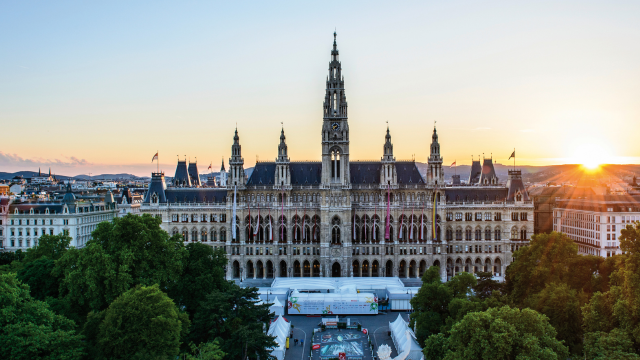
Rathuasplatz, home of Eurovision Village 2026 (Photo: Christian Stemper, WienTourismus)
As Eurovision comes to one of the continent’s most iconic cities, the Eurovision Village will pour out for a full week in front of the Rathausplatz. Most modern contests have to transform parks or random open spots for their festivities, but Vienna places the event on the same space and scale as its world-famous Christmas market.
Vienna is making this a big Contest because Vienna is a big city. Eurovision has the luxury this year of hitting one of the world’s most developed tourism destinations, and fans will reap all the benefits.