




The Model, a Eurovision Song Contest prediction tool, still projects Finland as the favourite to win if the competition were held today.
Following Eurovision in Concert in Amsterdam this weekend, the first major opportunity to see much of this year’s line-up perform live, ‘Liekinheitin’ by Linda Lampenius and Pete Parkkonen is still projected to be this year’s frontrunner.
Finland leads by 32 points from France, a lead which has reduced by four, while Israel has now climbed into third place in The Model despite singer Noam Bettan not performing at the pre-parties.
After Eurovision in Concert, which I was lucky enough to attend, we’re getting a better idea of what we could expect from this year’s Eurovision performances, and that is beginning to affect the data that The Model uses to make its calculations.
In this update, we’ll analyse:
- The countries rising and falling this week
- Which songs generated the most impact live in Amsterdam
- And whether a very low Eurovision winning total is possible
What Is The Model?
The Model was built to answer a simple question: “if the Eurovision Song Contest was held today, who would win?” To do that, The Model turns opinion into data in the lead-up to the Contest to create weekly updates on how the race to Vienna is shaping up. The tool has frequently been more successful in predicting the Contest than betting odds, fan polls, or any other indicator.
This year, The Model is bigger than ever before, with new updates released every Monday from now until Eurovision 2026 on the ESC Insight website, where the results will change and evolve as this year’s Contest comes closer.
A new companion podcast, ‘Inside The Model’, is also launching on the ESC Insight feed, providing weekly prediction updates, unique song analysis, and special guest appearances from the world of the Contest. This week, there’s a special episode as I visit the studios of Ding-a-Dong, the famous Dutch Eurovision podcast, for a long conversation about this year’s Eurovision race and our predictions for Vienna – some based on The Model, others not. However, you’ll have to wait until Tuesday 14 April to see that!
Under the Hood
The Model has had two small tweaks this week, but I’ll keep this short.
The first adjustment is in how Ukraine’s jury points are being calculated to offset against their expected strong diaspora voting from the public. This in theory will provide a more accurate balance for Ukraine’s points. The second one is a similar re-balance around Israel’s jury scores.
As a result, while all other countries are a direct comparison this week, the jury scores for Ukraine and Israel are slightly larger this week as a result of this re-calculation, so it’s best to approach those with that knowledge.
And with that, this is what The Model forecasts would happen if the Eurovision Song Contest was held today, 13 April 2026.
Semi-Final One
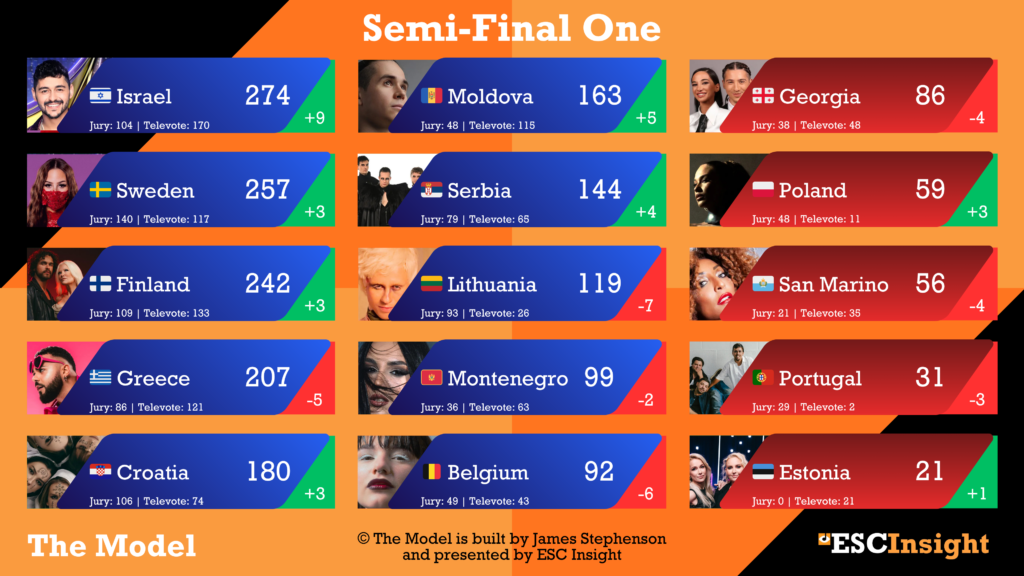
Semi-Final One from The Model – 13/04/2026 (James Stephenson)
Beginning with Semi-Final One, the main thing I notice from The Model this week is that there is a slight firming up in the numbers. Most of the contenders have seen their points increase this week, while songs towards the bottom of the scoreboard have seen their points decrease.
At the top end, Israel continues to lead The Model’s projection of this semi-final, with ‘Michelle’ now expected to haul in 274 points – 104 from the jury, and 170 from the public. Israel is up nine points this week, but they’re not the only contender increasing. Behind them, Sweden climbs by three, as does Finland in third place, while Croatia, Moldova and Serbia have all made modest gains as well. Greece is the outlier, with ‘Ferto’ falling by five points this week as its betting odds lengthen.
But towards the bottom end of this semi-final, most countries are falling backward. This indicates that, as we’ve now seen many of these songs live in Amsterdam, there is increasing confidence about how each song will turn out in Vienna. Lithuania and Lion Ceccah have lost seven points this week, the most of any country in this show, but The Model still has them qualifying comfortably. In fact, the Top 10 remains unchanged, with Montenegro and Belgium still holding on to the last two spots despite both losing points.
Essyla’s gap to Bzikebi, who are still in 11th place for Georgia, has gone down from eight to six points, with Georgia losing slightly fewer points in this projection. Behind them, Poland are three points up and a little closer to qualification in The Model, while San Marino, Portugal and Estonia continue to bring up the rear.
The bottom two and Israel are the only artists we didn’t see perform in Amsterdam, meaning I got the chance to see many of these songs in action and gather some thoughts. Personally, I felt Moldova and Sweden had the strongest live connections. ‘Viva, Moldova!’ getting a lot of crowd participation thanks to Satoshi’s on-stage energy, and ‘My System’ is a dance banger that feels tailor-made for a live environment. However, I felt that ‘Dancing on the Ice’ from Belgium lacked energy on stage, and while Serbia’s ‘Kraj Mene’ will work for a certain crowd, its intensity may turn some viewers off.
Semi-Final Two
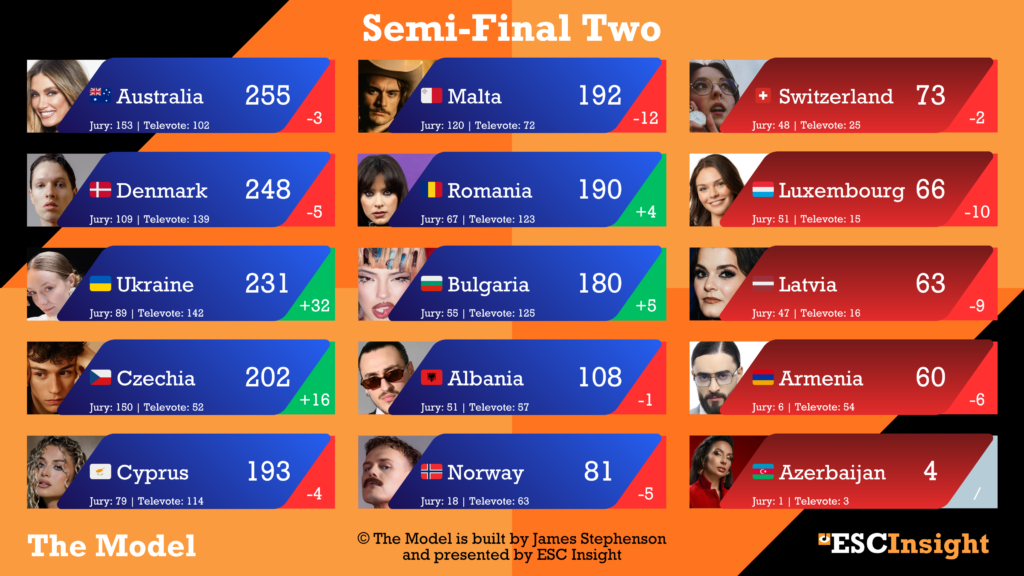
Semi-Final Two from The Model – 13/04/2026 (James Stephenson)
The Model’s projection of Semi-Final Two is also firming up – but in a slightly different way. This projection sees a lot of countries fall further, especially towards the bottom end of the scoreboard, with the qualification race beginning to solidify. However, the race to win this semi-final appears to be increasingly difficult to predict.
This week, Australia is still leading the projections. ‘Eclipse’ from Delta Goodrem is down by three points on the top, but it has an increased lead thanks to Denmark taking a five point hit. Both singers performed live in Amsterdam over the weekend, but both countries have seen their betting odds lengthen since. Behind them, Ukraine takes a massive 32-point rise, but that is largely down to a tweak in the methodology behind how Ukraine’s jury points are calculated, so take this with a pinch of salt.
A country that has gained unmistakeable momentum throughout the week is Czechia. ‘Crossroads’ from Daniel Žižka had been rising in the odds in the lead-up to his performance at Eurovision in Concert, and that momentum has only seemed to increase since. Daniel is a very impressive live vocalist, and there appears to be increasing confidence that Czechia could be a big jury contender in Vienna. Czechia’s rise appears to be causing Malta’s fall, with Aidan’s ‘Bella’ losing 12 points while ‘Crossroads’ gains 16.
Romania and Bulgaria are still projected to sail through, and Albania now has a healthy buffer into the qualifying positions. Further down, though, almost everybody has lost out compared to last Monday. Norway remains in tenth place on 81 points, five down compared to last time out, but Jonas Lovv is still being projected to make it through. This means, for the first time all season, The Model has kept the same qualifiers in both semi-finals from week-to-week.
In the chasing pack, Luxembourg has gone back ahead of Switzerland, perhaps boosted by Eva Marija performing at Eurovision in Concert and Veronica Fusaro opting to skip. Another country which has fallen is Latvia, and Armenia has also seen its points reduced by six. This appears to reflect a rising trend of most people’s predictions firming up this week, and the market responding. I’d predict that this will continue after this weekend’s London Eurovision Party.
Again, I had the chance to see most of these entries live in Amsterdam, although Cyprus, Malta, Bulgaria and Switzerland were absent. From those, I personally felt like Australia and Denmark performed well vocally, but those songs may be reliant on their staging concepts to make an impact. Czechia and Ukraine stood out, with phenomenal vocals from both artists, while the reaction to Armenia in the hall was one of bewilderment rather than appreciation. I also felt that Latvia and Luxembourg struggled to connect with the crowd, while qualifying rival Norway went down far better live.
Grand Final
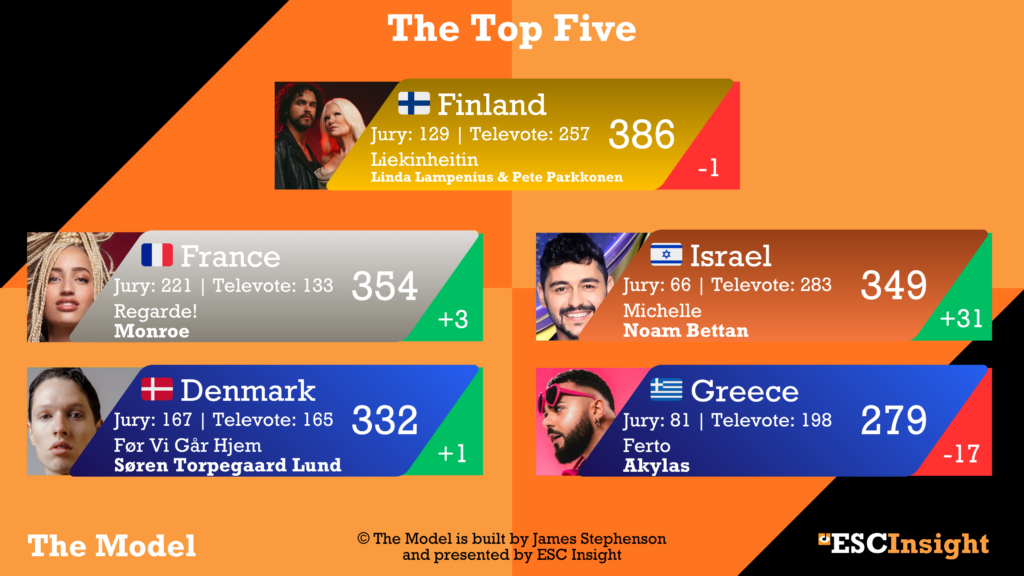
The Top Five from The Model – 13/04/26 (James Stephenson)
For the first time in several weeks, there is a small change in The Model‘s top five – Israel and Denmark have swapped places, with ‘Michelle’ entering third place while ‘Før Vi Går Hjem’ falls into fourth place.
While some of Israel’s rise can be attributed to the methodology tweak I mentioned above, I’d say around half of it does come from a shortening in the betting odds. And I think the reason for that became more apparent to me while I was attending Eurovision in Concert this weekend.
I saw a lot of discourse after the show that the crowd was lacking energy. I think a lot of that is to do with the boycott of Eurovision in the Netherlands: many younger fans chose to stay away, with tickets not being fully sold out on the night. Not only that, the biggest cheer wasn’t for a competing entry, but for Cornald Maas asking for applause for the five countries that have withdrawn from the Contest.
But I think another factor is that this year’s line-up isn’t connecting as strongly as in previous years. Streaming numbers pre-Contest are lower across the board, and it felt like there was less knowledge in the crowd in Amsterdam about the entries. The Model has been frequently projecting lower points totals than ever for the winner – while I still think the winning total will be above 400, it could be the lowest winning total in recent memory.
A perfect example of this feeling was ‘Liekinheitin’, which closed Eurovision in Concert in Amsterdam. As the pre-Contest favourite, it made sense to wrap the show up, with maximum anticipation for their live performance. There had been some concerns about Pete Parkkonen’s vocals at UMK, and I thought that he was far more polished in this performance – but considering the song’s fan-favourite status, I thought the reaction in the hall was actually quite muted.
For me, the stronger performance came from The Model’s runner-up. ‘Regarde!’ was very impressive on stage, with the French delegation bringing a proper performance to the show. And, most importantly, Monroe’s operatic vocals were flawless in my view. The addition of dancers is giving the song more energy and making sense conceptually, and France’s odds shortening following the performances seems to confirm it. I’d say, at this moment, momentum is shifting towards France rather than Finland.
But this leads to why Israel is climbing – they benefit most from a weaker year. We’ve seen in 2024 and 2025 how Israel can mobilise its televote, with both Eden Golan and Yuval Raphael hoovering up votes in Western Europe to achieve massive scores. Following this trend, we already know that Israel has an incredibly high floor. Because of this, if there is weaker competition around them, then Israel’s vote is still likely to go big even as other countries’ votes don’t. They came close to winning in Basel, and I expect them to have a similar chance in Vienna.
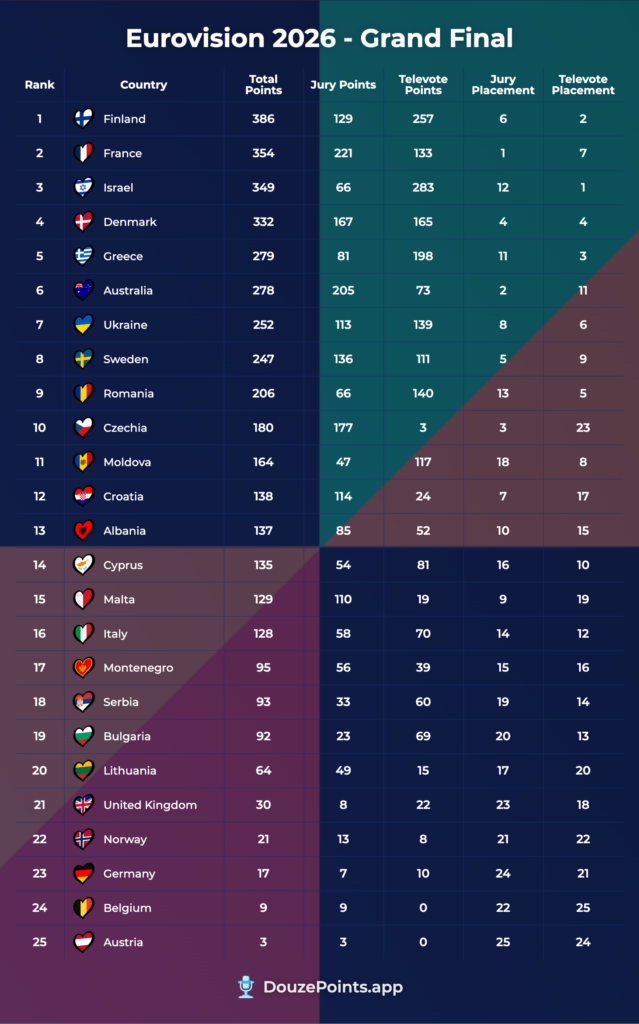
Full Split Results from The Model – 13/04/26 (James Stephenson / DouzePoints.app)
Let’s wrap up today’s update with two songs I think The Model is projecting low, but will score much higher based on what I’ve seen live.
Firstly, Italy’s ‘Per Sempre Si’ is going to do far better than sixteenth in my view. In a show where many songs struggled to generate a big reaction, Sal Da Vinci may have had some of the biggest audience interaction of the night. Many people knew the iconic choreography already. Much like at the Festival di Sanremo, Sal Da Vinci wasn’t towards the top of the odds for that contest – but it feels like this is a song that charms everyone who really gives it a chance. I expect that when we see it live in Vienna there will be a big reaction.
I also want to talk about ‘Tanzschein’, Austria’s entry. The Model has been particularly harsh on Cosmo since it began – if you add up all the public points he’s received in these weekly updates, he still hasn’t got one. Based on his charming, energetic live performance, I’d be amazed if that was the case. The Model is, in my opinion, a great piece of data analysis – but it takes longer for numbers to see textual things than we do.
And this is why the updates keep coming. It’s because everything is changing all the time in the Eurovision race – our opinions, our analysis, even our understanding of what makes each entry tick. The only thing I know is that I don’t know what will happen next week, and that the chances of things staying the same are certainly zero.
With The Model’s latest update, Finland remains in front – but that is set to keep changing. Next week, we move to my home city of London for the London Eurovision Party, and another chance to see the class of 2026 take centre-stage. And, once again, The Model will take updated betting odds, community rankings and more data into account in a brand-new update.
And, tomorrow, there will be a special ‘Inside The Model’ waiting in your podcast feed and on the ESC Insight YouTube channel. We filmed an insightful – and often ridiculous – chat with three Dutch Eurovision experts in Amsterdam: GJ Kooijman and Marco Dreijer from the Ding-a-Dong podcast, and my Eurovision Uncovered co-producer Sem Anne van Dijk about this year’s Contest and what we think lies in store in Vienna.
Remember, The Model will make weekly projections from now until the contest, updating with new information throughout. If you don’t want to miss any regular weekly update, read The Model on ESC Insight every Monday from now until the Eurovision Song Contest 2026.
Finland’s in front – but could someone catch them next week? See you then for the next update from The Model.