




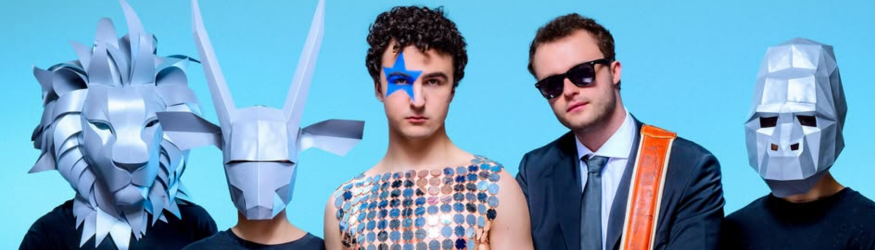
Supported by Auri, the mascot that has been publicly presented as the “new face for Vienna 2026”, a random draw for the running order position of the host country gave Austria the closing slot of participating countries at the Eurovision Song Contest Final.
The modern-day Song Contest has a producer-led running order, outwith the host country, since 2013. While there have been draws to decide if a song performs in the First Half or Second Half of the Song Contest (or, since 2024, a free “Producer’s Choice” through all the Grand Final), the host country is immune from this, with it deemed most fair for the host country’s running order slot to be randomly decided.
Why would it be different for the host country slot, that their position needs to be randomised? The main difference is the risk of bias, conscious or subconscious, in favour of the host country’s entry. The host broadcaster’s production team is responsible for setting the running order first. The EBU does have the final oversight on this decision, but at least to the public’s understanding, the EBU never had to step in and redo a running order suggested by the host broadcaster.
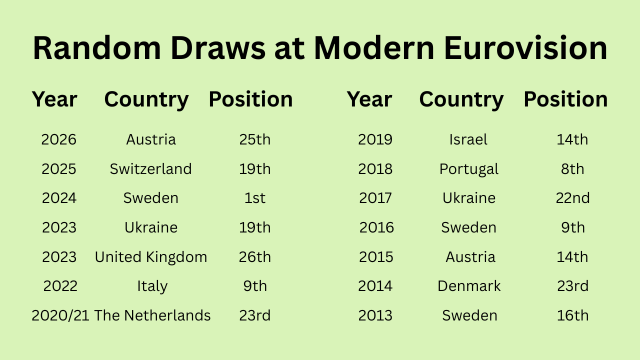
As the 2023 edition had two host broadcasters, with both the UK and Ukrainian entries being randomly drawn, we have in total seen 14 randomly drawn entries in Eurovision Grand Finals since this production decision. Of those 14, ten of those entries were randomly drawn into the second half of the show. However, the best two on the Eurovision scoreboard in this era were drawn in the first half, Frans’ ‘If I Were Sorry’ finished 5th in Stockholm, while Mahmood & Blanco’s ‘Brividi’ ended 6th on the 2022 scoreboard in Turin.
But there’s one of those fourteen songs that I want to talk about explicitly. While it finished on the final scoreboard with 15 jury points, 9 televote points, and a final position of 25th out of 26th, it’s hard to argue against the fact that ‘I Wrote A Song’ by Mae Muller gave us the most iconic host entry of this era.
Remembering Liverpool’s Minute of Madness
While the United Kingdom’s entry in 2023 may now be long down on the scoreboard in the Eurovision history books, the moment of Mae Muller’s performance can not be understated for what it brought to the Liverpool Arena. It may sound overly hyperbolic or patriotic, but I mean this wholeheartedly: we have not witnessed a reaction to a Eurovision song like that in the arena in Song Contest history. It brought the house down. The euphoric roars lived on a lived after Mae Muller’s three minutes on stage, causing the hosts to run off script in sheer astonishment at the cacophony of noise surrounding them after every song had been performed.
Graham Norton: “Well The Muller Corner Is Going Wild! Feel the love Mae Muller! And of course, we, we must remain impartial. I know, I know. It’s been a long time, it’s been a long time. Very good.”
Alesha Dixon: “Wow, wow, wow, wow. And just like that all 26 countries have performed. What a night! Hear that roar! Listen to that crowd – amazing! Can you feel it?”
Graham Norton: “Oh I, I love that! It’s such an amazing atmosphere here. For you at home it won’t be long until you get behind your favourite, because we’ll be opening the vote very soon.”
Hannah Waddingham: “Right, if you can hear me, listen up everyone, here’s how it works. (breaks out into spontaneous laughter).
Graham Norton: “Pop the subtitles on!”
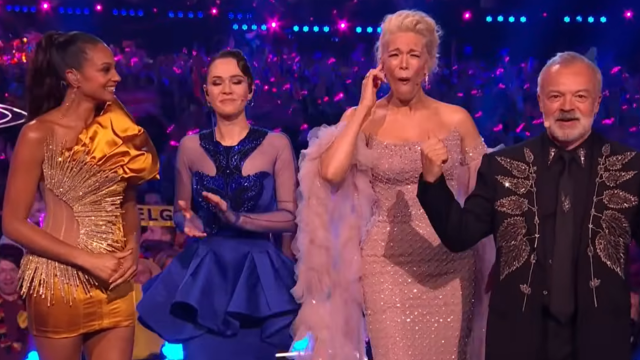
The hosts of Eurovision 2023 after Mae Muller’s performance in Liverpool
Throughout that entire exchange, lasting the best part of a minute of broadcast time, you can hear the crowd in the background screaming passionately and joyfully. It’s a combination of nationalistic pride in the performance, but also the relief that the competition had gone without a hitch and the sensation that all of Europe is watching that very moment. With every other competing entry, you chop in and out of the three minutes on stage into pre-arranged postcards or heavily scripted segments where the show and its entertainment are still part of the production. This transition into what is ultimately the start of the voting window and the recap of performing entries is for the hosts to take a big breath and move the show onto another phase. The home crowd took advantage of that space to roar in their approval and appreciation.
It is everything that the love of Eurovision should be, and, because of the luck of the draw, we got to witness that in Liverpool. Now we get to witness it again in Vienna.
Simply put, why not every year?
This Should Go On Beyond Vienna
As Cosmó brings the competing acts of 2026 to a close, there’s every chance there will be a similar outpouring of love from the thousands within the Wiener Stadthalle. Not just for Cosmó and ‘Tanzschein’, but for the production, for the Song Contest, for Austria, that will reach millions at home. Now, those reactions from Vienna will have some way to go to match what we saw from Liverpool, but I have full confidence that this scenario ensures Cosmó will get the maximum possible support from the home crowd.
This should be the case every single year. Having that host country entry last in the running order means the show ends not just on a crescendo, it ends on the biggest possible crescendo, the one that most of the home town audience want to rally behind. We now live in a world of a producer-led running order where half of the songs have complete free rein over their running order position across all positions. In the balance between whether Eurovision is a show or a competition, it is clear that the current running order placement freedoms tip the argument towards the show being of heightened importance. For the good of the show’s energy, this should become a new tradition and the new highlight of the competitive action.
That energy isn’t reserved solely for the 25 competing acts, instead beginning the moment the Grand Final starts. Since 2013, the Parade of Nations has opened the Grand Final, bringing all the pomp and circumstance of an Olympic-style build-up to the stage. At Olympic Opening Ceremonies the tradition is for the host country to enter the stadium last, soaking up the huge roars of the crowd, and ending the parade of a nations on a high. The Olympics has had this tradition since Amsterdam’s hosting in 1928, and its a tradition for a very good reason.
What if, though there are arguments about if, rather than a zany dance number, the host country entry ends up being a sentimental ballad? How could you end the show with such an intimate song rather than something to go out with a bang? That fear is completely misguided. We have seen examples at Junior Eurovision, where their Steering Group insists that first and last in the running order are still randomly drawn, that the most eclectic, gentle and theoretically disastrous closing entries get randomly pulled out last. And they work.
The example I’ll lift here is ‘O Rapaz’, the Portuguese entry from 2021, with a thought-provoking, introspective song as old-fashioned as Marcel Bezençon himself. It worked like a charm, with a maturity that stood out from all before, and was warmly appreciated by the Parisian crowd. If the Song Contest had this last year, with Switzerland’s entry ‘Voyage’ drawn last, I would still anticipate the joy of the audience post-performance to lift up the crowd and make that moment even more special and memorable. The audience allows the song to go out with a bang; the music itself does not.
On the flip side, some might question the unfairness and the benefits that performing last might entail. And while we have published plenty on ESC Insight for fifteen years about the significance of running order bias, we also note that we live in a universe where one can vote throughout the show and in those past two years have seven songs scored more than 200 televote points, four of which were drawn within the first five songs of the Saturday night marathon. It might well be that the Eurovision Song Contest, in a world of increased media attention and reach, is moving into a world where running order is less important due to the competition’s exposure in other ways, making pure running order bias less. It might well be that the time is no better than now to push such a new tradition, knowing the impact on the final scoreboard might be reduced compared to previous generations of the Song Contest.
A Rule Change For The Love Of Eurovision
I’m going to be watching how ‘Tanzschein’ goes down this year with huge anticipation. If, as I expect, the song is rallied behind even with half of the outpouring of joy that Mae Muller, it will be evidence enough. We should end on the host country every year. Produce the running order not around wherever the host country act randomly gets drawn into the show, but produce it knowing we are ending on the track that will bring the house down in a way nothing else can.
There is a profound symbolism in the Host Country closing the competitive chapter of the night. It says to the world: “We welcomed you, we kept the flame alive, and now we celebrate together.” By making this a tradition, the EBU acknowledges that the Host’s role is to catch the Contest as it falls into the voting window, ensuring it lands in a bed of local adoration.
By doing this, by allowing this deluge of devotion each year, the biggest love a home crowd can give to a Song Contest is put out there for the world to see. More love is what the Song Contest needs.