




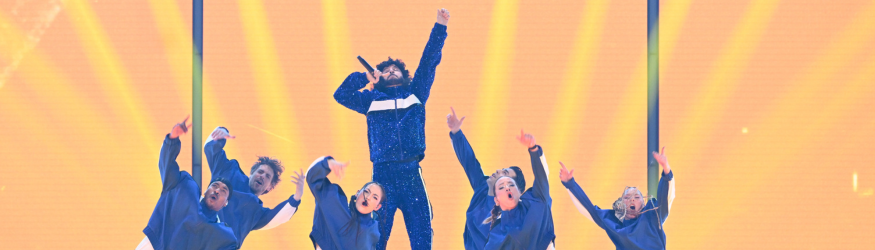
Sundsvall should have been Sanna’s swan song. As a Melodifestivalen Hall of Famer and veteran host of both this contest and Sweden’s cultural institution of Allsång på Skansen, Sanna Nielsen has reached a level of ‘national treasure’ status that many believed made her invincible in the race to qualify to the final. The consensus before heat five was clear: she could have walked onto that stage, belted out the alphabet song with her trademark clean vocals, and Sweden would have voted her straight through to the Strawberry Arena.
Sanna will go to Strawberry, but her route to the final wasn’t easy. In one of the biggest schlager shocks of Melodifestivalen’s modern history, when the first qualifier from Saturday’s heat was announced, it wasn’t Sanna’s name that was called, but instead host Hampus Nessvold called the name of unfancied Lilla Al-Fadji.
Lilla Al-Fadji now runs into the Melodifestivalen final with momentum out of nowhere. Having slayed Melodifestivalen’s queen Sanna, his song ‘Delulu’ is running into the final, topping the Spotify charts, and the conversations in Sweden are about how high this comedy number and character could actually make it in the Melodifestivalen final.
Much like we witnessed with KAJ, last year’s eventual Melodifestivalen winners, while on the surface the act and song may appear fluffy comedy, the song and character have cultural depths beyond a one-hit wonder.
In Lilla Al-Fadji’s case, ‘Delulu’ is a coming together of a career more than twenty years in the making.
The Start Of A Music Career
Lilla Al-Fadji is a character created by hip hop artist Felipe Andres Leiva Wenger, known to most as Fille. Fille was born in Chile in 1980 and moved to Stockholm as a five-year-old with his mother.
During the 1970s and 1980s many Chileans arrived in Sweden, escaping the rule of dictator Augusto Pinochet and the economic crisis that held a grip over much of his leadership. Fille has told the story that his mother, who supported those on the left in Chile wanting regime change at the time, felt forced into leaving the country after being expelled from her dentistry studies, fired from her teaching job for being accused of driving children against the regime, and psychological torture and threats that meant leaving the country felt her only choice.
There were already other family members in Sweden, and so the long flight across the Atlantic took Fille from a world of warmth and noise to one of cold and quiet. Today, it is estimated that around 50,000 people in Sweden have Chilean ancestry, making them the third-largest Chilean community in the world, after the United States and Argentina. Melodifestivalen fans will likely know both Mendez and Alvaro Estrella, who have both competed four times in Sweden’s selection this century.
Fille grew up in Vårberg, one of Stockholm’s suburbs that sprang up during the government’s Miljonprogrammet push during the 1960s and 1970s to build a million new homes in a country with a need for modern housing, especially around their cities after significant urbanisation. Like many suburbs from the Miljonprogrammet development, their creation was the architectural embodiment of Sweden’s move to a strong welfare state nation with modern, spacious and egalitarian design for everybody’s improved living standards.
However, areas like Vårberg soon became some of Stockholm’s most segregated, and today over 75% of Vårberg’s population are foreign-born, or the child of two foreign-born parents.
While growing up in Vårberg, Felipe played basketball in neighbouring Bredäng, despite describing himself as the “shortest Chilean in the northern hemisphere”. There he met Ison Glasgow. Like Fille, Ison grew up without a father figure and moved to Sweden as a young child together with his American mother. The two discovered that their interest in music was greater than their interest in sport, and they made music together at the local youth centre in Skärholmen, south of the capital. Their first songs were released in 2000, but it was with ‘När Vi Flyger’, a track that epitomised the hip-hop sound of the era, that the duo scored their first domestic hit.
A Character Years In The Making
Lilla Al-Fadji wasn’t anywhere to be seen at first, but Fille had already introduced the voice that became the character through the duo’s first albums. This voice, itself a parody of the types of voices and characters ever present in areas like Vårberg and Bredäng, was used solely to lighten the tone and create a comedic effect.
The character Lilla Al-Fadji saw its first fully fleshed-out light of day in one track on the duo’s 2006 album Stolthet, Hüüdfadern introduces Lilla Al-Fadji, claiming to be king of the hood and obsessed with thinking they are the big shot yet and a genius. Though in reality, Lilla Al-Fadji was comedically stupid at the best of times.
Fille spoke about the character’s creation on the tv show Så Mycket Bättre in 2015. The voice that became Lilla Al-Fadji was born from the voice Fille used to joke with his friends, a voice people thought was really fun. Eventually, Filipe got the chance to be part of a humour series, and Lilla Al-Fadji became a cult figure and early internet icon. The comedic character, crass in its nature and humour, but clearly identifiable from the Stockholm suburbs in which Fille grew up.
“In the beginning it was hard to take the metro, because people ran after me all the way home. It was crazy and I was not used to this.
“People everywhere started to know me more as Lilla Al-Fadji rather than Fille, it became so much bigger than what we did.
“The music was something we had put so much work into, and so many feelings. And with this all I did was a voice and talked shit and people thought it was ingenious. It was hard to get used to it.”
“It’s crazy that such a little thing became something that could become a job than I could support myself from.”
The comedy route took hold and became an increasing part of Fille’s work. It eventually led to a whole comedy series called “Lilla Al-Fadji & Co.” Broadcast in 2008, the character starts off the series filmed in Husby, a suburb to the north of the city centre, with the same type of cultural segregation and social challenges as Vårberg. Much of the series places Lilla Al-Fadji in this urban environment, or takes him out of his comfort zone, and has him speak a hammed-up dialect of ortensvenska, a language spoken in these majority-immigrant suburbs, where words are borrowed from a multitude of languages and grammar rules are less strictly followed.
A clear example of this from the series is bringing in that roughly 25-year-old Lilla Al-Fadji, who is unemployed, broke, and staying in the same apartment where he grew up with his mother. The one thing the character seeks more than anything is cash, cash being the loan word from English that’s dropped into suburban slang.
“He was just one of those characters we grew up with, a street thug, a friend, someone’s dad, a voice, a self-confidence and a walking style. He came from all the characters in the hood that got us to laugh, and I drove it further without thinking.
“He could say things I would never say and people laughed, and he is my opposite and my mirror. Maybe as well my more freeing voice.”
https://www.youtube.com/watch?v=U29Zd4MSOeU&list=PL52aij4EFDU3C7gAD-fj9X3eqB96jFY_m&index=1
From Satire To Sincerity
The character’s disarming and comedic approach meant it moved away from television and into the world of radio. Swedish Radio took the character to the airwaves in 2009, but in modern times, through his own YouTube channel and a podcast series called “The Greatest Podd of All Time”, Lilla Al-Fadji has become the brash voice that has interviewed many of Sweden’s biggest names in the entertainment business. While these are naturally funny interviews, they are not ones in which the guest is needlessly ridiculed or shamed; instead, humour is used to lighten the mood and encourage people to open up.
The recent time in the media spotlight has seen Fille, now aged 45, at Melodifestivalen, take on a more serious tone to what his art can achieve with a creative renaissance for the character. Alongside author Behrang Behdjou, Fille has released the novel “Dagbog från Dårhusen” for children, aimed at 7 to 14-year-olds. Speaking to local news platform Nyhetsbyrån Järva, Fille describes how the character is the perfect one for a children’s novel.
“It’s so cool with a character that is a little crazy, that says and does the wrong things sometimes, but that reflects on that and does right eventually. Now it feels like Lilla Al-Fadji and his friends are like real people, which is really fun.”
The novel looks at the upbringing of 12-year-old Lilla Al-Fadji in the fictional suburb of Dårhusen and its stereotypical high rise apartment buildings, juxtaposed against the desirable area of Drömsta Hills it borders. 12-year-old Al-Fadji is due to start a new school with many kids from this area, and while they have nice cars and travel far and wide, Lilla Al-Fadji and his mother don’t have the resources to have a summer holiday in the same way.
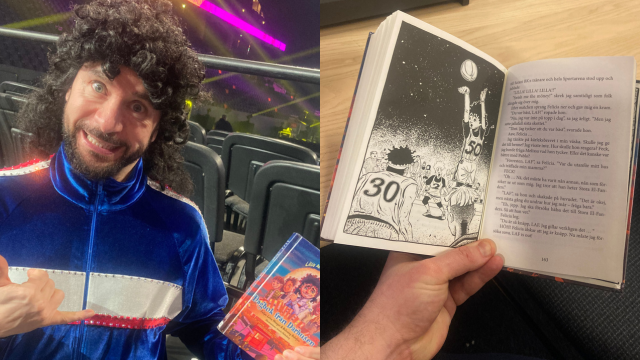
Lilla Al-Fadji and the book Dagbok från Dårhusen about the character’s life at age 12. (Photo: Ben Robertson, ESC Insight)
We spoke to Lilla Al-Fadji about this at the Melodifestivalen press conference, and managed to get the character somewhat out of character.
“This book describes another side of Lilla Al-Fadji that one has not seen before.
“This is really really important to take up and get this onto the school curriculum in history or in civil studies.
“If you like it there is so much to dive into.”
Last summer, Fille had the honour of being invited to be a part of one of Sweden’s most important cultural institutions, where he became a sommarpratare, speaking on P1 radio for an hour-long monologue (with Lilla Al-Fadji dropping in for support) about his career and personal life. He spoke with self-realisation about growing up not fitting in in mainstream society, and that it was the “rhythm, language and jargon” of suburban life that gave him the feeling of freedom growing up.
He credits the creation of Lilla Al-Fadji as giving him a lot, but also the inner conflict that the character’s success took him away from music and rap. Now, when millions will be watching Fille on Sweden’s biggest TV production live in front of 30,000 fans at Strawberry Arena, he won’t be able to be his true self and return to his rap and hip-hop roots.
Instead, it is his Lilla Al-Fadji alter-ego that takes to the stage and charms the nation.
Taking ‘Delulu‘ To Eurovision
That Sommarprat slot on Sweden’s P1 radio station was the catalyst for Fille’s journey to Melodifestivalen. Among the 2025 sommarpratare was none other than Edward af Sillén, who spoke about the importance of laughter and his career journey, which we know very well in the Eurovision Song Contest world, as Sweden’s commentator at Eurovision and the show’s scriptwriter on many occasions.
This meant Fille and Edward met at the launch of Sommar på P1. Speaking to the Euro Trip Podcast, Edward explains that they both “laughed together” at the launch day and soon afterwards, Fille approached Edward with the suggestion of entering Melodifestivalen and seeking advice on how to best get there. At the same time, Edward confessed that having his own song compete at Melodifestivalen would be a bucket-list dream, and now the stars have aligned.
Song wise, the track is this huge bunch of silliness that follows the motifs which took ‘Espresso Macchiato’ to third place at Eurovision 2025, as well as what brought Sean Banan so much success at Melodifestivalen back in 2012 and 2013.
It’s notable how lyrically the song makes sure to include some of Lilla Al-Fadji’s phrases, especially his trademark “Shululu” greeting, but also dropping in loanwords galore, switches word order to make the rhymes fit, but breaking grammatical rules in the process. Duolingo players are confused while reading the lyrics on the LED screens, the word “och”, meaning “and”, is instead written phonetically with “å”, again showing the more playful creativity in creating this track.
‘Delulu‘ is taking Sweden by storm in the build-up to the final. Lilla Al-Fadji is the character who has come to dominate the career of hip-hop artist Felipe Andres Leiva Wenger in ways he could never imagine. But for the better part of the last twenty years, people across Sweden have grown up to see his character not just as a silly but endearing stereotype of life out in Stockholm’s suburbs, but also one who’s interviewed a who’s who of the Swedish cultural universe and has a connection that many can relate to.
In the Grand Final of Melodifestivalen, the show’s voting system distributes half of the votes depending on the public vote, and half based on international jury rankings. It is unlikely that a song riddled with silliness that rhymes Pelé with Café au lait is going to be sufficiently close to the top of the table to challenge for representing Sweden in Vienna. I won’t suggest this has any of the cultural notoriety that ‘Bara Bada Bastu’ offered last year, but as a presentation of Lilla Al-Fadji’s character that has become so well known to so many in Sweden, the vibe is similar in that both are more than ‘just comedy’.
Whether or not the international juries ‘get’ the suburban slang or the chaotic energy of Lilla Al-Fadji is almost secondary to the moment itself. By reaching the Strawberry Arena, Fille has achieved something profound: his sounds, his ‘jargon,’ and the character he has created from the often underrepresented Miljonprogrammet suburbs get a window into the whole of the Swedish nation. ‘Delulu‘ is more than just a catchy comedy track; it is the triumphant celebration of a twenty-year journey from Vårberg to the nation’s biggest stage with an artist now more comfortable in his character’s wig than ever before.
On Saturday night, it won’t be just him going delulu, but a football stadium packed with celebrating fans and millions at home as well. He’ll be delulu, you’ll be delulu, let’s all be delulu together.