




Never let it be said that we Eurovision pundits aren’t dedicated. Over the course of the past seven days, I’ve sat through a total of 73 press conferences – two apiece from each semi-finalist, and one for each of the seven auto-qualifiers. So it’s quite a relief to learn that there’s just the one scheduled for today – the sign language press conference featuring ESC Executive supervisor Jon Ola Sand, Executive Producer Edgar Böhm and Eurovision Sign Language Project Manager Eva-Maria Hinterwirth.
Aside from that, the main activity today is a pair of full dress rehearsals for the first semi – including the all-important Jury final at 9pm. The first of these is a non-ticketed technical run-through, so my ESC Insight colleagues take the opportunity to watch the show from the arena. I’m going to the real show in Tuesday night, so I decide to linger in the press centre.
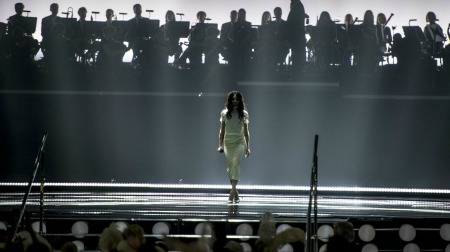
Last year’s winner Conchita Wurst opens the first full dress-rehearsal of the first semi final.
Photo: Eurovision.tv
Throughout the week my opinions have been flip-flopping on what feels like an hourly basis, and it’s striking what a different impression you get when you finally see a version of the complete show. The pacing of the evening has a real impact on how you perceive the song – for example I’ve been fairly confident about Hungary’s chances all week, but coming after Serbia’s disco explosion it comes across as a total buzzkill.
We’re also starting to see the finalised camera angles, which can really elevate or drag down a performance – as you’ll no doubt be aware if you’ve been following my colleague Ewan Spence’s excellent ‘Every Song A Story’ series. For sound mixing reasons you can’t play live instruments on the Eurovision stage, and the prominent close-ups on Maimuna from Belarus holding her bow a good inch away from her violin makes the performance come across as incredibly phoney. The Dutch entry begins with a tight close-up on Trijntje’s eyes, which looks very beautiful – but they ruin the effect by holding the shot for far too long.
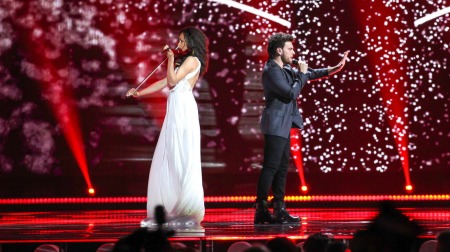
Belarus deliver an underwhelming rehearsal that makes it too obvious the violinist isn’t really playing.
Photo: Eurovision.tv
My vote for the most improved performance of the semi final goes to Macedonia, who have significantly toned down the choreography to put the focus back on the song – which I’ve always maintained is one of the strongest and most contemporary of the year. One of the big losers for me is Albania, which remains vocally impressive but just comes across as very flat and boring as a full performance.
This year, for the first time ever, the Eurovision Song Contest will be broadcast with a full-show sign language option, and the sole press conference of the day is dedicated to explaining how and why the service was put together. It turns out to be a really informative and thought-provoking hour. The delegates explain that the point of the service isn’t to provide word-for-word translations of the entries, but rather an interpretation of the story and the tempo of the songs.

8 broadcasters have already signed up to Eurovision’s international sign language service, and delegates are hopeful that it’ll become a permanent feature.
Photo: Derek Sillerud
The sign language artists – three of whom are on the panel – have pre-recorded their interpretations of the songs over the past few months, and we’re treated to video footage of some of the results. In addition to providing an opportunity for deaf viewers to engage with the show, they’re also great fun – the routine to the Israeli entry in particular looks like it has definite viral potential. The team are obviously really passionate about the project and it’s another inspiring symbol of Eurovision’s on-going commitment to inclusivity at every level.