



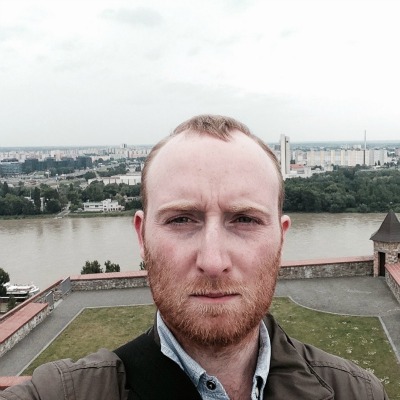
While the rest of the ESC Insight team turn their ever-critical eyes to the build-up towards the big show(s), new recruit John Lucas has challenged himself to get up close and personal with this year’s artists by attending all of the press conferences that run alongside the rehearsals. What really goes on when Eurovision 2015’s diverse roster of artists are forced to face the media? Today, John and the first eight artists from Semi Final One found out…
This wasn’t supposed to happen… Some countries just have Eurovision in their collective bones: Sweden, Malta, Ireland (before they turned into a cross between post-Oasis Liam Gallagher and Sunset Blvd’s Gloria Swanson, stubbornly ploughing their panpipe-laden furrow to increasingly diminishing returns, all the while declaring that they’re still big, it’s just the contest that got small). Other countries achieve greatness – Germany, Azerbaijan, The Netherlands: all countries whose broadcasters made a focused and committed effort to attract the right kind of talent to thrive in the contest. And then there are those countries that seem to have greatness thrust upon them. When Austria – a nation whose previous high watermark this century was Alf Poier and his ode to barnyard animals – enlisted Conchita Wurst to fly their flag in 2014, they probably weren’t thinking much beyond attracting a bit of local and international press and maybe boosting their ratings by actually getting into the finals for once. As it turned out, Conchita over-delivered in a manner comparable to a high-school student being given an assignment on Middle Eastern politics and turning in a workable solution to the Israel-Palestine conflict. Which means we’re in Vienna this year, with the Austrian broadcaster in the driving seat. Considering the sheer unlikeliness of it all, how on earth would ORF cope? As it turns out, pretty well. If there’s one thing the Austrians excel at, it’s hospitality – and they’re firing on all cylinders for this once-in-a-lifetime opportunity to run the biggest annual music contest on the planet. I’ve been in comfortable press centres in the past, but I’m pretty sure this is the first one with craft services and a roulette table.

What better way to relax during a hard day’s journalism than indulging in a little recreational gambling? (Photo: Derek Sillerud)
When you’ve been doing it for a few years, attending Eurovision in a journalistic capacity starts to resemble a mix between a convention and a family reunion. I see familiar faces at every table, trading gossip, predictions and tips on where to find the best parties. Sometimes it feels like watching the unfolding rehearsals is almost incidental to it all. That being said, as a relative newcomer to the ESC Insight team, I have plenty to prove – especially after a faintly terrifying reminder from team stalwart Ewan Spence that my accreditation badge “can come off as quickly as it goes on”. My role this year is to cover the Press Conferences, so after catching a few of the early rehearsals I dutifully shuffle to the conference room for the first batch of Q&As. Eurovision fans aren’t the most combative bunch – the average UK politician would kill for a press conference as smooth as the today’s. The only hint of awkwardness revolves around the questions that aren’t asked. Moldova’s Eduard Romanyuta and his 100% Ukrainian team manage to go through the entire conference without referencing the country he’s actually representing once. Armenia field a question about the significance of this year to their entry with fluffy answers about Eurovision’s 60th anniversary, and admit that they have to communicate in English because at one member of the international group doesn’t actually speak Armenian.
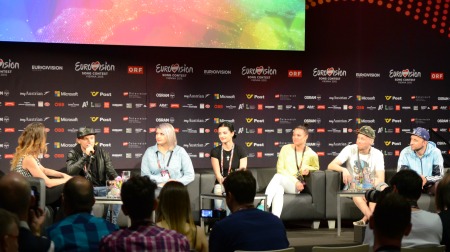
Eduard Romanyuta and his “Moldovan” team kick off the first artist press conference of the season (Photo: Derek Sillerud)
I brave my own first question during the meet and greet with Trijntje Oosterhuis from The Netherlands, whose first rehearsal induced audible gasps of horror from the fans and journalists thanks to her unspeakably hideous dress and a bizarre stage show that looked like a cross between the opening credits to Doctor Who and a surrealist production of Lorca’s Blood Wedding. In the most polite terms I could manage (I believe I described the performance as ‘striking’) I ask her to describe what the thought process had been and how she felt the rehearsal had gone. Fortunately she’s very gracious, tacitly acknowledging that it could have gone better, but stressing that the performance was very much a work in progress. We shall see…
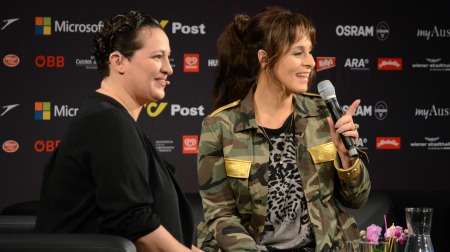
A more comfortable-looking Trijnte Oosterhuis faces the journalists. (Photo: Derek Sillerud)
The only moment that threatened to puncture the slick, polite vibe of the afternoon’s proceedings is – predictably enough – the appearance of Finland’s Pertti Kurikan Nimipäivät. The group’s press conference was delightfully anarchic throughout, though it peaked when member Kari Aalto hijacked the introductions to deliver a lengthy, increasingly animated monologue in his native tongue, translated with suspicious brevity by their assistant as “he says they want to win”.
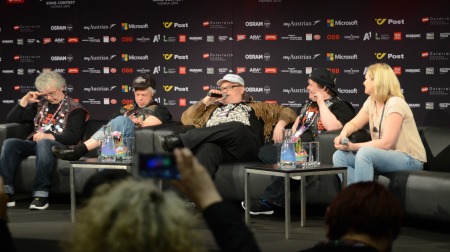
Finland’s Pertti Kurikan Nimipäivät (PKN) hold court (Photo: Derek Sillerud)
Greece have sent a slick, professional and utterly forgettable middle-of-the-pack ballad this year. Singer Maria Elena Kyriakou delivers an equally slick and professional performance, leaving the journalists struggling to think of anything to ask her. She wins points for a neat comparison between the lyrics of her song and the current economic situation in her home country, but that’s about as edgy as things get.

A consummate professional, Greece’s Maria Elena Kyriakou gets a smooth ride from the journalists. (Photo: Derek Sillerud)
The Estonians aren’t a demonstrative bunch in general, and despite ranking among the favourites to win the whole contest, Stig and Elina are so apologetically low-key you half expect them to offer to help stack the chairs after their press conference ends. I try to help them along with a question about their memories of Estonia’s 2001 Eurovision victory, but the singers diplomatically admit that neither of them saw it.
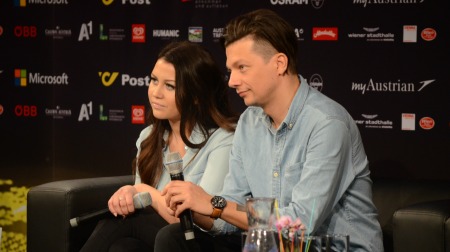
The Estonians have a somewhat reserved energy, but they answer their questions thoughtfully and courteously. (Photo: Derek Sillerud)
It’s late in the evening by the time Macedonia take to the stage with the final Q&A of the day, and energies are flagging. Fortunately, Daniel Kajmakoski is a total delight, bounding onstage with a huge grin on his face and radiating a sunny, good-natured energy totally at odds with his moody song. He obligingly sings a few bars of the song that inspired his name – Džuli by Daniel Popović, and attempts to explain just how the hell the artists formerly known as Blackstreet wound up singing backing vocals for his performance (something to do with a Bulgarian charity single featuring DJ Bobo, obviously). After a bit of a mid-afternoon lull, it’s a charming way to end the day.
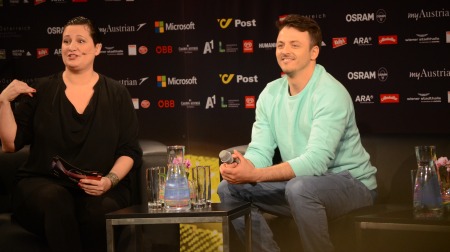
The eminently likeable Daniel Kajmakoski from Macedonia charms the assembled journalists at the end of a long day (Photo: Derek Sillerud)
Tomorrow, the artists in the second half of Semi One rehearse, which means I get to enjoy the relaxed, 100% controversy-free environment that is a Russian press conference. What could possibly go wrong?
Great summation – enjoyable read as always!
Just getting used to it not being on escgold.com…